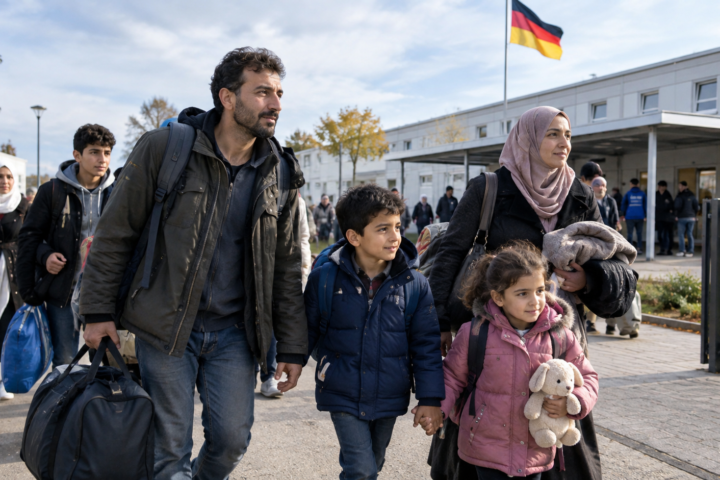

Half of Ukrainian refugees who arrived in Germany at the start of full-scale hostilities found work three and a half years after moving. This is evidenced by data from a new study by the research unit of the Federal Employment Agency. For comparison: migrants and refugees who arrived in 2015—among whom were many from Syria and Afghanistan—reached a 50 percent employment rate only six years after arrival. Thus, Ukrainians are integrating into the labor market significantly faster than previous groups of immigrants.
This did not come as a surprise: Ukrainians received access to language courses faster, did not go through the asylum procedure, and could start work earlier. They also benefited from various support programs of the former coalition government, were included in the structures of job centers, and became recipients of benefits in the Bürgergeld system.
It is also true that the employment rate of Ukrainians (50 percent) is still significantly lower than that of the entire population, which in June last year was 68 percent for persons of working age. This is due to the specifics of Ukrainian migration and a number of obstacles created by the German state.
The picture that our research demonstrates is ambivalent, summarized co-author of the work Yuliya Kosyakova. She heads the migration, integration, and international labor market research department at the Institute for Employment Research (IAB) and is a professor of migration studies at the Otto-Friedrich University in Bamberg. This ambiguity manifests in many areas—for example, in the employment rate, the nature of work, and the receipt of social payments. In Germany today live just over a million Ukrainians who entered the country in the context of the military conflict in their homeland since February 24, 2022, and received temporary protection based on the EU directive on a mass influx of displaced persons. IAB scientists in their study paid special attention to refugee women. Many of them came to Germany with young children, while men of conscription age mostly remained in the country.
This has a significant impact on statistics: according to the study, the employment rates of Ukrainian refugees differ markedly depending on gender and increase as the duration of stay grows. Only after 31 months does the gap between men and women begin to narrow again. The process of entering the first job for Ukrainian women is slower because there is a lack of places in childcare facilities, noted Yuliya Kosyakova. Those who do not get a place in an after-school group for their child find it difficult to enter the labor market. Accordingly, in September 2025, only 21 percent of Ukrainian women with children under three and without a partner were employed. However, according to the researcher, this is far from the only reason for the differences.
Entry into the healthcare and education sectors—fields in which Ukrainian refugees often have specialized education—is very strictly regulated in Germany and requires a high level of language proficiency. This makes it difficult for many Ukrainian women to start a career, Kosyakova added.
Another factor: many women struggle with the traumatic experience of war. They suffer from a high psychological load and health problems, noted Julia Erner, head of the Fast-Track for a Life in Germany program of the Deutschlandstiftung Integration foundation. She works with young Ukrainians who arrived in Germany because of the war. The gender gap in employment is characteristic not only of Ukrainian war refugees but also in general of women and men seeking asylum. At the same time, it does not matter whether they arrived from Syria, Afghanistan, or other countries and how long they have been in the country. According to the latest IAB data, in 2024, nine years after arrival, 76 percent of working-age men with protection status were working, but only 35 percent of women.
International comparison also shows how significant the gender gap is in this country: on average in the EU in 2021, 41 percent of women who had previously entered as refugees were working, and in countries such as Spain, France, or Denmark—more than half, according to OECD data. In Germany, however, this figure was only 32 percent.
Many receive top-ups despite having a job
When Ukrainians manage to enter the labor market, a mixed picture emerges: after almost three years, full-time workers received about 72 percent of the median gross salary of all full-time employees. Nevertheless, a large part remains in the low-income segment.
In the third year after moving, almost half of Ukrainian women and men worked in systemically important industries, for example, those ensuring the functioning of central infrastructure. At the same time, a high proportion continued to work in the low-paid sector, performing support work. This is especially relevant for Ukrainian women (38 percent) employed as cleaners, in trade, or in the healthcare sector.
Despite the growth in employment, the level of receiving benefits, according to the study, remains high—partly because many Ukrainian women work only part-time. 41 percent of those employed cover their needs only through additional payments. Statistics take into account those living in a common household. The overall picture is as follows: 67 percent of Ukrainian women and 61 percent of men live in families receiving Bürgergeld or unemployment insurance payments. Families with children receive top-ups particularly often.
In the first months and years after the start of hostilities, predominantly women arrived, often with young children. The situation has changed. At the end of August 2025, Ukraine eased the exit rules for men aged 18 to 22. Since then, the number of requests for protection from this group in Germany has increased significantly. In recent months, young Ukrainian men without children have begun to arrive in Germany more often. For this group, everything happens faster in the labor market, including because they do not need to deal with childcare, noted Yuliya Kosyakova. They more often find work in the construction sector, where there are fewer obstacles in the form of language requirements and the need to obtain permits.
The CDU/CSU and SPD bloc in their coalition agreement agreed that refugees from Ukraine who arrive in Germany after March 31, 2025, will no longer receive Bürgergeld, but will fall under the Asylum Seekers’ Benefits Act. Critics fear high administrative costs and a negative impact on the future integration of Ukrainians into the labor market, which job centers previously handled closely. The Cabinet of Ministers approved the bill on the change of legal status last year. In the near future, the Bundestag must make a decision on this issue.
Source: Die Welt