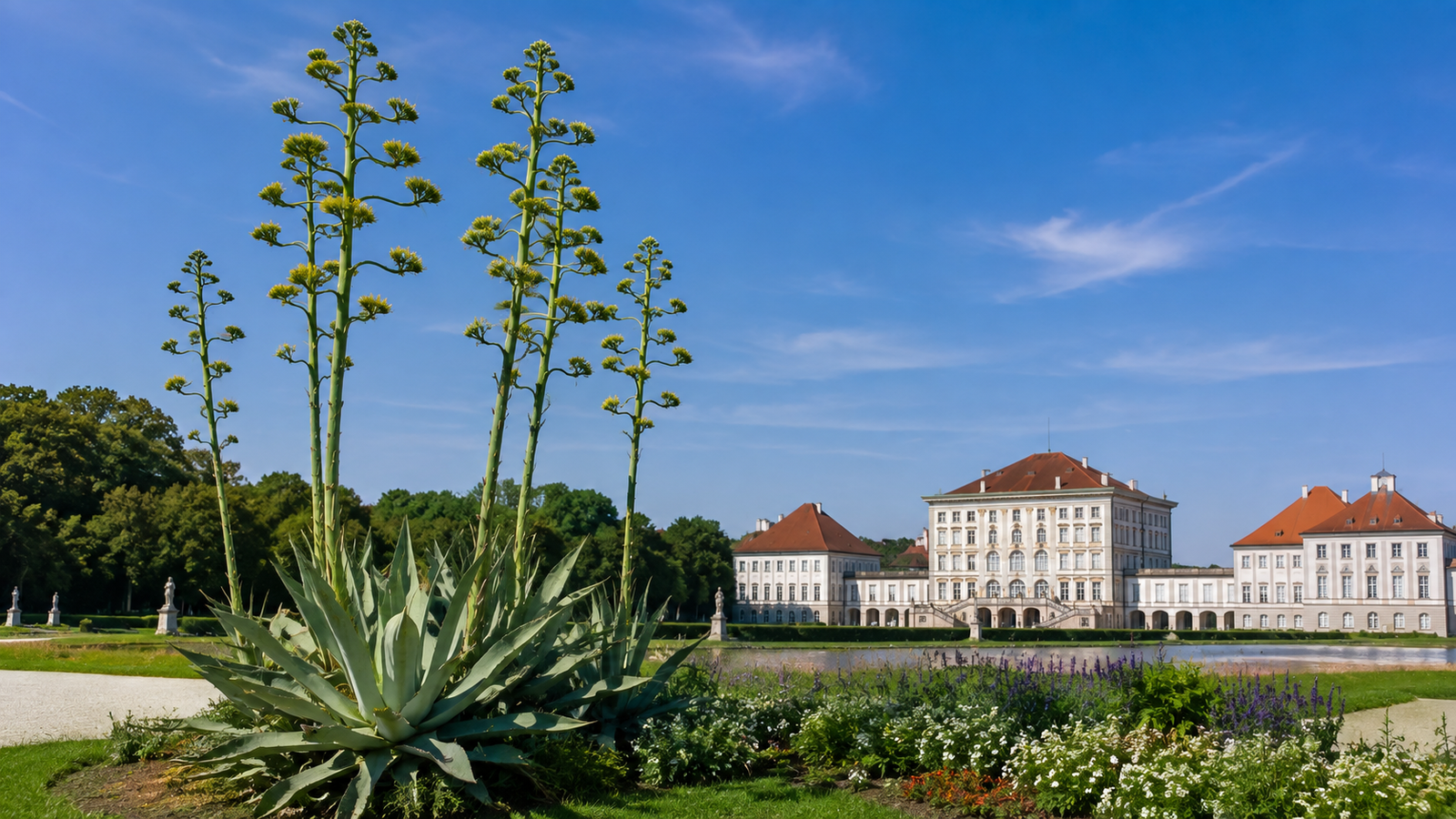

This was announced by the directorate of the Nymphenburg palace and park ensemble in an official press release.
Half a Century for a Single Moment
This species of cactus, from which Mezcal and Tequila are produced in Mexico, belongs to the American Agave species – long known in Europe as the “century aloe,” though botanically it has no connection to the Aloe genus and blooms considerably earlier than its popular name suggests.
The Nymphenburg specimen of this plant has been part of the Eiserne Haus collection of potted plants since the 1980s. Every winter it is moved into the greenhouse, and in summer it is put on display for park visitors.
Throughout all these decades, the agave has invested its energy exclusively in its leaves and growth. The life cycle of this species is simple and, at the same time, merciless. The plant stores up nutrients until it has accumulated enough energy for a single, final surge. When that moment arrives, the agave’s flower stalk rises to a height of 5.85 metres in a short span of time and branches out at the top like a candelabrum, forming more than 20 flowering branches.
Hundreds of small flower buds form on these branches. For several days now these buds have been opening gradually, shimmering in yellow-green and cream shades. According to staff of the palace horticultural service, many visitors have been returning to the park repeatedly – simply to see how the inflorescence changes from day to day.
This Blooming Will Be the Plant’s Last
The peculiarity of the agave is that it blooms once in its lifetime, and then dies. All of its accumulated reserves go entirely into the flower stalk, leaving the plant with nothing left to sustain its life. This natural spectacle can only be observed for a limited time. According to the palace and park administration, the blooming will continue for another two to three weeks, that is, until roughly mid-August.
After that, the stalk will gradually begin to dry out, and the agave itself will die. Staff of the palace horticultural service plan to preserve the dried flower stalk without dismantling it, and to display it in future at special events as evidence of this rare occurrence.
Such a blooming is not an everyday occurrence even for professional gardeners in Bavaria. The last comparable case within the network of Bavarian Palaces and Lakes took place in 2014 in the Hofgarten in Ansbach. An interesting detail is that in 2026 the agave is blooming in two places in Bavaria at once – besides Nymphenburg, a similar spectacle can be observed in the Hofgarten in the city of Würzburg.
The Plant’s Story Doesn’t End Here
The story of the Nymphenburg agave will not end here. The mother plant has already managed to form two offshoots. After the main cactus stalk dies, its “offspring” will be planted in separate pots, and over the following years gardeners will raise them just as they once raised the mother plant.
In time, the offshoots will be returned to the historic collection of potted plants in front of the Eiserne Haus – the very spot where their predecessor once stood. If the life cycle of the new plants follows the same pattern, the next blooming will not occur for another 40 to 50 years.
At present, the park and its plants continue to be cared for by 28 gardeners and landscape architects of the palace and park ensemble, who will also be responsible for raising the new offshoots of the flowering Agave.
A Three-Century-Old Tradition
Interest in the blooming of the agave is not a modern trend toward rare natural phenomena. It has roots going back to the court gardens of the 17th and 18th centuries. Even then, the blooming of an agave was regarded as a genuine botanical sensation and was depicted in books, engravings, and even on some coins.
The current blooming at Nymphenburg continues this centuries-old tradition – with the one difference that today the rare spectacle is being captured not by engravers, but by thousands of park visitors on their own cameras.