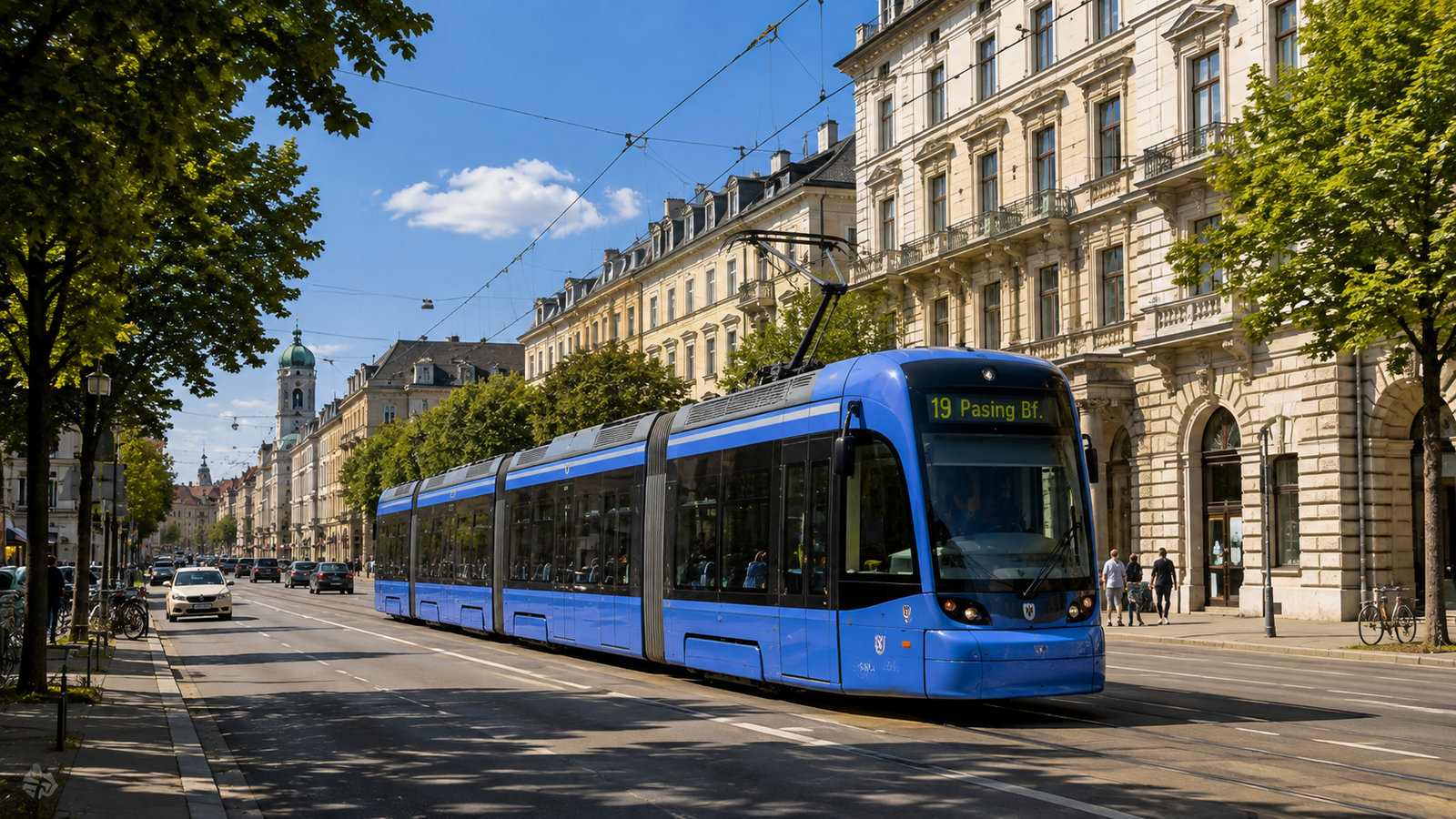

For the thousands of passengers of Munich‘s public transport who use the tram daily, this means not only enduring the heat at the stops, but a practical sauna inside the carriage itself. Part of the city’s tram fleet is still not equipped with cabin cooling systems. And the part that is equipped simply doesn’t use them, replacing climate control with an ordinary fan.
We don’t think it’s necessary to remind readers what happens to people locked for an extended period (from 15 minutes) in saunas, and especially in metal transport standing under a scorching sun. This situation was commented on by the “Friends of the Munich Tram” society (Freunde der Münchner Trambahn), which has long monitored the state of the city’s electric transport.
How many trams run with air conditioning
According to this organisation’s estimate, of the roughly 160 trams currently operating on the city’s lines, only about 115 units are equipped with climate systems. At first glance, the share of such equipment seems substantial – more than two-thirds of the tram fleet. On the other hand, most of the trams equipped with cooling systems frequently don’t use them, including the ordinary carriage ventilation.
Now let’s consider: outside it’s +35-40, and in the sun the temperature is even higher. Metal, as is well known, heats up very quickly in the sun. Even if outside air enters the cabin, that air will be just as scorching as the air already inside the vehicle. After all, the ventilation system itself is heated through. Spending more than 20 minutes in such conditions could cause even the hardiest man to lose consciousness. What, then, can be said of people with chronic conditions, children, and the elderly?
In response to journalists’ inquiries, city authorities always reply with formulaic brush-offs containing simple manipulative and populist phrases: “We care about…”, “The air conditioners aren’t designed for this kind of heat” (this is apparently written by someone who doesn’t know how an air conditioning system technically works), “We’re saving electricity” (apparently at the expense of city residents’ health).
On the other hand, the same officials have repeatedly stated that most of our electricity is environmentally clean, and that roughly 65% of solar energy last year and this year was simply lost due to a surplus of generated power. So where is the logic in the authorities’ position?
And the issue isn’t only the number of air conditioners. A second problem lies in the distribution of air-conditioned and non-air-conditioned trams across routes. Climate-equipped carriages are assigned to lines unevenly: on some, a passenger is almost guaranteed a cool cabin, while on others the chance of boarding an air-conditioned tram is close to winning the lottery.
Where passengers are most often forced to ride without cooling
The “Friends of the Munich Tram” society named the routes where the share of non-air-conditioned units is especially high:
- line 12;
- line 14;
- line 19;
- line 23.
- line 27.
According to the organisation, it is precisely on these routes that older carriages without air cooling systems predominantly run. For passengers who use the tram daily – not occasionally – the difference between a line with air conditioning and one without is already felt by the second or third stop.
The position of the “Friends of the Munich Tram” society
The chairman of the organisation, Nikolaus Breitner, draws attention to the fact that many Munich residents simply have no alternative to the tram:
“Many passengers depend on the tram. That’s why it must be guaranteed that on every line, at least half of the units in service are equipped with air conditioning.”
I would add on my own behalf: “Working air conditioning” – Ed.
In other words, the Munich society, speaking on behalf of passengers, is not demanding an immediate replacement of the entire tram fleet, but is insisting on a fairer distribution of the already existing climate-controlled carriages among the routes. As well as ensuring that these systems actually work, rather than supposedly saving electricity. In the organisation’s view, as in the view of many passengers, the minimum benchmark should be the principle that at least every second run on any line must be cooled by air conditioning.
The buses have already been through this
It’s telling that Munich’s bus fleet has fully solved this problem. Today all city buses are equipped with air conditioning without exception.
The question, after all, isn’t about the presence of a cooling system, but about its use!!! – Ed.
Munich’s tram network, in this sense, is lagging behind, and the unevenness, as well as the number of disabled air conditioning systems, concerns rail transport specifically – bus routes no longer draw such complaints. At least not from representatives of the organisation. Passengers, however, are of a different opinion…
The demand from the Friends of the Munich Tram society looks modest against what has already been achieved with the buses. This isn’t about a technological breakthrough, but about the correct distribution of the transport fleet, as well as about the so-called “saving at the expense of people’s health” – so that the heat doesn’t become an additional ordeal for those who depend entirely on public transport.