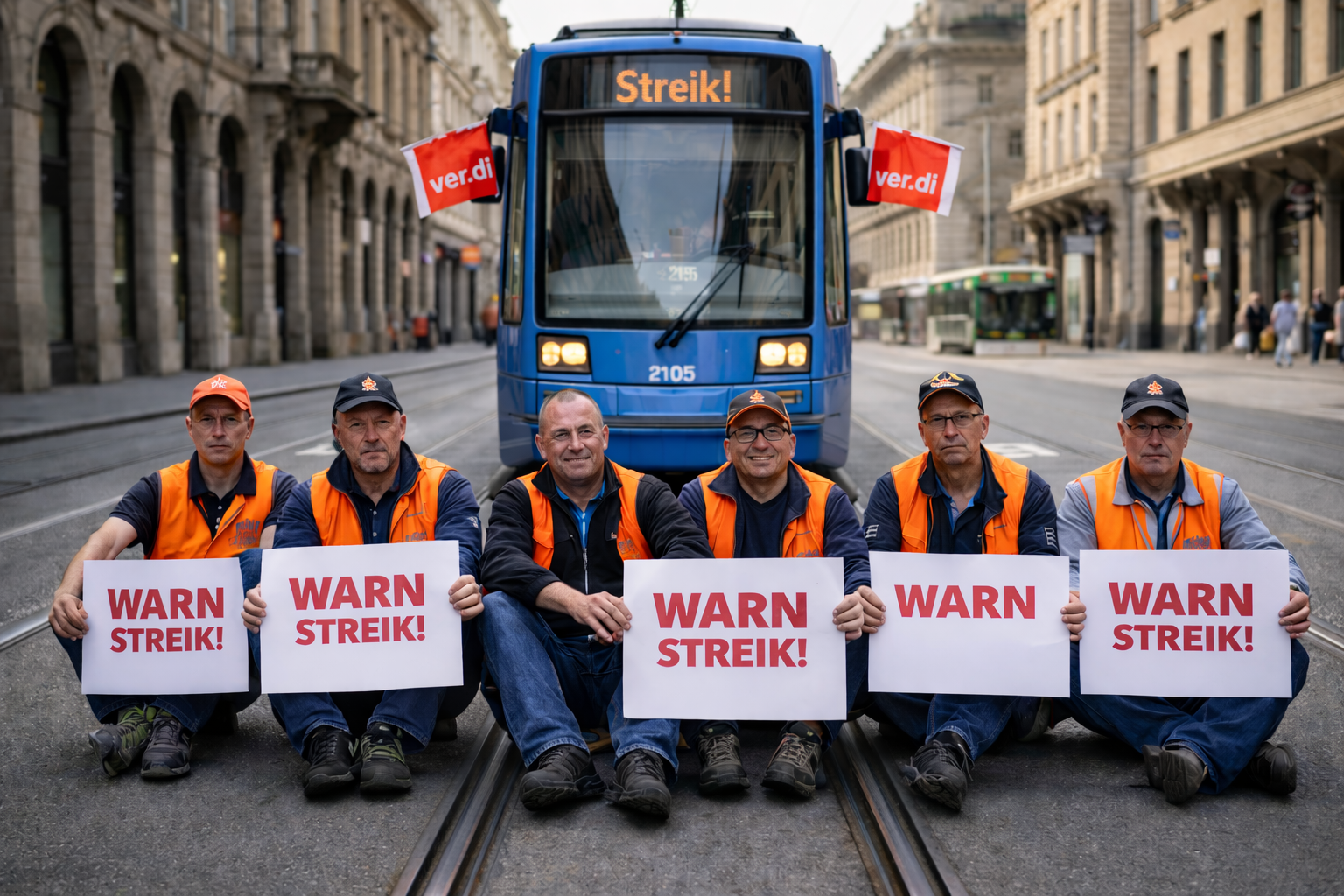

Now, the Bavarian capital could face new large-scale disruptions in public transport, causing justified concern for thousands of people whose daily commutes to work, study, or home are under threat of cancellation. The situation has reached a deadlock: while negotiators exchanged arguments in the silence of offices, the city began preparing for a possible transport collapse again.
Disruptions in the usual schedule of the metro, trams, and buses have already become an unpleasant reality for Munich residents several times this year. Each time the union called on drivers to strike, the city’s transport arteries effectively froze. In the near future, this scenario risks repeating itself, as the concluded round of negotiations has been officially recognized as unproductive.
This information was confirmed by representatives of both sides, adding that the next attempt to find a compromise is scheduled only for April 15. This means that in the coming weeks, the city will live in a so-called “powder keg” mode, where any union statement could turn into a cancellation of public transport operations.
Financial gap and the battle for free hours
The demands of the Verdi union look very determined: for underground and surface transport drivers, a salary increase of almost 670 euros per month each is requested. Additionally, the social package of proposals will include a reduction of the working week to 35 working hours, which is supposed to reduce the burden on staff. However, the KAV association considered such requests excessive and economically unjustified in the current realities.
In the course of the discussion, there were certain shifts in financial components and working schedules, but the positions of the parties still diverge catastrophically, noted union representative Katharina Wagner.
On the employers’ side, a counter-offer was made: either a phased increase in payments by 6% until the end of 2027, or by 9% until 2029. The latter option also provided for a reduction of the working week by only one hour, which is unlikely to satisfy the expectations of transport sector employees who are set for more significant changes.
Transport trap during the Easter holidays
For Munich residents accustomed to relying on the almost flawless precision of city services (not counting the S-Bahn), the current uncertainty means constant stress and the risk of being late. Katharina Wagner emphasized that at the moment there are no specific strike dates, as the union sincerely counted on success in the third round of negotiations.
Nevertheless, she made it clear that without significant steps towards the employees, protest actions will become inevitable. Such statements sound particularly alarming on the eve of the holidays.
The situation is further complicated by the fact that throughout the Easter holidays, the mobility of citizens will already be severely restricted. Due to planned maintenance work on the main line, S-Bahn train traffic will completely stop on the key central section between Stachus and Ostbahnhof stations.
If spontaneous strikes by MVG drivers are added to these planned inconveniences, Munich risks finding itself in a real transport trap just at the moment when many planned spring travels and trips to loved ones.