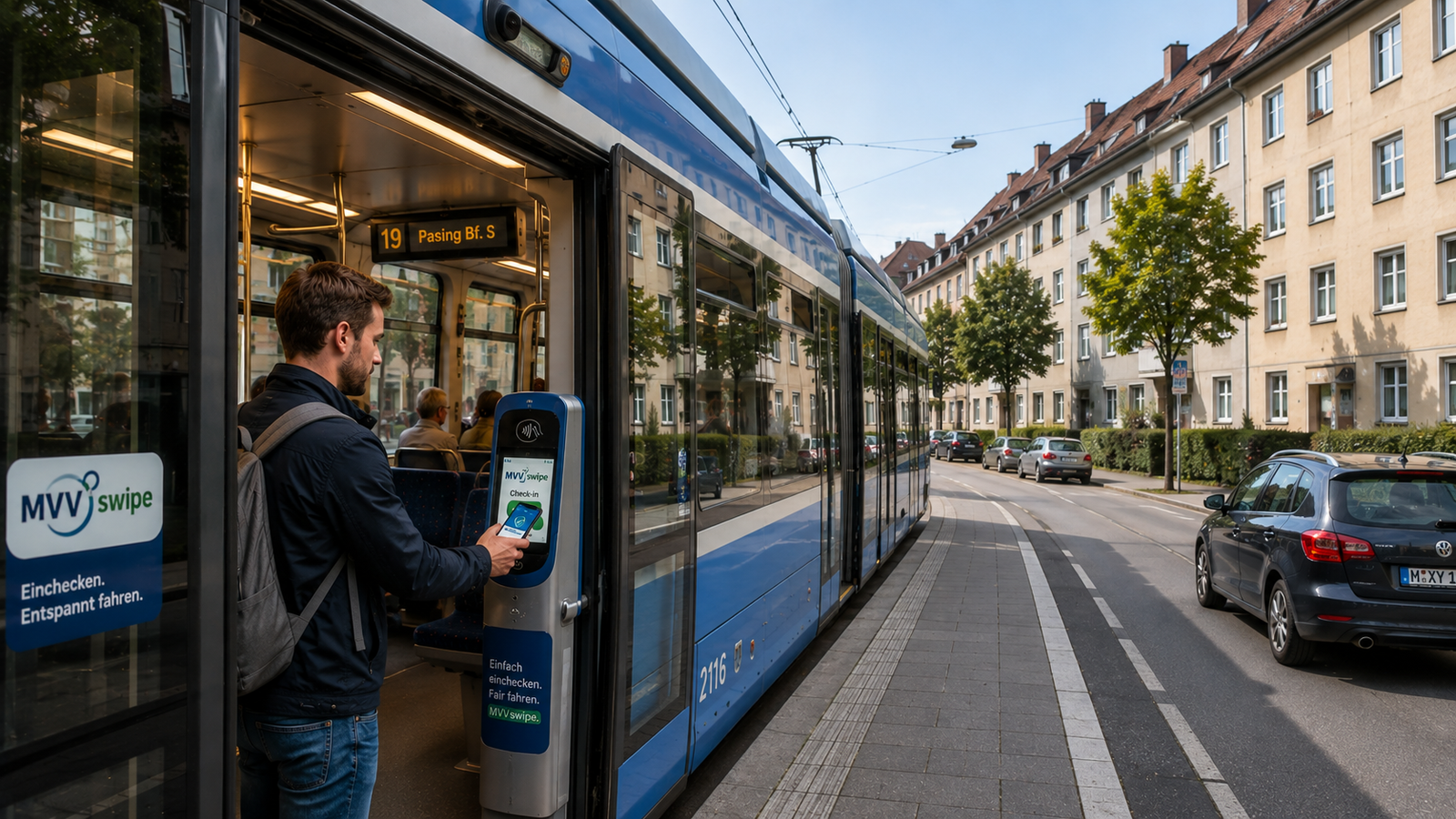

An algorithm will independently determine the optimal fare based on distance and process the payment. Such a system already operates in Munich and has demonstrated high demand among users.
How the application works
The application is very straightforward. A passenger opens the application before boarding a bus, tram, or train and registers the start of their journey with just a single tap. Upon exiting, they repeat the same operation. The system uses GPS data to determine the distance the passenger has traveled and calculates the fare according to current rates.
Knowledge of transport zones and tariff structures is now unnecessary. The developed system is useful for passengers who rarely use public transport or prefer not to buy travel passes, as well as for tourists who want to pay only for what they actually travel.
The technology also works for routes crossing the boundaries of different transport associations. A passenger can transfer between buses and trains operated by different companies, but the system will process this as a single journey with one payment.
Practical application in Munich
The Munich transport association (MVG) began using a similar solution called MVVswipe in December 2024. Over its first six months of operation (through May 2025), the system processed more than 500,000 journeys. This testifies to high demand for this initiative among passengers. Unfortunately, the transport association did not provide journalists with usage statistics data after May 2025. If a decline in paid journeys is found in that data, it will mean that there was actually no sustained demand, and the rise in demand was due to the novelty for passengers. And what is new, as we know, everyone always wants to try out.
Before introducing this application, according to data from the Munich Municipality, a pilot project called “Swipe+Ride” lasting three years had been conducted. Some 12,000 people participated in the testing. The results showed that 96 percent of participants approved of the system. On the basis of these data, the developers decided to move to regular use. Unfortunately, the research data was not provided in the form it should be presented in accordance with statistical law. Which raises many questions about the representatives of the transport association.
The question of a unified ticket
The Bavarian government considered creating a unified ticket and tariff system for the entire Free State. After the launch of the federal project Deutschlandticket (€63 per month), the strategy, like all so-called “Söder ideas,” was revised.
A decision was made to abandon the underdeveloped ideas of the government and to make the federal ticket the primary instrument for developing passenger transport in Bavaria. The idea of introducing a regional ticket was pushed to the background. This decision provoked criticism from the Green party faction in the state parliament. But as is known, aside from criticizing and proposing expensive, useless ideas that no one needs, the Greens can’t do anything else. And apparently do not know that ethics obliges the critic to do more than simply express their discontent with an “ugh,” but rather to propose alternative solutions.
Markus Büchler, the Greens’ spokesman on mobility issues, pointed out that people who rarely use public transport are left without competitive alternatives. The federal ticket is useful for regular passengers, but it does not solve the problem of occasional passengers, who need flexible daily and one-time fares. The Green spokesman apparently forgot or did not know that daily, weekly, group, tourist, and many other types of travel passes already exist and work excellently in transport associations. Which only confirmed the unprofessionalism and, more accurately, activism of Green party politicians.
Opposition demands
The Greens have put forward three priorities for developing public transport:
- First – simplifying ticket purchase and creating a transparent tariff system. This concerns not only Swiping technology, but also providing passengers with clear information about payment methods.
- Second – inclusion of all districts of Bavaria in fully functional transport associations. Currently, such associations do not cover the entire region, leaving gaps in service.
- Third – development of infrastructure in Swabia and Lower Bavaria, where the network is less developed than in the center and around Munich.
Büchler emphasized that without uniting all territories under a single transport association, modern public transport is impossible. Different operators with different fares and rules create obstacles for passengers and hinder the integration of routes between regions.
People who themselves do not travel or rarely travel on public transport are demanding something for those who use it constantly and have a completely different opinion about how it works! I wonder if this is his personal daydream, or is it based on some unknown research? And aside from making demands, can the Greens actually do anything? Work well, for instance? Think? Analyze? Calculate the efficiency of their ideas and set goals? Because in all my years living in Germany, I see only demands and populism from them, squandering of state funds without a single idea how to replenish it (… – Ed.).
Prospects for 2027
The Bavarian government is considering introducing the In-/Out-system by 2027 supposedly as a solution to the main problems (forgetting that this is not actually Bavaria’s main problem). In the view of the authorities, convenient payment technology should make life easier for passengers. (For the politicians themselves and their friends who rarely travel on public transport.) However, the opposition points to a deeper problem: technological improvements do not replace the need for structural reorganization of the system. And actual passengers see completely different problems with our transport, which once again proves that our populist Bavarian government, like the opposition, live in their own world – a soap bubble not seeing what is actually happening on the streets.
In 2027, it will become clear how effective the compromise between technology and structural reforms turns out to be. After which one can confidently ask the government and opposition where the millions allocated to this idea that no one needs were actually spent.