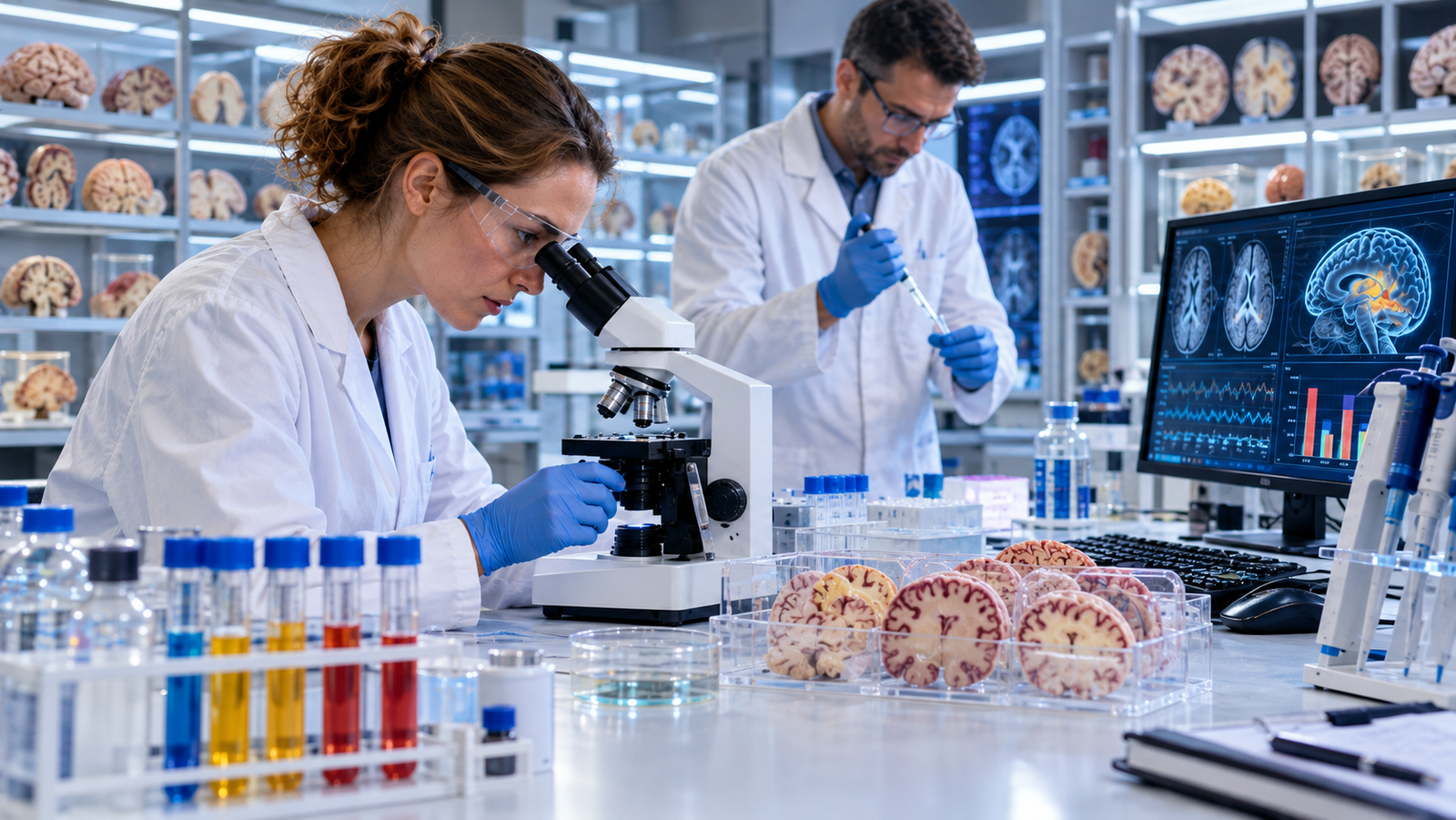

About 6,000 such specimens are preserved in the archive of the Munich Institute of Psychiatry of the Max Planck Society (MPI). They belonged to people whom the Nazi regime first deprived of life and then turned into scientific material.
The Institute of Psychiatry has examined its own past during the National Socialist era and now openly acknowledges that its scientists dissected the brains of 486 victims of the regime for so-called “scientific purposes.” No one asked these people for consent. A significant portion of the sections belong to children killed under the “euthanasia” program. Now the institute’s staff must decide what to do with these remains and whether they should be buried.
The path began at the guillotine
Even before 1933, courts and medicine in Bavaria saw no ethical problem in handing over the bodies of executed murderers to anatomical institutes. The hope was to better understand diseases and the structure of the human body. The practice continued under the Nazis, when executions by guillotine at Munich-Stadelheim prison became an everyday matter.
Of the nearly 1,200 people executed at Stadelheim, roughly half of the bodies ended up in the anatomical institutes of Munich, Erlangen, Würzburg and Innsbruck. The Kaiser Wilhelm Institute of Psychiatry, today’s MPI, also benefited. It acquired 35 brain specimens. Anatomists removed them immediately after decapitation, placed them in alcohol or formalin, and then prepared ultrathin sections and mounted them between glass slides for microscopic study.
As many bodies as they could get
The Institute of Psychiatry of the Max Planck Society began re-examining its history in 2015. At that time, a box with 100 specimens from the collection of Julius Hallervorden was found in Berlin. The result was nine years of work by an independent group of historians, published in four volumes. One of its participants was Michal Palacz of Oxford Brookes University.
Palacz spoke bluntly about how scientists of that era treated their material. “Researchers took as many bodies as they could get,” he noted. “There is no indication in the documents that they gave any thought to ethics. And when the specimens were no longer needed, they were simply thrown away.”
A turning point in this practice came in 1939, when the victims of so-called “euthanasia” appeared. That was the Nazi term for the systematic killing of people with mental illness and disabilities. Brain specimens of executed prisoners, prisoners of war and forced laborers numbered in the hundreds in the collection. Anatomists dissected and studied the brains of 430 such victims. In total, the Munich archive held brain specimens from about 1,400 people, but the exact number of victims of the Nazis’ so-called “scientists” may be higher, since the surviving data sources do not contain complete information.
Children turned into research material
More than half of these 430 victims were children under the age of ten. Most often they died at the Eglfing-Haar care and nursing institution or were taken from there to be killed. Today the Isar-Amper Clinic operates on that site. According to available data, about 2,000 people died in the facilities under the so-called “euthanasia” program, including 332 children. Historians estimate that the Nazis killed about 300,000 mentally ill people and people with disabilities in Europe in total.
Anna Greithanner, a historian studying the history of the MPI building, described how scientists treated these children. “In the documents one can indeed trace that staff noted with delight: ‘Now this material is available, and thanks to it research can be expanded,'” she explained.
According to her, there are even indications that doctors requested the brains of very specific children and thereby possibly influenced their killing. Some of the specimens scientists took home and assembled into private collections. Many of these collections have probably gone missing.
Where the line is drawn
The Max Planck Society’s study cost €5 million. The results were presented at a public event in Berlin on October 20; the next one will be held in Munich on November 16. Professor Elisabeth Binder, director of the Munich Institute of Psychiatry, believes that remembering the victims and restoring part of their dignity is not enough. Doctors and scientists, she stressed, must return again and again to ethical questions. The same goal was named back in 2017 by Martin Keck, director of the institute’s clinic: to restore the victims’ identity and part of their dignity.
Human dignity must not be lost from view, Binder stated: “A career matters to a researcher, too. If suddenly, as in Nazi times, new opportunities open up because ethical boundaries disappear, we must think about how to set these boundaries for ourselves so that something like this never happens again.”
The project’s authors also point to another problem. Julius Hallervorden, Hugo Spatz and Willibald Scholz continued working at the Max Planck Society after 1945, and their students headed research institutes. This continuity, according to the authors’ conclusions, long obstructed a critical look at the provenance of the collections. Historians counted at least 84 scientific papers from 1940-1996 that relied on brain tissue material from victims of so-called “euthanasia,” and another 256 papers that probably could have been based on it.
What to do with the remains
“Brain specimens, even after all these years, remain human remains, and the best thing is to bury them,” Binder believes. Using them for an exhibition commemorating the victims, she said, is unethical. The institute intends to make its decision together with ethics specialists and historians. Representatives of the Max Planck Society announced that the study’s results should form the basis for a dignified burial at Munich’s Waldfriedhof cemetery.
First, however, the victims’ families must be found and involved in the decision, since relatives may wish to bury the remains in a private grave. Those who suppose or suspect that members of their family are in the collection can contact the research institute, where an electronic database of victims of the Kaiser Wilhelm Society has existed since 2025. Many specimens, however, were buried anonymously many decades ago, and part of the collections was interred at Waldfriedhof in 1990.
Why this matters
The Munich collection is not the end of the matter. The Max Planck Society announced plans to establish the names of victims and give the remains a dignified burial back in 2017. At the time it was a three-year project; in reality the work took nine years. The project also covered the Berlin Institute for Brain Research in Buch, where the brains of 926 victims of so-called “euthanasia” were kept. In total, historians established the names and fates of more than 1,900 victims.
For science, this is not merely a page of history. The question of the boundaries of what is permissible in research, which Binder raises, also concerns today’s laboratories. The fate of the remains of victims of Nazi research has not yet been resolved, and some of them, it appears, have been lost forever or are kept in private collections of secret admirers of National Socialism.