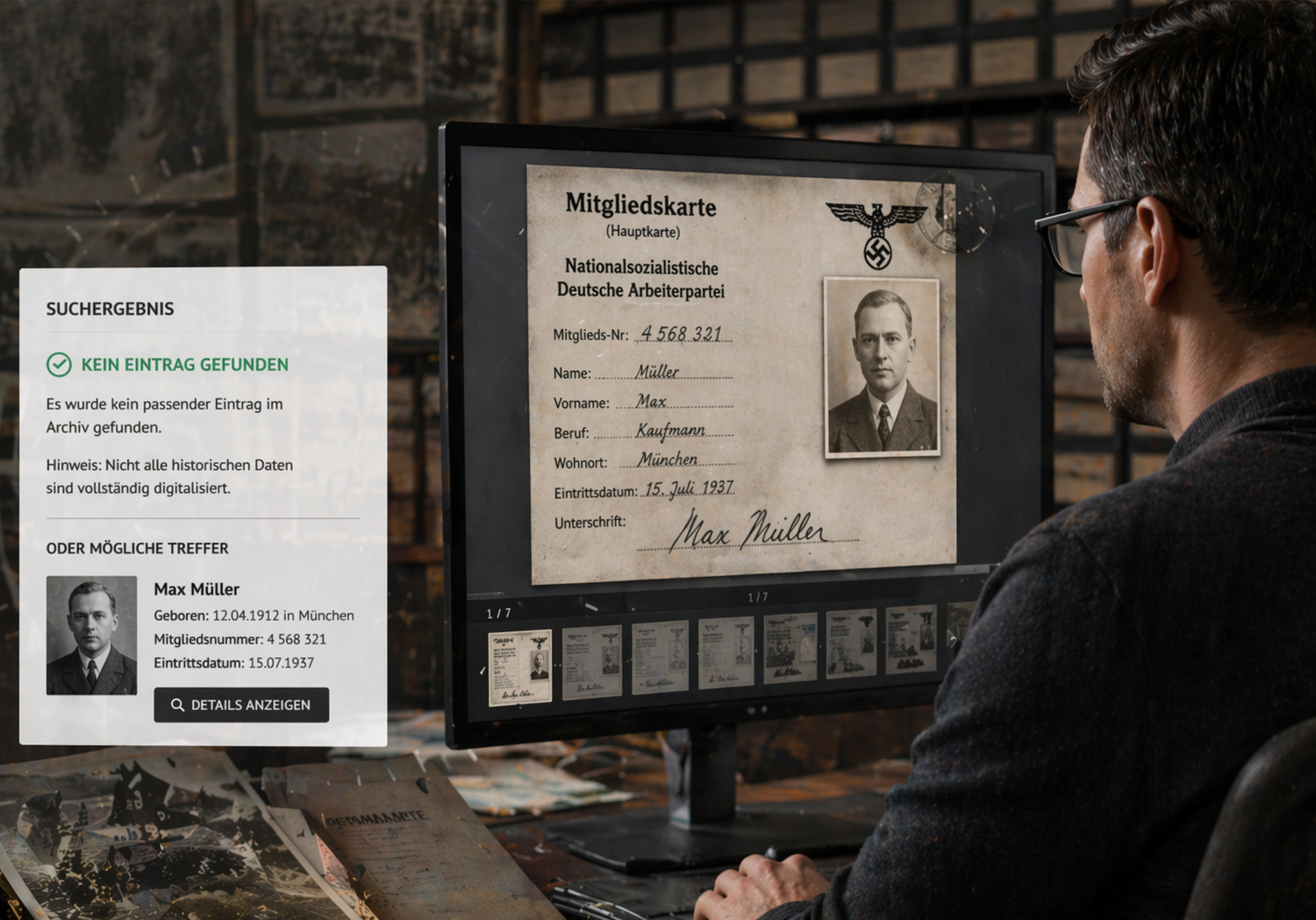

Today, these questions are moving from the category of family secrets into the realm of accessible historical data. Since mid-March 2026, unprecedented access to a massive body of information has opened up on the global network—information that previously required a personal visit to specialized institutions or lengthy correspondence with archivists.
In 1945, at the twilight of the “Third Reich,” about 8.5 million people were registered in the ranks of the NSDAP—a colossal figure covering a significant portion of the country’s adult population. Unsurprisingly, the launch of the new online service, containing more than 16 million digital objects, caused a real technical collapse.
According to official data from the US National Archives press service, in the first days of operation—March 17 and 18—the load on the servers increased by an incredible 925%. Thousands of people simultaneously tried to break through the digital barriers to find familiar surnames in the lists. In our review, we will analyze in detail how this system is structured, why it is based across the ocean, and what nuances to pay attention to during independent research.
Where to Find the NSDAP Member Files Online?
The search is carried out through the official catalog of the US National Archives (NARA), which has stored copies of captured documents for decades. For the convenience of users, two main areas are highlighted:
Main series of documents: “Records Relating to Membership in the Nationalsozialistische Deutsche Arbeiterpartei (NSDAP)”.
This is a fundamental section where digitized microfilms of the original card index are collected.
Internal search interface:
A specialized tool within the catalog that allows filtering data by specific criteria.
Access to these resources is open to everyone, making the research process as democratic as possible, yet requiring a certain methodical approach and an understanding of archival structure.
How Does the Search Work?
The main factor that triggered the rush was the simplified access procedure. Unlike many state archives in Europe, the American system does not require filling out multi-page questionnaires, proof of kinship, or even the registration of a personal account. To start work, the user simply needs to click the blue “Search within the series” button in the catalog interface.
Although the logic of the search at first glance resembles the familiar Google, working with an archive requires a stricter approach to formatting queries. To achieve maximum accuracy, experts recommend using the following formats:
SURNAME, FIRST NAME — this is the basic format in which data was entered into lists by party functionaries (for example: Maier, Hans).
FIRST NAME SURNAME — an alternative option that is also indexed by the system.
“SURNAME, FIRST NAME” — the use of quotation marks is a critically important tool. This forces the system to search for an exact phrase match, cutting off thousands of unnecessary results.
Additional filters, such as city of residence or year of birth, can significantly narrow the search circle. Dates are recommended to be entered in “dd.mm.yy” or “d.m.yy” formats. It is important to remember: the system does not always provide an individual card at the click of a mouse. Often, it redirects the researcher to digitized microfilm reels that must be viewed manually, simulating work with a physical archive. If the first query yields no result, it is no reason for despair—it may be worth experimenting with the spelling of the surname or looking through adjacent films.
What Should You Pay Attention To?
The interpretation of the obtained data is a separate stage requiring critical thinking. Archival documents, despite their status as a primary source, are not without flaws:
Technical errors: Modern optical character recognition (OCR) systems sometimes incorrectly read Gothic fonts or handwritten notes, leading to typos in names.
Lost fragments: History was merciless to documents. According to historians’ estimates, about 20% of the original card index perished during bombings and fires in the final months of the war.
Analysis of the entry date: This is a key marker for understanding a biography. Joining the party before January 1933 (the so-called “Old Fighters”) almost always speaks of ideological conviction. Dates after 1937 may indicate either careerism or the collective joining of entire professional unions under the pressure of circumstances.
Subject limitations: It is important to understand that this archive is only a party card index. You will not find data here regarding combat paths in the Wehrmacht, SS awards, or service in the SA stormtrooper detachments. Other funds exist for this.
Why Was the Archive Opened in the USA and Not in Germany?
This question causes the greatest number of discussions. Indeed, the originals and identical digital copies are stored in the German Federal Archives (Bundesarchiv). Any citizen can send an official request there and receive information for free. However, German legislation stands guard over the protection of personal data with particular strictness.
According to current norms, the publication of such information in open access is prohibited until the protection periods expire: 100 years from the person’s birth or 10 years from the date of officially confirmed death. The German Federal Archives plans to mass-upload the card index online only in the coming years, when these periods expire for most individuals. The United States, possessing copies of the documents by right of the victorious party and not being bound by internal German law, preferred to make the information available now, adhering to the principle of freedom of information.
To Whom Do We Owe the Saving of the Card Index?
The story of the preservation of these documents resembles an adventure novel. When Allied troops approached Munich in April 1945, the party leadership gave the order to destroy the entire NSDAP membership card index. Trucks with millions of cards were sent to Hanns Huber’s paper mill for immediate burning.
However, Huber, realizing the colossal historical value of this archive for future generations, committed an act of sabotage. He simulated the destruction process, burning empty paper and stalling for time in every possible way until American units entered the factory territory. Thanks to his courage and prudence, the world today possesses a database that allows for deep sociological and family research.
Where to Look for Information on Service in the Wehrmacht?
If your searches in the party card index brought no results, this does not mean the person was not involved in the activities of the Nazi state. Many Germans served in the army without being members of the party. To obtain information about military service in the Wehrmacht, as well as details of service in paramilitary organizations (SS, SA), it is necessary to apply directly to the German Federal Archives (PA Department — Personalunterlagen) with an official request. The process may take several months, but it is this process that allows for the restoration of a full picture of ancestors’ biographies during one of the darkest periods of history.
Похожие записи

Number of Racist and Right-Wing Radical Incidents Has Grown in Munich Schools

Munich Municipality Approved the Installation of Commemorative Signs in Honor of Five Jewish Victims of National Socialism
Cognitive Dissonance: In Munich, an AfD Member Narrowly Misses Becoming the Commissioner for Combating Right-Wing Extremism