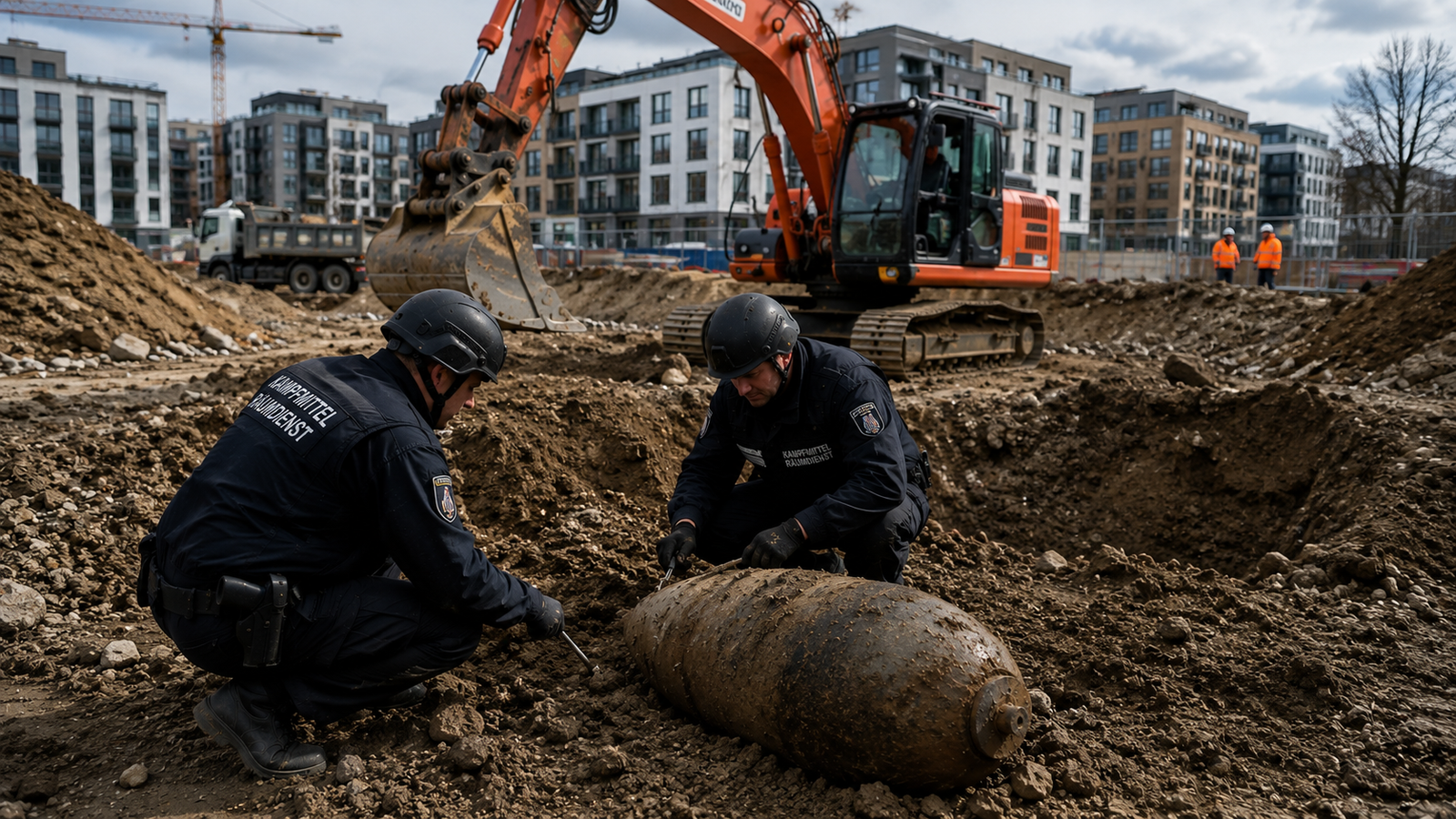

On Wintergünthergrasse in Gibitzenhof, workers carrying out excavation work at a local building site struck an unexploded World War II aerial bomb. For a city whose southern districts were regularly bombed throughout the 1940s, such discoveries have long since become part of everyday life – though that offers little comfort to construction crews or residents of the surrounding neighborhood.
What Was Found, and When
The bomb was discovered on the morning of August 3, 2026, during excavation work at the construction site. According to preliminary information from the Nuremberg municipal authorities, the ordnance is an American-made device weighing 112 kilograms, of which 56 kilograms consists of explosive material.
Key details of the discovery:
- Type: American-made World War II aerial bomb
- Total weight: 112 kilograms
- Explosive mass: 56 kilograms
- Location: a construction site on Wintergünthergrasse in Gibitzenhof
Evacuation and Cordon
Bomb disposal experts have established a 400-meter evacuation zone around the discovery site. Under standard safety protocols, this is the distance considered safe for defusing ordnance of this class on location. Police have scheduled the disposal operation for today at 16:00.
City authorities have not yet specified exactly how many residents will need to leave their homes for the duration of the operation, as assessment of the evacuation zone’s full scope is still underway. In cases like this, the number of affected residents often runs into the thousands. Gibitzenhof faced a similar situation back in 2006, when a bomb was unearthed by an excavator on a school playground. During that disposal operation, more than 2,500 residents were forced to leave their homes.
Why Gibitzenhof — Not the First Time, and Not the Last
During World War II, the southern part of Nuremberg was one of the city’s largest industrial zones, which made it a prime target for Allied air raids. This is why unexploded ordnance continues to turn up regularly in Gibitzenhof and neighboring districts – and not always near the surface. Some unexploded bombs, driven by their own weight on impact, sank as deep as four meters underground, while others – like today’s find – have lain for decades just half a meter below the surface.
A similar case occurred in May 2026 at Nuremberg’s Southern Cemetery, where a 70-kilogram aerial bomb was found and defused that same evening without incident. Each such discovery sets off the same sequence of events: a cordon is established, disposal experts assess the ordnance, and, if necessary, residents are evacuated for several hours.
City authorities have promised to provide updates as the disposal operation progresses. In the meantime, residents of Gibitzenhof are advised to follow the city’s official news channels and prepare for a possible temporary evacuation from their homes.