
Residents in this situation face two questions: how long can one manage without heating, and how can a home be heated economically once the heating has been switched on after all?
The answer to both questions begins with checking the heating system before the start of the heating season. It helps to retain warmth in the flat and to save energy. For example, if radiators gurgle or heat up only partially, the cause can most often be remedied with a few simple steps.
When to switch the heating on
There is no fixed date from which heating is switched on. The outdoor temperature alone is not a reliable guide, because flats, and especially the walls of buildings, cool down at different rates, depending on the material from which the home is built. The rate of cooling, like the rate at which walls warm up in summer, depends, among other things, on the energy performance of the building and on its insulation. In a new, well-insulated house, warmth is retained for longer, as is coolness, than in an old one with poor walls and windows.
For this reason, what matters is the temperature inside the room, not the reading on the outdoor thermometer. If the temperature in the rooms falls below 16 degrees, that is a reason to switch the heating on, even when it is not yet so cold outside.
On the other hand, the thickness of walls, especially concrete ones, lengthens the time it takes for the rooms within them to warm up and cool down. But it also lengthens the time needed to reach the required constant temperature in the room.
Why 16 degrees protects against mould
The Bavarian Consumer Advice Centre recommends warming living rooms and bedrooms to at least 16 degrees during the daytime in the heating period. The reason is moisture. When walls and other surfaces are too cold, moisture settles on them, and as a result of a raised so-called “dew point” in the room, mould that is hazardous to health appears.
If the building is in poor technical condition, a higher temperature may be needed to reduce the risk of mould.
But it should not be forgotten that if a building is made of concrete or brick and has thick walls, these walls absorb cold in winter and heat in summer. A brief period of heating or cooling of such a room will not solve the problem, since as soon as the heating or cooling is switched off, supposedly to save money, the walls will give their cold or heat back to the air in the room, and within 10 to 15 minutes the room will return to its initial temperature. That is, the “saving” the resident had in mind will cost him several times more than ordinary heating. Only once the walls of the building have reached a mean temperature between the room and the street is saving possible, and only with the heating or cooling constantly kept on at a minimum.
What room temperature is considered reasonable
The mark of 16 degrees sets a lower limit, but is not suitable as an ideal for human living. Nor do we wish, during hours when it is warmer outside than in the room, to run outdoors to warm up.
The Federal Environment Agency (Umweltbundesamt) has named different guideline values for different rooms:
- for living rooms, about 20 degrees;
- for the kitchen, about 18 degrees;
- for the bedroom, about 17 degrees.
Air humidity should also be monitored. In poorly insulated flats, moisture settles especially easily on cold walls. A thermo-hygrometer or a modern indoor weather station measures temperature and humidity at once, and from their readings it is easier to notice that a room is becoming too damp or too dry. The ideal humidity for people indoors is considered to be 45 to 60 percent.
How to spot radiator problems quickly
After the summer break, faults in the heating system are discovered as soon as the heating is switched on.
Typical signs of faults are as follows:
- the radiator gurgles;
- it heats up only halfway;
- the room remains cool even though the regulator is fully open.
Many of these problems are easy to remedy, and it is better to discover them in the first days of the autumn season, before it becomes really cold outside.
When to bleed a radiator
If a radiator gurgles or heats up unevenly, air has probably accumulated in the system. As a result, the heating works less efficiently, and energy consumption may rise. In that case, the air is bled out.
With an individual heating system, one can first switch off the circulation pump and open the thermostatic valves fully. Then a small container is placed under the bleed valve and the valve is carefully opened with a special key. A hissing sound means that air is escaping. As soon as water appears, the valve is closed.
Finally, the water pressure in the system is checked, because it may drop when air is bled.
The radiator and thermostat must not be covered
The next check of the heating system is even simpler and concerns the radiator itself. Furniture, long curtains or items lying on it impede heat output, and the warmth spreads less well around the room.
The thermostatic head must not be covered either. It senses the temperature in the room and regulates how much hot water enters the radiator in order to reach the desired temperature. If the head is covered by a curtain or furniture, it may misjudge the temperature in the room.
Whether to switch the heating off at night
Not every room needs to be warm around the clock. At night, and also when no one is at home for several hours, the temperature can be lowered, but do not switch the heating or cooling of the room off completely. For such periods the Federal Environment Agency recommends setting the temperature at about 18 degrees.
The heating should not be switched off entirely, because the walls of the building, and therefore the rooms, would cool down, and restoring a constant temperature level would again be costly. How far the temperature can be lowered depends, among other things, on the condition of the building and its insulation. In a well-insulated house, walls cool down more slowly, and the night-time reduction in temperature is felt less.
How to set the thermostat correctly
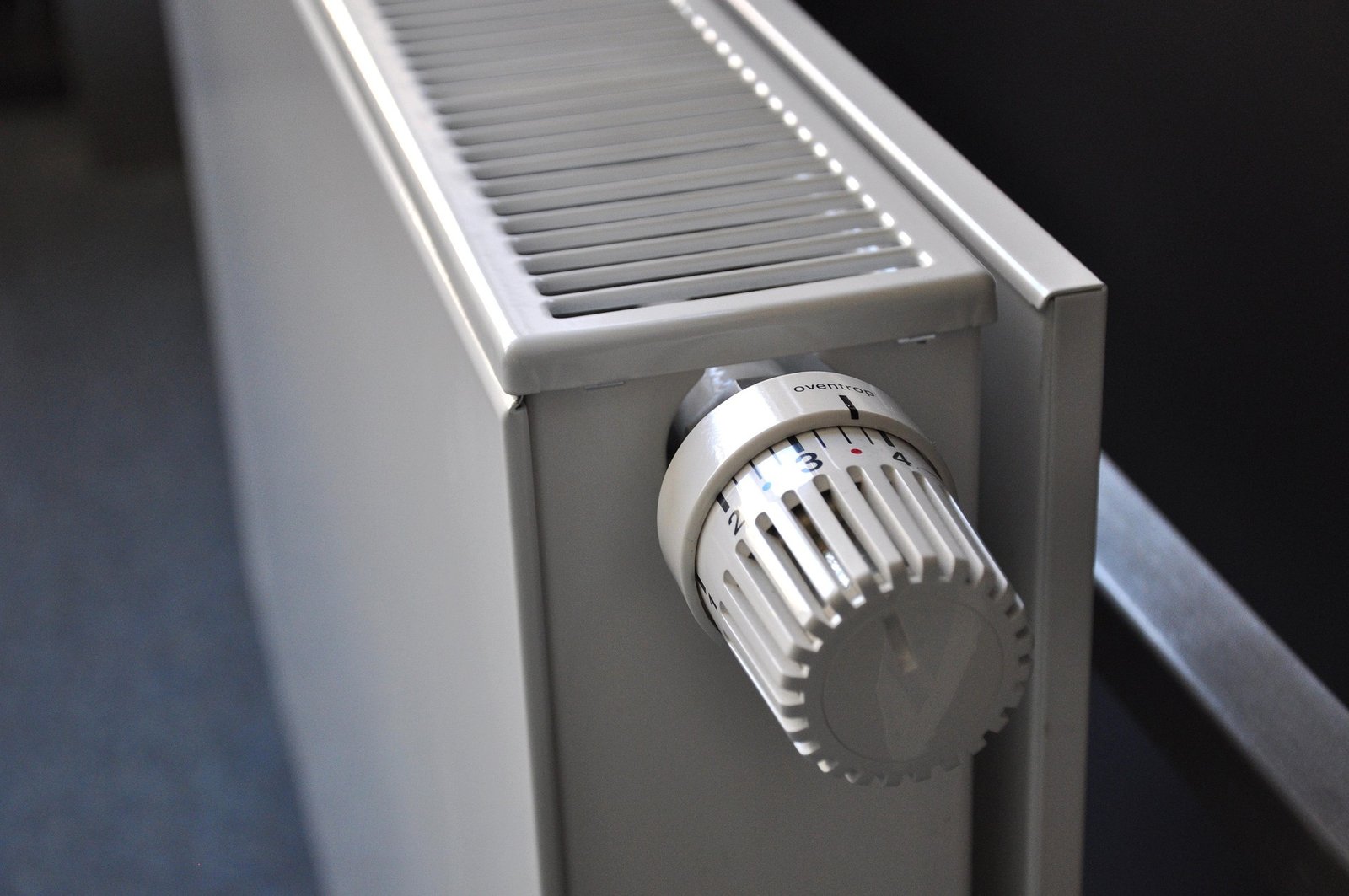
A familiar situation: a person comes home, feels cold and sets the thermostat to five in the hope that the room will warm up faster. This does not happen. A higher setting does not speed up heating, but merely sets a higher target temperature.
On an ordinary thermostat, the settings correspond approximately to the following values:
- setting 1 gives about 12 degrees;
- setting 2 gives about 16 degrees;
- setting 3 gives about 20 degrees;
- setting 4 gives about 24 degrees;
- setting 5 gives about 28 degrees.
These values serve only as a guide and may differ between thermostats.
Even a small adjustment has a noticeable effect. According to the consumer advice centre, each degree by which the room temperature is lowered saves roughly six percent of heating costs. On this estimate, lowering the temperature by two degrees would save about 12 percent.
How to ventilate a room in winter
Ventilation remains a part of the heating season at all times. Showering, cooking and drying laundry produce moisture, which must be removed from the flat, otherwise it settles on the walls. Likewise, where there is a large difference between the temperature outside and inside, condensation forms, which also leads to mould and to the deterioration of walls.
The Federal Ministry for the Environment of Germany recommends that, instead of ventilating for a long time through a window left ajar, windows be opened wide several times a day, preferably with a through-draught. For this it is ideal to open opposite windows at the same time. While ventilating, the thermostat should be turned down, so that the system does not expend energy on heating air that escapes outdoors. But if a room has no ventilation, these steps will not be enough: there are many rooms, often in old buildings, in which only a window or transom kept constantly open for ventilation can help avoid excess moisture and mould. Conversely, an overheated room leads to low humidity, which dries the skin and airways and allows various diseases of the skin and mucous membranes to develop.
What is important to remember
The temperature in a flat is determined by the condition of the building and the humidity of the air, not by the date on the calendar. For protection against mould, it is recommended not to go below 16 degrees, and in living rooms to aim for 20 to 22 degrees at most. Indoor humidity should also be monitored and adjusted by ventilation or by special modern devices.
Savings are helped by lowering the temperature at night, but not switching the system off completely, by radiators free of obstructions, by air bled from the radiator and by brief through-ventilation. Each of these actions on its own has a small effect, but together they noticeably reduce heating costs without a loss of warmth in the flat.