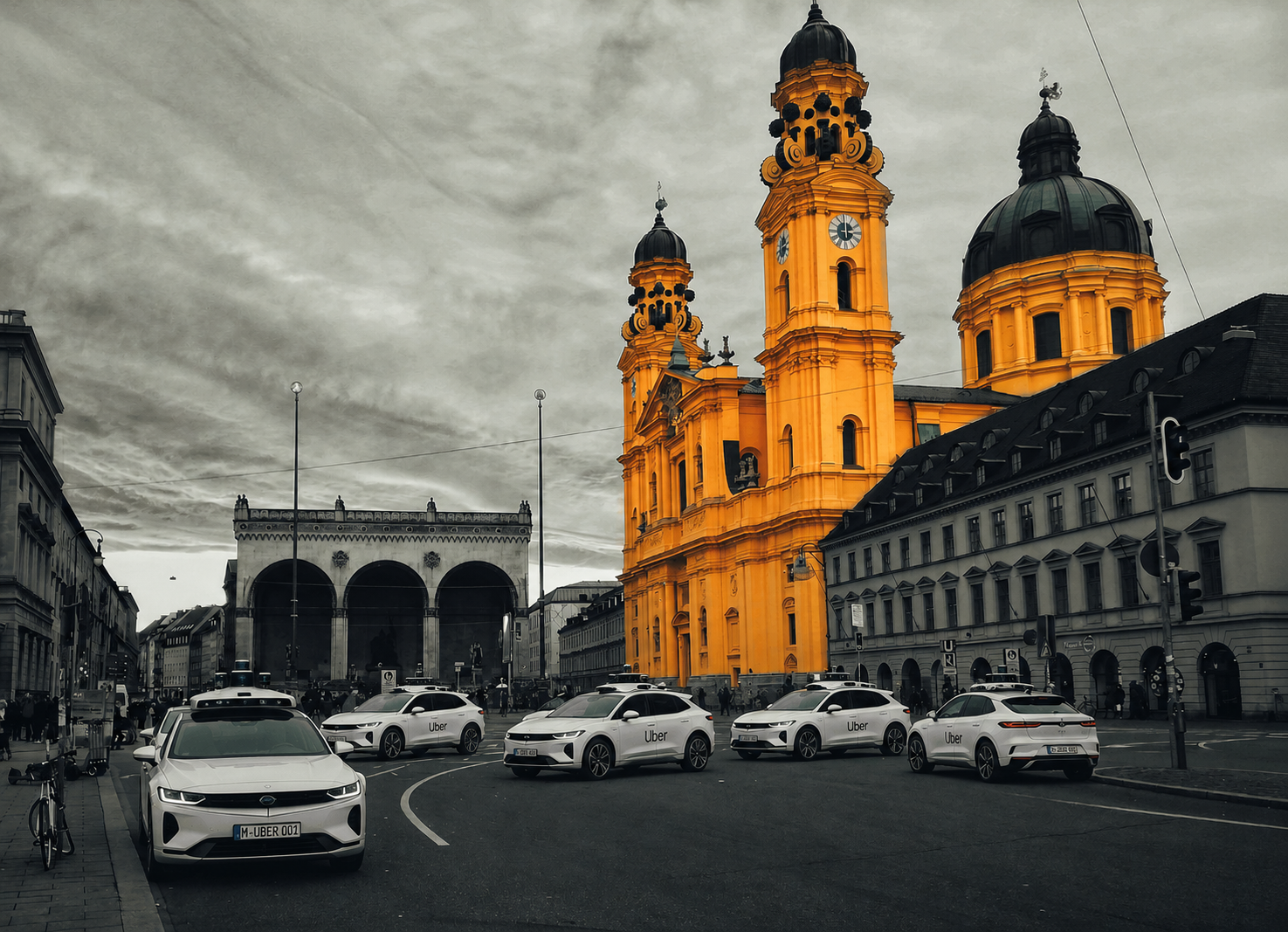

For reasons no one can fathom, the Munich authorities gave in to the conventional taxi drivers: the ones who run red lights, cut off other road users, stop in the middle of the road and cause a traffic jam just to read a message on their phone, and who sound their horns at startled pedestrians. These are the very drivers who love not to switch on the meter and who name a fare after sizing up the passenger by appearance. It was precisely this section of the taxi trade that besieged City Hall with demands to ban the other, more customer-oriented and more convenient taxi services.
As usual, instead of seeking a constructive solution to the problem (if one existed at all, since we live in a market economy, not in the Soviet Union), City Hall introduced artificial and unlawful quotas: a minimum price for taxi services. Now the Munich Administrative Court, having considered the complaint brought by the online taxi services and by ordinary citizens, has restored a sense of fairness to our city by ruling City Hall’s decision unlawful. The ruling is still provisional, but it has already changed the situation on the urban transport market: there are currently no minimum fares for taxi services in the Bavarian capital. This has restored conditions of fair competition in our city, where the more flexible, more customer-oriented and more convenient service survives.
In response to an enquiry, a spokeswoman for the press office of the District Administration Department (KVR) said: “The state capital Munich is ceasing to enforce the general order with immediate effect and is examining whether to appeal against this court decision.” So far the city authorities have not lodged an appeal and are merely weighing the possibility.
The court has exempted the companies from minimum fares
The Munich Administrative Court previously issued five rulings in expedited proceedings. This is a procedure in which the court makes a preliminary assessment of a dispute in order to temporarily protect the applicant’s rights until a final decision is reached. The court granted five applications from companies and private citizens, thereby overturning the artificial quotas that undermined fair competition, which the city had imposed through an unlawful general order (Allgemeinverfügung). This is the term for an act by which the authorities introduce a rule that applies at once to an indeterminate group of persons.
According to the court, the competent chamber assessed the case under the criteria for expedited proceedings and concluded that the city authorities’ order is unlawful as a whole. The city authorities extended the decision to territory beyond their jurisdiction, and the unlawful part of the decision cannot be separated from the rest of the text. The minimum fares applied also to journeys from and to Munich, that is, to routes that extended beyond the city limits.
The KVR spokeswoman explained that in the expedited proceedings the court found the following: “Unlike the taxi tariff, minimum fares can apply only within the city limits. The taxi commission and the city council must now discuss the next steps”, thereby once again twisting the law and the court’s decision.
The positions of City Hall and the city council
Lord Mayor Dominik Krause (Greens) stated that the aims of the unlawfully imposed quotas remain valid. The minimum price is meant to protect drivers from dumping and Munich’s taxi drivers from a ruinous price war. “We will now await the decision on the merits and then examine whether the rules can be brought into line with the law,” he said, forgetting the prohibition on government interference in the business environment.
The Left group on the city council believes that the city is obliged to correct the rule as quickly as possible. “The court criticised the wording of the provision, not its substance. What remains in force is the main point: municipalities have means against dumping by Uber and similar services,” said group chairman Stefan Jagel.
He demanded that the city administration present, as soon as possible, a legally sound proposal that takes the court’s requirements into account.
In his words, it should provide for the following:
- clear regulation of journeys within the city;
- negotiations with neighbouring municipalities and other licensing authorities where necessary.
According to Jagel, every week without regulation comes at the taxi drivers’ expense.
All of which once again proves the incompetence of many representatives of our authorities who, instead of finding a lawful solution that would satisfy all parties in the business, stoop to the level of the Soviet-era Bolsheviks by artificially regulating whom to help and whom to subject to quotas, and this within a market economy, where state interference in the competitive environment of business is, in essence, prohibited.
How the minimum fares were structured
The general order in force since July linked the fares of taxi services to the tariff of conventional taxis, which, as before, is inflated by the conventional taxi drivers themselves, and City Hall, unilaterally taking their side, enshrined it in its decision. At present this tariff, including for journeys beyond the city limits, is €5.90 for boarding and €2.70 per kilometre. In practice, however, when you get into such a taxi, you pay double and sometimes triple the stated tariff. Yet the Mayor, for reasons unknown, turned a blind eye to these facts, as well as to the laws of Germany and the EU. Before the July decision was introduced, rides booked through online services cost on average about 40 percent less than in a conventional taxi.
The official aim of City Hall’s July decision is formulated thus: to protect the drivers of conventional services from falling wages and taxi drivers from a price war. But what about fair competition? Instead of conventional taxi services modernising, becoming more considerate towards customers, and improving their service and their behaviour on the roads, we see City Hall artificially protecting those who create more problems than they bring benefits. In principle, this City Hall decision resembles its other decisions, for example its handling of the problem with Munich’s cyclists.
The court, in a preliminary ruling, has doubted this aim, as well as the lawfulness of City Hall’s actions. One would like to remind Mr Krause that fair competition and a market economy imply both a price war and a war of service quality, and in business some always survive while others go bankrupt. That was always so and always will be, and no ultra-left ideas lifted from Soviet-era handbooks will save a business that is heading for bankruptcy.
What happens next
Until the court issues a final decision (City Hall may try to appeal), minimum taxi fares will not apply in Munich. City Hall staff are reportedly examining the possibility of lodging an appeal and the chances of winning it in court, while the taxi commission and the city council are preparing to discuss how to bring their unlawful decision into line with the court’s requirements.
For drivers, passengers and taxi companies, the question of whether the taxi system will obey the market economy or fall victim to yet more artificial and unlawful restrictions remains open. If City Hall manages to bring its July decision into line with the letter of the law and the laws of business, it may not be necessary to return to unlawful decisions. If not, we may face a surreal situation in which, in a modern, developed democratic country, deputies and elected leaders of the districts and the city unilaterally protect the interests of a narrow section of the population at the expense of the majority and its opinion.