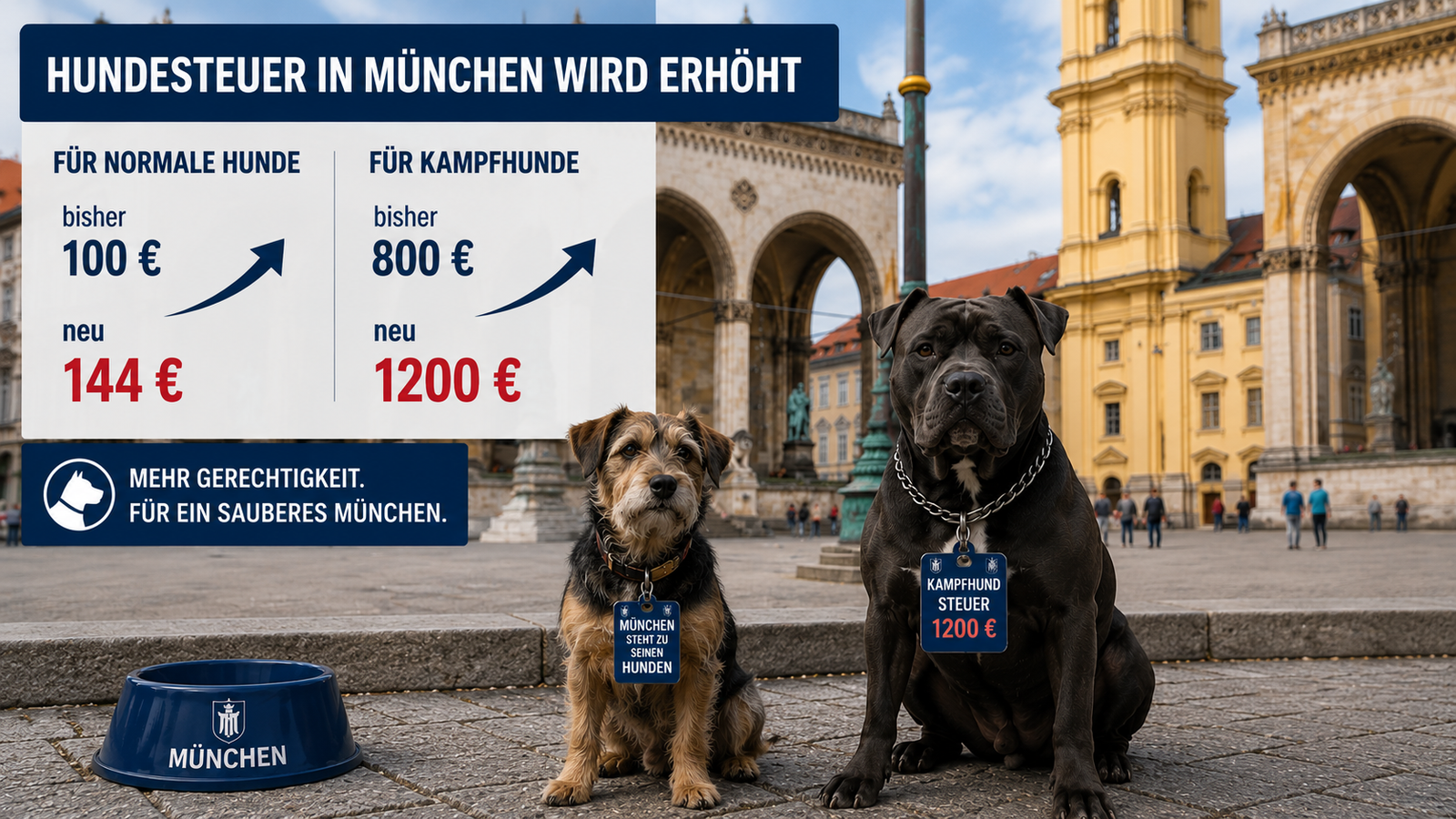

The agency has prepared a draft decision for the city council, according to which, starting in 2027, the dog tax will rise from 100 to 144 euros per year, representing an increase of nearly half—or 44 percent. This refers to a municipal tax collected annually for every registered animal, which German cities traditionally use not only as a source of revenue but also as a tool for tracking the dog population.
Increase Will Affect 43,000 Owners
The change will affect approximately 43,000 owners and 46,000 dogs registered in the city—virtually every family in Munich that owns a pet. A separate and noticeable increase will apply to the tax on fighting dog breeds: from 800 to 1,200 euros, an increase of 50 percent. Elevated rates traditionally apply to this category of animals in Germany, under the premise that keeping such breeds requires additional responsibility from the owner and entails extra monitoring expenses for the city.
In 2025, the dog tax brought approximately 4.38 million euros into the city budget. The finance department estimates that the new, higher rate will generate an additional 1.9 million euros annually—a sum intended, according to the department’s plan, to help cover the current city treasury deficit.
Among the arguments presented by the agency in favor of the increase:
- In other German cities, the dog tax is often higher than in Munich;
- The last rate increase was carried out back in 2011, when it rose from 76.80 to 100 euros, and for fighting breeds from 613.80 to 800 euros;
- Since then—for more than a decade and a half—dog owners have enjoyed stable rates, as a result of which the city never compensated for the accumulated loss of purchasing power.
Lord Mayor Announced the Decision in Advance
Plans to raise the tax were previously announced by Munich’s Lord Mayor, Dominik Krause, representing the Green Party. Now, the finance department has submitted a concrete, fully developed proposal for consideration by the city council, which is set to vote on its approval.
Within the council itself, the initiative has met with a mixed reaction. The head of the CSU parliamentary group, Manuel Pretzl, called the jump in the rate from 100 to 144 euros too sharp, noting that his faction still has questions that need to be discussed prior to the vote.
Dog Owners: Increase Is Acceptable, But Changes Are Needed
Ursel Keller, whose family has owned a retriever named Lemmy for four years, considers the proposed increase generally acceptable—especially since municipal services continue to distribute pet waste bags free of charge. At the same time, she noted that in return, the city ought to offer dog owners more reciprocal benefits: for example, more durable waste bags, as the current red bags, according to her, frequently tear during use.
Furthermore, Keller drew attention to the lack of space for walking dogs: most lawns in Munich’s city parks are closed to animals, forcing owners to seek out the rare designated areas.
Fate of the Tax on Second Dogs Remains Unresolved
The finance department has not yet determined whether the tax on a second pet in a household will remain at its previous level: the decision has been deferred until the implementation of new tax calculation software. However, it is already clear that a second dog will not be taxed higher than the first; according to the department’s assessment, a differentiated calculation would incur administrative costs disproportionate to the tax revenue itself.
By way of comparison, in many other German cities, second and subsequent dogs cost owners significantly more than the first. In Hanover, for instance, owners pay 150 euros per year for the first dog, and 276 euros for each subsequent one—nearly double.
Payment Deadline Will Also Change
In addition to the rate itself, the finance department plans to shift the tax payment deadline. Currently, the amount must be paid by January 15, but citizens face numerous other mandatory payments during that month, which can create liquidity issues at the start of the year. Therefore, the agency proposes moving the tax collection deadline to April 1, in order to distribute the financial burden on residents more evenly throughout the year.
If the proposal receives approval from the city council, the increased tax will take effect in 2027, and Munich dog owners will have to adapt not only to the new rate, but also to the new payment deadline.