
Bavaria’s family associations assessed the idea in terms of efficiency and real-world conditions, and consider it useful, but in their view it does not get to the main problems facing parents. Much like all the ideas of our Prime Minister, in principle.
What Söder Has Proposed Again
The new plan, the so-called “Food Blogger’s” plan, looks like an ostensible advantage for parents and children. Söder announced that families with children will soon get a so-called “fast lane” (Überholspur) in shared queues. He said this at the autumn retreat of the CSU parliamentary group in the Bavarian Landtag at Banz Monastery. But, as usual, he did not say how he intends to put the idea into practice, whether there is any demand for it, or how it could help people who visit government offices not in a live queue but with a fixed appointment time (a Termin). This alone makes Söder’s latest announcement populist, made in the hope of lifting his negative ratings.
Söder’s initiative has two points:
- the new solution is supposed to shorten families’ waiting times both in ordinary queues and when processing documents and applications at public authorities;
- a digital platform for families will be created which, for example, will show available places in kindergartens.
“We want to make Bavaria even more child-friendly,” Söder emphasised. Thus, under one name, two ill-considered solutions have been combined: one concerns live queues, which have long ceased to exist; the other works on a phone screen. And if this solution works the way other Bavarian websites work, such as SOWON, then it is already safe to speak of a wasteful misuse of funds that will not lead to the expected result. On the other hand, it remains unclear whether there is any demand for such an idea at all. After all, our Prime Minister is known for personal ideas that have nothing in common with the reality of ordinary residents.
What Remains Unclear
There are few details so far: this is yet another loud announcement, not a finished solution. It is also unknown how the so-called “fast lane” will work and where it will be introduced. After Söder’s statement, the Bavarian Ministry for Family Affairs has not provided any details. No timeframe has been given for when the new queuing arrangements will appear in family policy. There is also still no answer to which authorities will be included in the so-called “fast lane” and how families will prove their right to a priority queue when queues are in any case allocated by appointment time.
Other questions remain as well. How do parents themselves view the idea? What do family associations expect from politicians? It is already clear that several issues concern them at once, and queues at government offices are by no means the most important problem among them, if they are a problem for families at all.
German Family Association: “It Would Be Eyewash”
Rikarda Bollinger-Schönnagel heads the Bavarian branch of the German Family Association. She responded to the so-called “fast lane” in a restrained manner, though with a note of irritation. In her words, it is good if mothers with children do not have to wait four hours at the district office to process papers or submit an application. “But to think that this idea will solve families’ main problems would be eyewash,” she added (in the original, Augenwischerei).
Bollinger-Schönnagel’s criticism is directed at the cuts to social provision in recent months. “When it comes to families, Bavaria is all too ready to reach for the red pencil,” noted the mother of several children and grandmother.
She listed what exactly weighs on parents:
- the housing question and high rents;
the family allowance (Familiengeld) is no longer paid;
- the monthly 100 euros per child in kindergarten no longer goes directly to families;
- the Bavarian government quickly and completely abolished the child start-up allowance (Kinderstartgeld).
“For many parents this is an enormous burden,” she emphasised. It turns out that, on the one hand, Söder is lowering the standard of living of young families without solving their main problems, and on the other he proposes a solution that not only fails to fit the reality of visiting government offices but also has no demand.
An App Will Not Replace a Kindergarten Place
The government is planning yet another app and website, spending hundreds of thousands of taxpayers’ euros on it, and in the end we will most likely get another SOWON: non-transparent and non-functioning.
Bollinger-Schönnagel considers such a service useful, but asks: “What use is it if there is simply no place within reach?” Her argument is simple: the service will show where there is space, but will not create new places if there are not enough.
Even a kindergarten place found through the app does not guarantee that it will be obtained. So finding a place and being able to afford to take it are two separate tasks. After-school care, meals and excursions are also becoming more expensive. Working parents, moreover, have to arrange childcare themselves for about 20 days a year when the kindergarten is closed. “For young families this is a heavy burden,” explained the representative of the parents’ association.
She also drew attention to the financial side. “One salary goes almost entirely on rent. Many want two or three children but cannot afford them. Family planning also depends on the wallet.”
But Söder is concerned not with the well-being of Bavaria’s residents but with his personal ratings, which will soon become deeply negative.
Association of Large Families: “The Most Valuable Thing for Families Is Time”
Florian Brich also draws on personal experience. He is the father of four children and lives with his family in Nuremberg. Brich heads the Bavarian branch of the Association of Large Families of Germany (KRFD). He, too, began by criticising the Bavarian government’s cancellations in family social policy. “It is a fact that many families were outraged and deeply hurt when the Bavarian government abolished programmes such as the family allowance,” he stated.
Brich sees the so-called “fast lane” plan as compensation with small sums of money. In his assessment, developing the app and speeding up visits to authorities are unlikely to be very expensive.
At the same time, he sees benefit in these steps. “The most valuable thing for families is time. And such steps can really help,” Brich believes. Resolving a matter quickly at an authority and not standing in a long queue, in his words, “would be a real gain.” Provided it were thought through in detail, taking realities into account rather than the personal views of the Prime Minister of Bavaria.
Do Families Feel Bureaucratic Pressure
Brich did not confirm that families have so far suffered from bureaucracy more than others. “No, I feel that I am treated the same as everyone else,” he noted. Every citizen faces trips to various offices and the burden of bureaucracy. “But for large families the volume of hassle accumulates,” he added. This applies to everything, from finding a kindergarten place to obtaining a driving licence. The rules are the same for everyone, but for a large family the number of visits to government offices grows with the number of children, and the overall burden becomes more noticeable.
Brich also has his own proposal for the digital platform: a kind of family ID that could be built into the app. It would simplify proof of family status when entering institutions and when dealing with authorities. “I sometimes had to carry the birth certificates of all four children with me, just to prove they are mine,” Brich said. But whether Söder will hear the voice of the real people and of his electorate, no one is sure.
Criticism and Discontent Around the Idea
In Söder’s concept of the so-called “fast lane,” Brich sees goodwill. “You can see that someone has started to think. We approve of that,” he emphasised. At the same time, he allows that such a privilege for families may provoke criticism and anger among others. The mood in society, he says, is nervous.
His association’s position nevertheless remains unchanged: “Respect and the joy that children bring are important to us.” Brich places these words above any individual programmes and apps: for him, a conversation about supporting families begins with the attitude towards parents and children.
What Next
So far, Söder’s idea, like all his ideas, consists of a loud announcement unsupported by basic information and two points of ostensible goals, but with no timeframe, no plan, not even a study of whether there is demand for the idea, no launch location, and no other details.
Both of the journalists’ interviewees draw on personal experience: one is a mother of several children and a grandmother, the other the father of four children. Both associations are ready to appreciate the idea of speeding up visits to government offices, and Brich calls time the family’s most valuable resource. At the same time, they remind us of the abolition of the family allowance and other payments, of the shortage of kindergarten places, and of parents’ growing housing costs, which depend directly on the work of the Prime Minister.
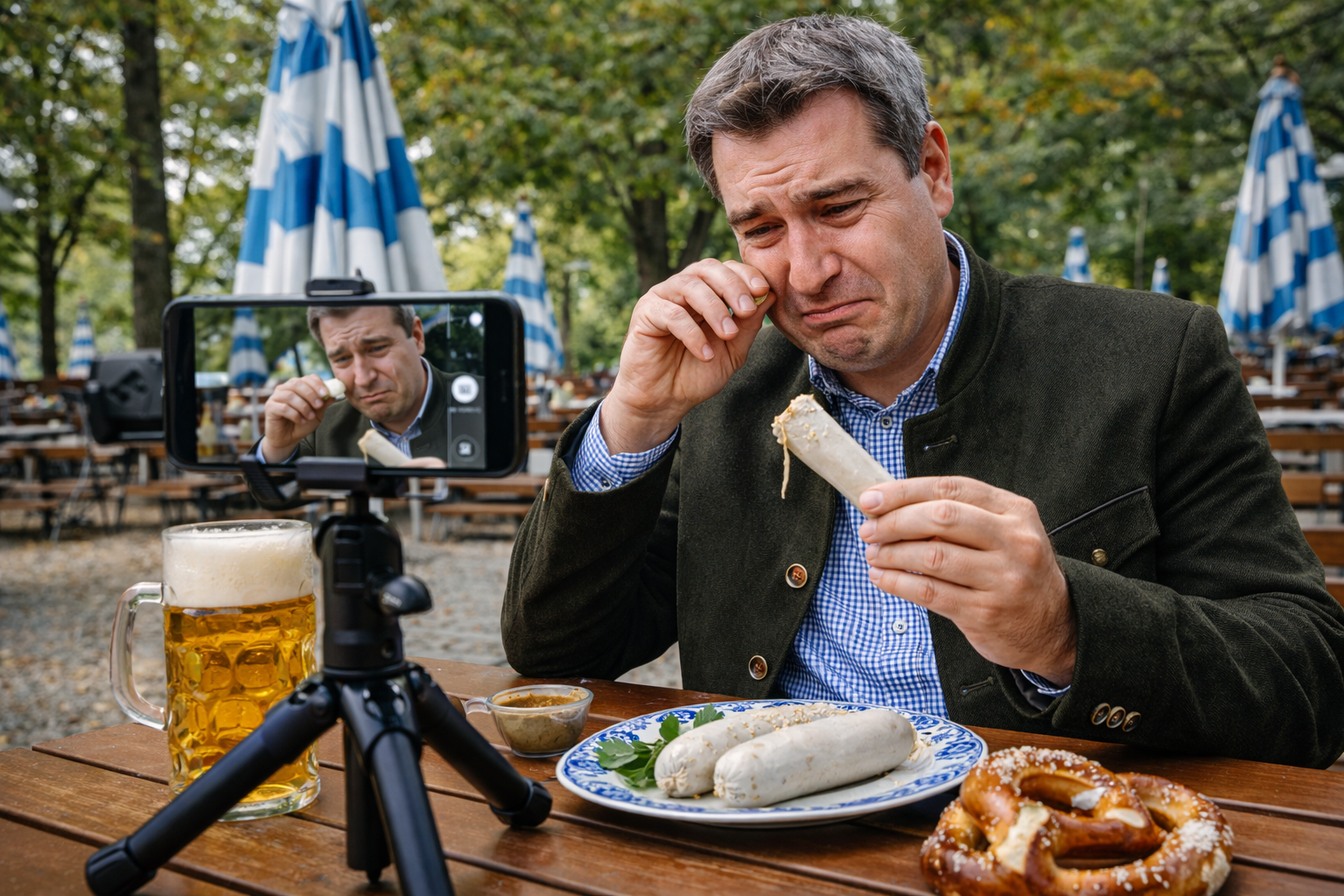
How much the so-called “fast lane” will help families will become clearer when the ministry reports the details and the government names a timeframe. If that happens. Until then, talk of this idea remains just talk and yet another piece of demagoguery from the Food Blogger of All Bavaria.