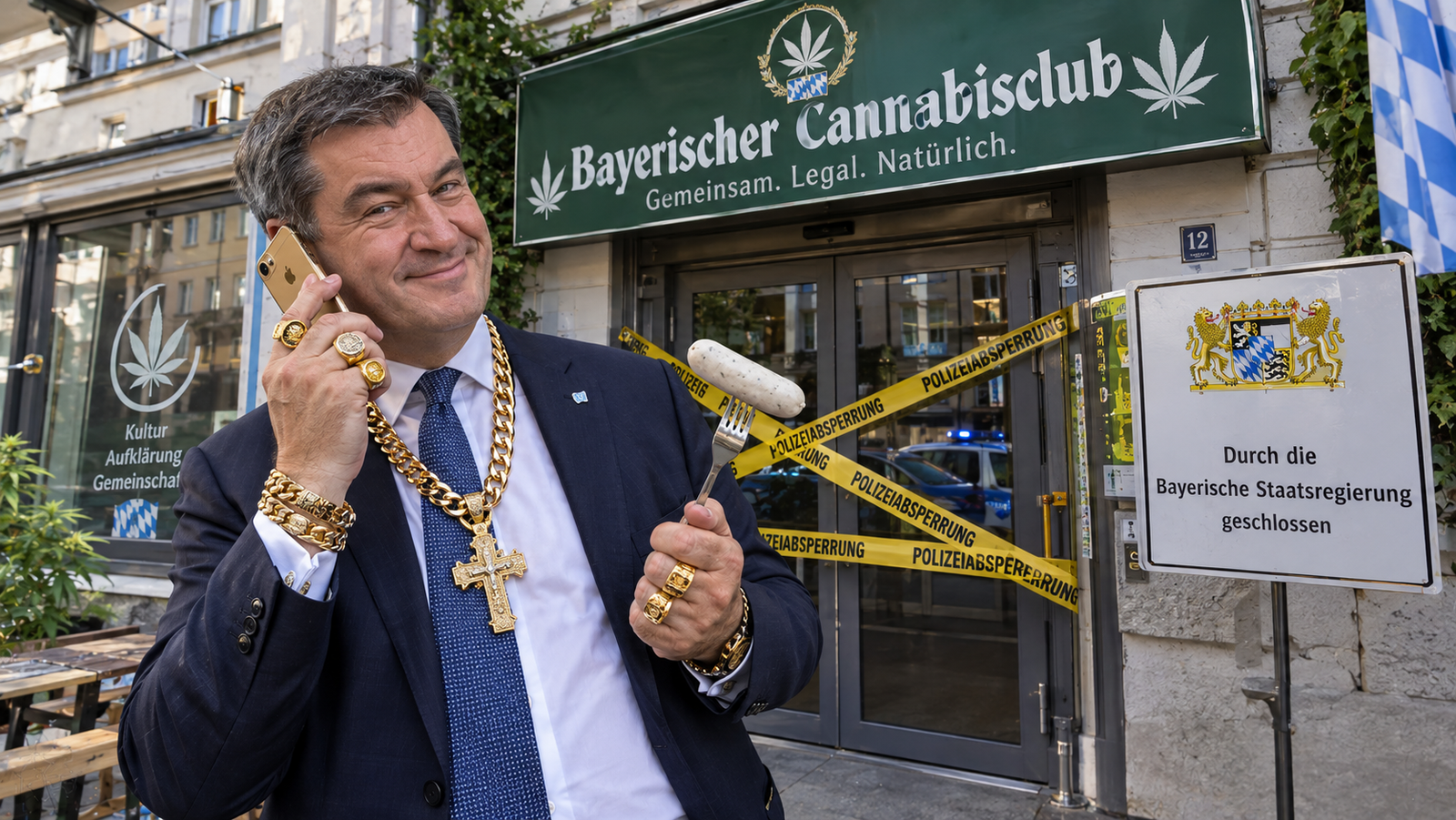

The club is in the Upper Palatinate, and its team spent a year and a half seeking permits to grow cannabis in Bavaria. Since 2024, when cannabis was legalised, the Bavarian state government has been doing everything to keep the collective cultivation of this plant difficult or outright impossible. Nowhere else in Germany is federal law treated this way. Even after losing in court, the government of the “food blogger” indulges in every kind of populism except upholding the law, complying with court rulings and doing its own job.
On paper, Bavaria has eleven cannabis clubs with official licences. In practice, not one of them grows cannabis on the state’s territory. What is more, the authorities do everything possible to shut these clubs down, not shying away from unlawful inspections or public accusations of things that simply are not so. To understand how this came about, it is worth tracing an application’s path from the first signature to the building authority.
In pursuit of ratings among an elderly, devoutly religious target audience and the ultra-right, Söder has himself become tangled in his own statements. As for action, one can say nothing, since it has long been invisible even under a microscope, apart, of course, from making the rounds of interviews and banquets.
What the law permits and where the Bavarian “peculiarities” begin
The Federal Cannabis Act came into force on 1 April 2024. From 1 July 2024, specially founded and licensed clubs gained the right to grow cannabis collectively. These are registered non-profit associations of cannabis enthusiasts who cultivate the plants themselves and distribute the harvest to their members for personal consumption. Up to 500 people may belong to one such club. To obtain a licence, clubs must fully meet the Act’s stringent requirements, pass numerous strict inspections and report to the supervisory authorities more often than any comparable associations in Germany.
The licence for such activity is issued by the state government. In Bavaria this is handled by the State Office for Health and Food Safety (LGL). But a licence alone is not enough: the club also needs building approval for its premises, which is issued by another authority. It is at this second stage that Bavarian applications get stuck.
Eleven licences and not a single plantation
Despite the authorities’ hard line, in 2025 Bavaria was for the first time compelled to approve the operation of three clubs. By the authorities’ own account, unavoidable legal obligations forced them to do so. The German Hemp Association reminds us that the state health minister, Judith Gerlach (CSU), promised, even before the law came into force, to fight it by every means available. It looks strange that the minister openly violates federal law, yet nobody punishes her for it. One hand washes the other? Does someone profit from illegal cannabis sales? For it is precisely legalisation that destroys the illegal market. But the minister believes legalisation is harmful to society. Why, then, is she silent about the harm of alcohol, and about how many incidents and crimes result from its consumption? Why does she not put a spoke in the wheels of doctors who prescribe amphetamines to children with ADHD, or opiates to adults who do not need them? Profit? Or ordinary human incompetence? Or perhaps she has decided to place her personal views on life above the law and professional standards?
Today eleven associations in Bavaria hold such a licence. At the end of August 2025, according to the Bayerische Staatszeitung, there were eight, so the number of clubs in Bavaria is growing, albeit slowly, and only on paper. A summary from the federal association of clubs for the end of July 2026 shows how these figures compare with the rest of the country: 896 applications submitted, 455 licences issued. In Hamburg, 18 of 28 applications were approved, and in North Rhine-Westphalia, 126 of 240. In Bavaria, 11 of 46 applications were approved, only 6 were formally rejected, and 24 applications were withdrawn by the clubs themselves.
Georg Wurth, an active member of the German Hemp Association (Deutscher Hanfverband), is familiar with the work of clubs across the country: “Comparatively few licences are issued in Bavaria as it is. But the fact that virtually nobody here is actually growing is explained by tricks with building law, and there is nothing like it in any other federal state.” The result is a paradoxical situation: one authority allows a club to exist, while another does not let it grow cannabis.
And the most interesting thing is that there is no lawful basis for the absence of licences. Officials at the final instance, just as in the USSR and the GDR in their day, simply find reasons to return the application. The reasons include even an elementary typo in a word or a missing punctuation mark. In essence, this can easily be assessed as deliberate sabotage on orders from above. Even the judges understand this, but can do nothing.
Building inspectors demand special zones
The project in Grafenwöhr, too, very nearly fell through. Staff at the local building authority reproached Berlinski and asked whether he knew about the so-called “directive from Munich“. According to this directive, a building for growing cannabis must stand in a specially designated, so-called “special zone”. Municipalities establish such zones for specific purposes, for example shopping centres or clinics. Creating a new zone takes time and money, and the municipalities themselves would have to pay for it.
There is a legal logic to this requirement. In July 2026, the Administrative Court of Hamburg ruled in another case that a cultivation licence under the Cannabis Act does not replace a building permit, and that converting a greenhouse into a club counts as a change of use of the building. In Bavaria, the dispute is about something else: whether a club needs a special zone specifically.
Applying for such a special zone for cannabis is theoretically possible, but the chances are minimal. At present the Bavarian government has not created a single such zone. Wurth calls this a “knockout criterion for cannabis social clubs” and believes that the unfounded requirements fit the Bavarian government’s general line. Bavaria is trying to circumvent the Cannabis Act by all manner of legal tricks, even nitpicking over letters and punctuation marks.
What is stopping cannabis clubs from starting work today:
- a requirement for a “special zone”, none of which exists in any municipality;
- a lawsuit against this requirement, backed by the German Hemp Association;
- detailed reports by local authorities to the Bavarian building ministry;
- a postponed town council decision on opening a distribution point;
- the personal stance of the Minister-President and the Health Minister of Bavaria.
The club CSC Inntal from Raubling filed suit on 3 June 2026. It received its licence more than a year ago but cannot grow cannabis. The German Hemp Association is paying for the proceedings, hoping for a landmark ruling, and the case is being heard by the Administrative Court of Munich. Legal clarity will most likely have to be awaited for years. Until the dispute is resolved, clubs either look for workarounds or abandon their plans. Which is exactly what Söder, having overeaten sausages at yet another banquet, is after.
The club found a way out through Saxony
Berlinski later found out that the local authorities were “more or less compelled” to report in detail to the Bavarian building ministry on this club’s case. In his words: “There was more than enough personal will on the part of the Bavarian government to stop the whole process here.” Nevertheless, “Buds Collective” found a way out: in mid-2025 the club began growing cannabis not in Bavaria but in Falkenstein in Saxony’s Vogtland region, not far from the Bavarian border. The licence the club received in June 2025 is valid for seven years.
The first distribution of cannabis to club members was scheduled for November 2025. Shortly before that date, the Bavarian health ministry imposed a veto on the distribution (which it had no legal right to do), but the distribution took place all the same. The authorities checked the first distribution thoroughly and found no violations. According to Berlinski, the club became the first in Bavaria to supply its members with cannabis legally, and the process afterwards ran without hitches, unlike other Bavarian clubs that tried to organise something similar.
Bavaria and Saxony: two free states, two approaches to cannabis
“Buds Collective” also distributes cannabis to its Saxon members. Both states supervise the club, but Saxony plays the leading role. According to Berlinski, the local authorities in the neighbouring state work differently: “The attitude and approach there are completely different from here in Bavaria.” Of the 40 applications submitted in Saxony, not one was rejected.
In Grafenwöhr, problems remain, but in Berlinski’s assessment the atmosphere has become somewhat calmer than a year ago. The opening of a distribution point must be approved not by the building authority but by the town council, where the CSU holds the majority, and the decision keeps being postponed for the reason described above, the “directive from Munich”. “The political climate here is also very heated,” Berlinski noted.
Beyond the state borders
The CSU’s radical position on cannabis, it seems, affects other municipalities in a similar way. In the foreseeable future the situation is unlikely to change, all the more so as the party advocates reversing legalisation. But whether Söder will manage to raise his poor ratings with these steps, or whether they will fall even further, we shall see very soon. So far, all attempts to lure radically minded elderly voters and AfD fans have ended in falling ratings for the CSU, even among its own sympathisers.
While Bavarian clubs receive licences but cannot grow cannabis within the state, the only workable option remains in neighbouring Saxony. For Bavarian clubs this means a choice: wait for a final court decision or, like Berlinski, look for a site outside the state. A court ruling or the replacement of the populist government with technocrats could change the situation. But since no ruling has yet been issued, and a change of government is still several years away, Bavarian cannabis grows where both it and people are treated differently.
There, where a person matters more than faith in God and more than personal ratings, and where the government works for the development of the state rather than protecting the interests of its businessmen friends, and possibly of illegal drug traders. For it is illogical that a law that should destroy or reduce the black market is being sabotaged, thereby developing that market.