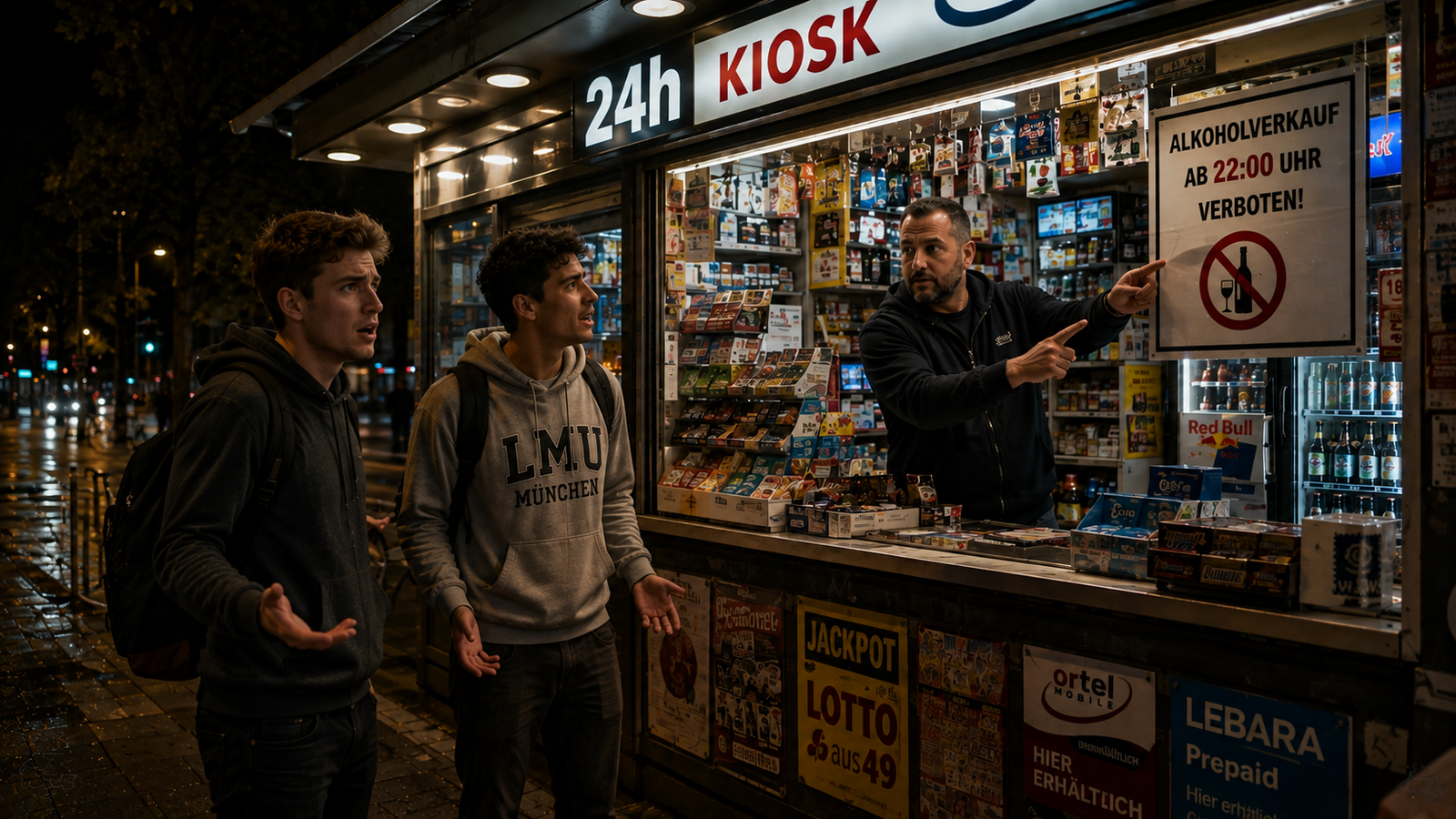

That means that as of this coming Friday, nighttime sales of takeaway beer will disappear from the university quarter entirely – and this time, by all appearances, for good.
The Dispute Ended Without a Court Ruling
The City of Munich announced that two kiosk owners who had challenged the ban on beer sales after 10 p.m. withdrew their lawsuits, thereby effectively acknowledging the legality of the city’s decisions. The Munich Administrative Court had already ruled on the third kiosk, ordering the business to stop selling takeaway alcohol after 10 p.m.
Because the city is required to apply the same rules to every business in the quarter, the decision not to appeal the nighttime alcohol sales ban automatically extended the restriction to all establishments in the district.
Munich’s head of the Department of Public Order, Hanna Sammüller, explained that the municipal orders concerning all the kiosks have entered into legal force and must be enforced. Munich’s mayor, Dominik Krause (Greens), stressed that the court required the city to ensure uniform application of the rules in the university quarter, in the interest of treating all business owners equally.
The Ban Was Imposed, Lifted – and Imposed Again
The saga of the nighttime alcohol sales ban in the university quarter has now run for more than a year, full of unexpected twists.
The most contentious element of this whole affair is the way the very first decision was made. The former mayor of Munich abruptly announced the introduction of alcohol trading restrictions without any public consultation, citing what he claimed were numerous complaints from residents of the district. But as experience shows, his decisions were often poorly justified. Take, for example, the ban on surfing the Eisbach wave and the destruction of the wave itself. Every year hundreds of people die in accidents on the roads, in the mountains, on lakes and elsewhere, yet nobody bans the autobahns, driving, or swimming in lakes. Yet the Eisbach wave supposedly just happened to disappear on its own after a surfer’s accidental death.
At the same time, a ban on surfing was introduced. The whole city pushed back against the decision, but City Hall pointed to supposedly numerous requests from surfers and residents that, in reality, never existed. Apparently, much the same thing happened with the university quarter. To this day, nobody has seen the so-called “numerous complaints” about nighttime alcohol sales, yet the decision was made without any discussion whatsoever. It seems the former mayor badly needed the votes of grandmothers and grandfathers – though even that didn’t help him at the ballot box.
Immediately after the trading restrictions were introduced, Dominik Krause temporarily took over the duties of mayor. And it was he who then lifted the freshly imposed ban, deeming it excessive.
Now, as the city’s full-fledged mayor, Krause finds himself on the other side of the same dispute – and has himself reintroduced the very restrictions he once rejected.
The decisive factor behind the new ruling was a summer lawsuit brought by “Superschmarrn,” an establishment at the corner of Schellingstraße and Amalienstraße that, alongside serving customers in its main dining room, does brisk business in takeaway sales. In late July, the Munich Administrative Court ruled that the ban on alcohol sales between 10 p.m. and 5 a.m. was lawful, though it did overturn a previously imposed fine of 5,000 euros against the business. The court had scheduled hearings for September on three further lawsuits from kiosk owners in the quarter, but these proved unnecessary – the plaintiffs withdrew their claims on their own.
A separate complication in the alcohol sales ban stems from Bavaria‘s retail laws. Unlike many other German federal states, which grant special exemptions for round-the-clock kiosks, Bavaria offers no such relief. After 8 p.m., kiosks may sell only a limited range of goods, and bottled beer, soft drinks, and tobacco products are permitted only at outlets that are simultaneously registered as food-service businesses.
Residents Complain About Noise and Trash
This summer, residents of the quarter again complained about the consequences of nighttime revelry around Schellingstraße (though, as before, nobody has actually seen either the number of complaints or the complaints themselves).
According to City Hall, residents’ main grievances include:
- nighttime noise under their windows lasting until morning;
- urinating in stairwells and courtyards;
- broken glass on sidewalks and in courtyards.
According to Krause, the situation has not improved recently: “Noise, trash and pollution are placing a serious burden on the residents of the quarter.” He had previously acknowledged that he had done a great deal to foster good mutual understanding among residents, kiosk owners, and the partying youth – but that this was precisely what could not be achieved.
Not Everyone Is Happy With the Outcome
Reaction to Krause’s new decision has been mixed, even among supporters of stricter rules. Svenja Jarchow (Greens), chair of the Maxvorstadt district committee, welcomed the uniform application of the ban and expressed hope for more peace and quiet and better mutual understanding in the quarter. At the same time, she added that she would have preferred other, more flexible solutions to the problem – it’s just that no workable alternatives could be found at this time.
Sammüller, for her part, thanked everyone who had spent recent months working to find a balance between the interests of the various parties in the university quarter.
But the appearance of work is not the same thing as work. – Ed.
Why It Matters
The saga of the Schellingstraße kiosks is not just another now-banal local dispute over shop opening hours. It shows how difficult it is for a major city to reconcile two legitimate interests: young people’s right to accessible, lively public space, especially in a university district, and the right of residents – whose complaints nobody has actually seen – to a quiet, clean courtyard of their own.
Apparently City Hall staff have never actually set foot in this quarter – anyone who spends time there daily would notice that the overwhelming majority of the establishments’ patrons are the very residents of the quarter. And neither the noise nor the alcohol sales bother them. So who exactly is bothered? That remains a mystery. – Ed.
Whether the new restrictions will solve the underlying problem in the long run will become clear only next summer. In the meantime, let’s enjoy the bans and restrictions, while the rest of Germany lives freely!