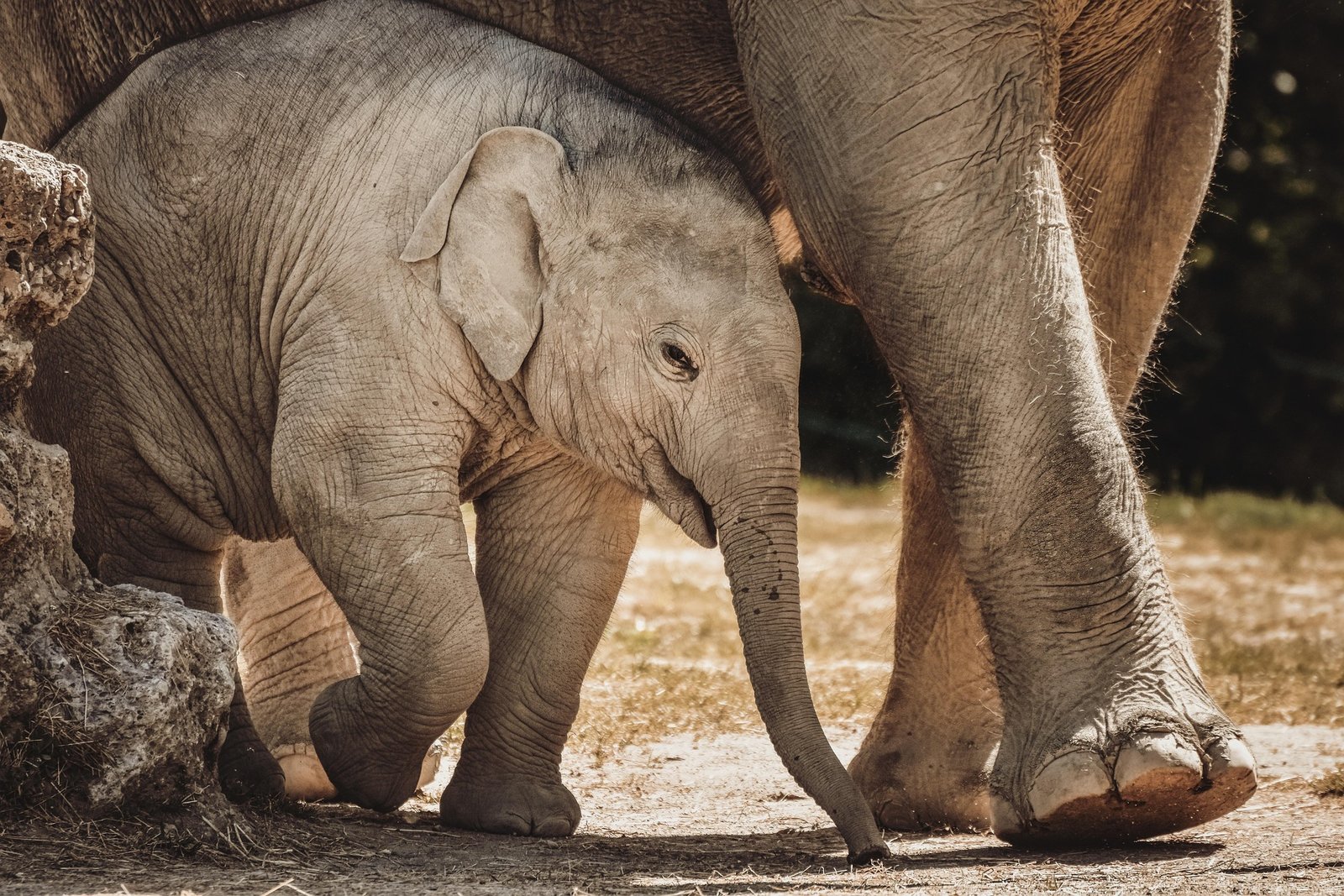

This marks the third consecutive addition to Munich’s elephant herd. Shortly before this happy announcement, the elephant cows Rani and Savani joined the group after relocating to Hellabrunn from Leipzig Zoo.
Birth expected in August 2027
According to zoologists’ calculations, the calf will be born in August 2027. Asian elephant cows carry their young for around 22 months, one of the longest gestation periods of any mammal on Earth, exceeded only by certain whale species.
The newborn calf will weigh between 80 and 110 kilograms. Like most calves of its species, it will stay close to its mother for four to five years, feeding on her milk throughout that time – milk that provides the calf with natural protection against viral infections during its first two years of life.
The shadow of last year
The joy of this news cannot be separated from last year’s tragic events. In June 2025, the elephant calf Otto – Temi’s second calf, born after a 652-day pregnancy – died at Hellabrunn. The cause was infection with elephant herpesvirus EEHV1. The disease progresses rapidly and is most often fatal in young animals.
Symptoms appeared in the four-year-old Otto on a Saturday, and by Monday night veterinarians were unable to save him despite emergency treatment with blood plasma, painkillers and antiviral medication. Shortly before falling ill, Otto had received a new Dutch vaccine against EEHV, and plasma had already been drawn from his father, Gajendra, in case of urgent need.
Zoo director Rasem Baban described those days as a race against time, in which the team of veterinarians, keepers and laboratory staff did everything possible to save the calf. After the loss of the calf, the five remaining elephant cows had to re-establish their hierarchy within the group, a process that did not always go smoothly.
Munich’s Lord Mayor and chair of the zoo’s supervisory board, Verena Dietl, noted at the time that the young elephant had become a true ambassador for his endangered species to thousands of park visitors.
Over time the herd stabilised, despite populist commentary from local officials, though keepers do not rule out that hormonal changes brought on by Temi’s new pregnancy may once again affect the animals’ behaviour – a common feature of elephant groups during such periods.
A species on the brink of extinction
Asian elephants once inhabited vast stretches of territory across Asia. Today the species is considered endangered. Its natural habitat has shrunk by roughly 85 percent, the main cause of the population’s decline. No more than 15 percent of the original population remains, though no exact figures exist – scientists work only with rough estimates.
The bulk of the Asian elephant population survives in India and Sri Lanka. In the wild, elephants live in tight-knit family groups and can live to 70 years old. The herd is typically led by the oldest female, who decides where to move in search of food. Males live apart, alone. Elephants spend most of the day foraging, consuming up to 150 kilograms of plant matter daily.
Why zoos need offspring
Zoo curator Hanspeter Steinmetz stressed: “The regular birth of Asian elephant calves in captivity plays an important role in preserving genetic diversity and stable population numbers within European breeding programmes.” He added: “Temi’s new pregnancy is a good sign, especially as the herd has already grown thanks to the arrival of Rani and Savani.”
Zoo director Rasem Baban noted that for the entire zoo staff, this news carries particular weight after the difficulties of the past year. The birth is still a long way off, but the zoological park intends to monitor Temi’s condition closely throughout her pregnancy.
Why this matters
The shrinking of natural habitat means wild elephants increasingly come into contact with humans, and in such conflicts it is the animals that suffer most, as people gradually take over land where elephants have lived for centuries. Compounding this is the threat of poaching and the illegal ivory trade, which continues to erode an already vulnerable population.
That is why every successful birth at Europe’s zoos, operating under shared breeding programmes, is more than just cause for celebration among staff – it is a contribution to the future of a species that, in the wild, is losing its habitat faster than its population can recover.