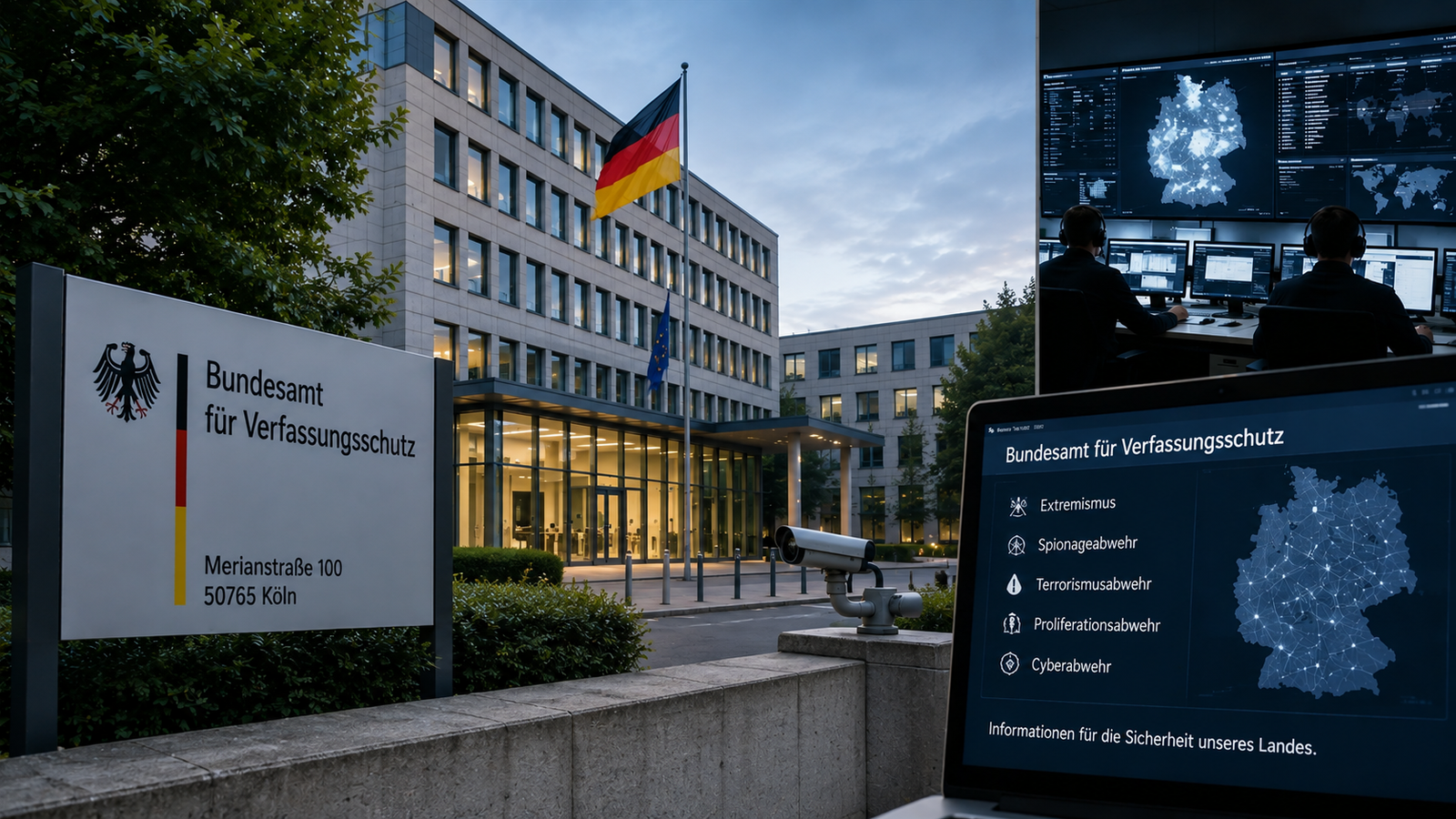

According to Hauser, his organization is currently monitoring 29 people in Bavaria classified as potential Islamist terrorists – so-called “Gefährder.”
Only six are at large
Hauser also clarified his office’s statistics. In total, 29 potential Islamist terrorists have been identified in Bavaria, but only six of them are currently at large.
The remaining twenty-three are either serving sentences or are abroad. The Bavarian Regional Office for the Protection of the Constitution itself – a regional intelligence agency subordinate to the Free State’s Ministry of the Interior – was established in 1950 and has since been responsible for monitoring anti-constitutional activity, including Islamist, right-wing, and left-wing extremist terrorism.
Radicalization occurs primarily through the internet
Hauser named the changing nature of radicalization itself, which is now imposed primarily through the internet, as the main reason the threat of Islamism persists. According to him, the general trend is shifting away from complex, carefully planned attacks toward the actions of lone individuals using simple, readily available means – knives or vehicles.
“We are talking,” Hauser explained, “predominantly about lone individuals who radicalize in isolation, under constant exposure to the internet. This process is fueled by an enormous flow of jihadist propaganda, which is produced, in his words, very professionally, including with the use of so-called ‘artificial intelligence.’ It is therefore extremely important to identify and interrupt such radicalization processes at the earliest possible stage.”
Last year, the Bavarian Office for the Protection of the Constitution, working together with police, in many cases succeeded in uncovering the planning of attacks in advance. As an example, Hauser cited the foiled attack on the Christmas market in Deggendorf – one of the cases in which timely intervention by the security services made it possible to avoid future casualties.
Hauser calls cooperation with foreign intelligence services effective
According to Hauser, the Bavarian authorities have a sufficient legal basis to combat this threat, since state law permits broader powers for the security services than the current federal regulations allow. At the same time, the reform of the federal Act on the Protection of the Constitution currently in preparation could further ease the work of this agency.
Above all, Hauser noted, a significant step forward is possible in the area of information exchange between the police, the Office for the Protection of the Constitution, and other state agencies. He described cooperation with foreign intelligence services as very, very important, noting that in practice it functions effectively.
The BKA points out: the number of potential terrorists is not the main indicator
According to the Federal Criminal Police Office of Germany (BKA), as of July 1, 410 people are registered nationwide as potential Islamist terrorists. By comparison, 65 potential terrorists have been identified in the area of right-wing extremism, and only 17 in the area of left-wing extremism.
Potential terrorists (in German, Gefährder) are people from whom the security services expect the commission of serious, politically motivated acts of violence, up to and including terrorist attacks. The decision to place a specific individual on this list, or to grant them the status of a so-called “relevant person,” is made independently by the respective federal states.
At the same time, the BKA emphasized that the figures alone do not allow conclusions to be drawn about the level of threat. The number of potential terrorists and relevant persons does not reflect the actual scale of danger in a given area of extremism.
In light of the above, it can confidently be said that the statements made by representatives of the Bavarian Office for the Protection of the Constitution confirm the general dynamic that the security services have been describing for several years now. The threat of Islamist-based terrorism in Germany is not decreasing but is changing form, shifting from organized terrorist cells to radicalized lone individuals. These lone individuals typically act under the influence of internet propaganda.
They are therefore the most dangerous for ordinary citizens. It is precisely this shift in the tactics of terrorists, in the view of the security services, that requires earlier intervention and closer coordination between government agencies both within the country and beyond its borders.
Source: AFP