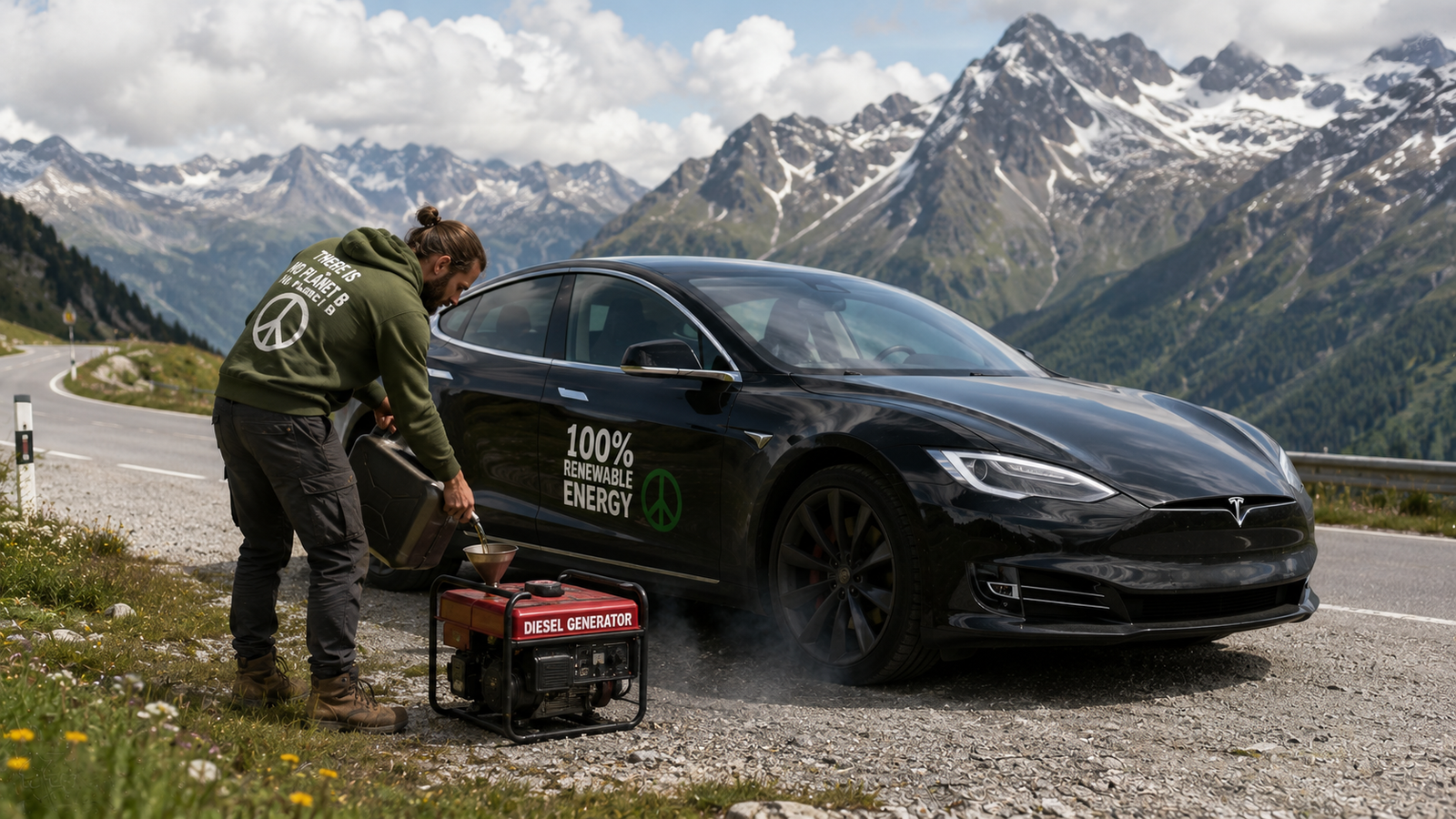

So how environmentally clean are electric vehicles, really? Scientists at the Technical University of Munich (TUM) examined the scientific research and concluded that the EU automotive industry’s climate regulation system is built on incomplete data. More precisely, on rigged, manipulative data.
The Essence of the Complaints Against the EU Council’s Methodology
The authors analysed 19 international studies and 47 scenarios for the development of the European vehicle fleet in order to compare the full carbon footprint of electric vehicles and internal combustion engine vehicles. Their conclusions fundamentally diverge from Brussels’ official position. As of today, the methodology for assessing the harm caused by an electric vehicle is estimated at zero grams of CO2 per kilometre, since only the act of driving itself – and only gas emissions – are taken into account.
But the following remain outside the field of view of official statistics:
- Extraction of raw materials and production of steel, aluminium, other metals and plastic with imitation leather for the vehicle;
- Glass production;
- Production of the onboard computer and other electrical equipment plus wiring;
- Extraction and production of lithium for battery cells;
- Subsequent disposal of battery cells;
- Extraction and processing of raw materials for electricity generation;
- Emissions from generating the electricity used to charge the electric vehicle;
- Subsequent disposal and recycling of the vehicle.
Taking the full life cycle into account, an electric vehicle reduces CO2 emissions by an average of only 41% compared to an internal combustion vehicle – not by 100%, as the current methodology implies.
At the same time, the benefits that the current version of the so-called EU “automotive package” grants manufacturers for low-carbon steel and alternative fuels cover, according to the TUM researchers’ study, no more than 10% of the required emissions reduction.
Why the Electric Vehicle Is the Greatest Fraud in Human History
The electric vehicle is customarily presented as a technology that will save the planet: supposedly “zero emissions,” “the clean transport of the future,” “a green alternative to petrol.” Yet these slogans rest on a single assumption – that a vehicle’s carbon footprint begins and ends at the operational stage. One need only broaden the scope of analysis to the entire life cycle (that is, apply generally accepted analytical methods – mathematics) for the picture to stop looking so unambiguous.
The Hidden, Non-Environmental Footprint of Production
Metal, plastic, electrical equipment, glass and the vehicle’s interior trim – do they simply appear out of nowhere? The technology for producing an electric vehicle body requires quality steel and aluminium, and other alloys, no less than its petrol counterpart – and often more, because of the weight of the battery pack. The mining of ore, smelting of metal, and production of plastic trim and small parts with imitation leather upholstery, the production of electronics using rare-earth metals as well, and the lithium battery – the production of all of this is accompanied by significant CO₂ emissions, comparable to those of the classic auto industry.
Glass. Manufacturing automotive glass is an energy-intensive process. The raw material is melted at temperatures above 1,500°C, which requires significant volumes of fossil fuel and electricity. The environmental friendliness of an electric vehicle is no different here from that of an ordinary car – the glass is produced using the same technology for both types of transport.
Electronics and wiring. An electric vehicle is packed with more electronics than an ordinary car: onboard computers, sensors, power electronics and kilometres of wiring. Their production requires rare-earth metals, rubber and copper, the extraction of which causes serious environmental damage in the regions where it takes place – and even more so during the processing of the raw materials.
Lithium for batteries. Lithium extraction is one of the most water-intensive industrial processes. Up to 2 million litres of water are used per tonne of metal, depleting the already scarce reserves in the arid regions of Chile and Argentina and destroying salt-flat ecosystems. Lithium extraction also destroys entire mountain massifs, forests and so on, since lithium is most often mined by open-pit methods rather than in shafts. Lithium production requires substantial amounts of electricity. And given the countries where lithium is extracted, one can safely say there is an absence of exhaust-gas filtration following lithium production.
Battery disposal. Spent batteries contain toxic compounds of cobalt, nickel and lithium. Full-scale recycling is still poorly established. Most batteries are either disposed of at high cost or remain in storage, posing a long-term threat to local flora and fauna.
Raw materials for energy. To charge an electric vehicle, electricity is needed, and its production begins with the extraction of coal, gas, oil (for fuel oil) or uranium. These are the same quarries, mines and pipelines as in classic energy production – simply moved outside the field of view of the European vehicle owner.
Emissions from electricity generation. The burning of coal, fuel oil and gas at power plants releases CO₂, sulphur oxides and nitrogen oxides into the atmosphere – exactly like an internal combustion engine, only not in the owner’s yard, but many kilometres from home, at a thermal power plant. Out of sight, so it doesn’t exist? What’s more, according to the latest research, over 90% of the electricity produced on our planet still comes from gas, coal, fuel-oil and similar power plants.
Vehicle disposal. At the end of its service life, an electric vehicle, like an ordinary car, must be dismantled and recycled. But an added complication arises: dismantling the high-voltage system and disposing of the battery require special additional technologies that simply do not exist in many countries.
The Battery – the Weak Point of Ownership Economics
Unlike a classic vehicle, whose service life is determined primarily by the engine, an electric vehicle depends entirely on the condition of its battery. And batteries, like any electrical device, wear out: the battery’s capacity falls with every charge-discharge cycle. After five to seven years of active use, the owner typically has to replace the battery – which amounts to around 30% of the cost of a new electric vehicle. At the same time, selling a used electric vehicle with a worn battery is practically impossible. The buyer either demands a substantial discount to cover the future replacement, or refuses the deal altogether. As a result, an electric vehicle loses residual value far faster than its petrol or diesel counterpart.
What the “Clean” Car Is Really Charged With
Electric vehicle owners tend to picture the charging process as something neutral – just a socket, just electricity. But electricity doesn’t come from nowhere. According to the International Energy Agency, in 2025 coal remained the world’s largest source of electricity, providing around 34% of global generation – a position it has held for over half a century. Natural gas adds a further 21-22%, and petroleum products several percentage points on top. In total, fossil fuels account for around 73% of all electricity generated worldwide (including nuclear energy in that calculation).
Nuclear power provides around 10% of global electricity generation – a market share that has noticeably declined over the past twenty-five years. The remainder is covered by renewable sources: hydropower (around 9%), wind (around 8%), solar (around 7%) and bioenergy (around 3%). At the same time, in the largest developing economies dependence on coal is significantly higher than the global average: in China coal accounts for around 70% of electricity generation, and in India almost three-quarters.
In other words, two-thirds of the electricity used to charge the so-called “environmentally friendly” electric vehicle is produced at the very same coal, fuel-oil and gas power plants that are conventionally regarded as the source of the problem rather than its solution. From the atmosphere’s point of view, there isn’t much difference between burning petroleum products in a car engine and burning coal in a power-plant furnace – it’s simply that in the second case, the power plant’s chimney has been moved further away from the logic of eco-activists.
Six of One, Half a Dozen of the Other
Adding up every stage of an electric vehicle’s life cycle – from ore and lithium extraction to battery and vehicle disposal – it is difficult to claim that an electric vehicle is unambiguously cleaner than its petrol counterpart. It shifts the environmental burden along the chain: from the exhaust pipe to the mine, from city air to the power plant’s industrial zone. The consumer, meanwhile, is left with an illusion of personal freedom from responsibility for emissions, even though on a planetary scale the footprint remains comparable – and at times heavier – simply invisible to the activist’s eye.
Why the EU’s Targets May Prove Unattainable
If official Brussels continues to rely solely on activists’ data on exhaust emissions, the Union’s climate targets will be at risk of failure – this is precisely the conclusion the study’s authors reached. The current plan calls for a reduction in net greenhouse gas emissions of at least 55% by 2030 compared to 1990 levels.
But the problem lies in the structure of the vehicle fleet. Even four years from now, around 78% of all vehicles on Europe’s roads, according to the forecasts of genuine specialists – that is, scientists – will still run on internal combustion engines. Under such circumstances, the stated emissions-reduction target will remain unattainable regardless of the pace of the transition to electric transport.
TUM President Thomas Hofmann, who initiated the study, insists that the scientists’ conclusions must be placed on the agenda for discussion before the European Parliament’s vote on the so-called “Automotive Package,” scheduled for 23 November 2026. It is then that MEPs and the EU Council will decide how to further regulate climate requirements for automakers. The European Commission presented the bill reforming Regulation (EU) 2019/631 last December.
And it still remains unclear why the EU Council keeps repeating the legends spun by Musk and his activists for the sake of superprofits, rather than listening to scientists. Why Tesla, and after it other, better-made electric vehicles, were taken as the basis for climate policy – rather than the hydrogen engine, which is in fact genuinely environmentally clean.
Why This Matters
The work of the Munich scientists does not deny the partial climate benefit of electric vehicles in the short term – this is confirmed by their own statistics. The point is something else: the current emissions-counting methodology creates a distorted picture of reality, one capable of leading to incorrect decisions in the auto industry, metallurgy and the energy sector. Decisions that allow an American oligarch to reap superprofits, but do not solve the environmental problem in the long term, when the time comes to dispose of batteries and electric vehicles.
The topic of the so-called “environmental friendliness” of electric vehicles remains a matter of dispute between proponents of a complete switch to electric drive (most often poorly educated activists) and those who insist on a comprehensive calculation of a vehicle’s carbon footprint, from raw-material extraction through to disposal. November’s vote in the European Parliament will show whether the Munich scientists’ conclusions influence the EU’s future climate policy – or whether our MEPs are so bought off by the Musk lobby that, behind the guise of environmental concern, they see no one around them but themselves, least of all the scientists.
Source: epd