
This time, the Moon will enter Earth’s shadow. Those who want to see the total lunar eclipse over Munich with their own eyes will have to wake up before dawn, as the observation window this time is very short and falls during the pre-dawn hours.
Why the eclipse is called total
A lunar eclipse occurs when the Sun, Earth, and Moon align in a straight line, with Earth positioned between the Sun and the Moon. This is the main difference from a solar eclipse, where the Moon passes between Earth and the Sun. On August 28, the Moon will pass through Earth’s shadow so deeply that according to NASA data, the eclipse magnitude will be about 0.93 points. This means that at peak darkness, approximately 93 percent of the lunar disk will be in shadow.
If we consider visible surface area rather than the diameter of the lunar disk, the darkness index will be even higher – about 96 percent of the Moon’s surface will plunge into darkness. Still, the eclipse will not become 100% total: a narrow bright strip along the edge of the disk will remain throughout the entire astronomical event. Because of this, the classic red “blood” tint that the Moon acquires during a total eclipse should not be expected this time. Shadow will cover almost the entire surface of the Moon, but unfortunately not all of it.
Timeline for the morning of August 28
The first phase of the eclipse will begin while it is still dark and remain practically invisible to the human eye.
The main astronomical action will unfold later, closer to dawn:
3:23: Moon enters Earth’s penumbra, phase is barely visible to the naked eye
4:33: Moon reaches the darker part of the shadow, partial eclipse proper begins
6:12: Eclipse peak, Moon stands low above the horizon
6:32: Moonset in Munich
7:51: End of the partial phase, no longer visible from Munich
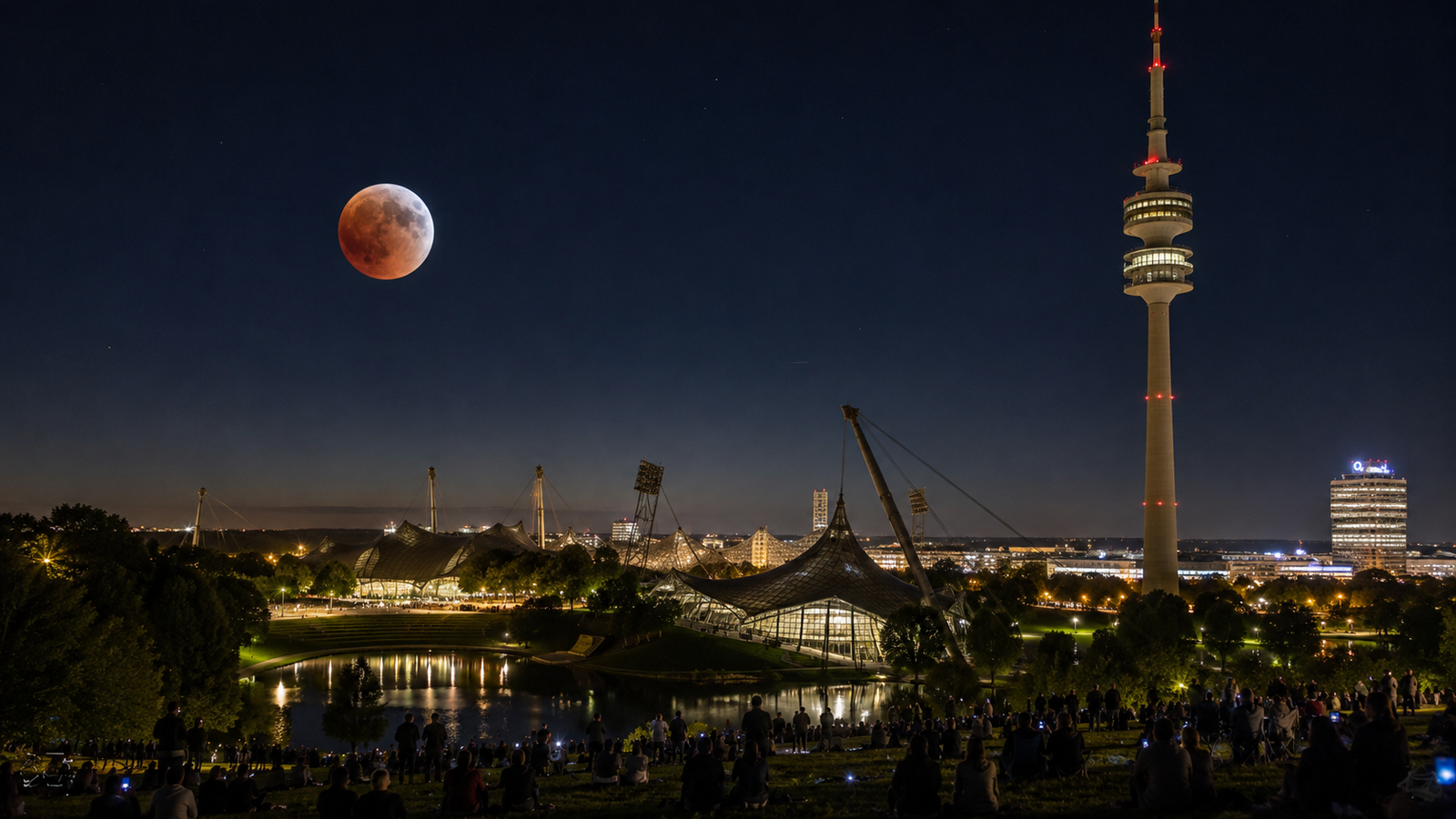
By the time of peak darkness of the lunar disk at 6:12 AM, the Moon will drop to about two degrees above the horizon in the west-southwest direction. Twenty minutes later it will disappear behind the horizon, and Munich residents will not be able to watch the end of the lunar eclipse completely, as the conclusion at 7:51 cannot be seen from our city.
Best places to watch
Munich City Hall representatives suggested Olympiaberg and Fröttmaninger Berg as primary locations for viewing celestial phenomena. Both spots previously gathered spectators during the solar eclipse on August 12 as well as for observing the lunar eclipse last year, when many people also chose Riemer Berg.
No special protection needed
Unlike a solar eclipse, where looking at the Sun without protective glasses is dangerous, a lunar eclipse is completely safe for the eyes. You can watch it with the naked eye, and binoculars or other optical devices require no special filter for light radiation that could damage eyesight.
How rare is this phenomenon
The last total lunar eclipse occurred in early September last year and fell during evening hours. Observing it was noticeably easier than the upcoming August lunar eclipse. According to astronomical calculations, through the end of 2028, no deeper partial lunar eclipse will occur over Germany with such a large portion of the lunar disk in Earth’s shadow.
Munich’s calendar for viewing celestial events does not end here. For example: the next solar eclipse over the city is expected on August 2, 2027.
A total lunar eclipse will be visible over Munich on August 28
Two weeks ago, thousands of Munich residents climbed Olympiaberg to watch the solar eclipse. And this Friday, August 28, the sky over the city will show Munich residents a new astronomical spectacle. This time, the Moon will enter Earth’s shadow.