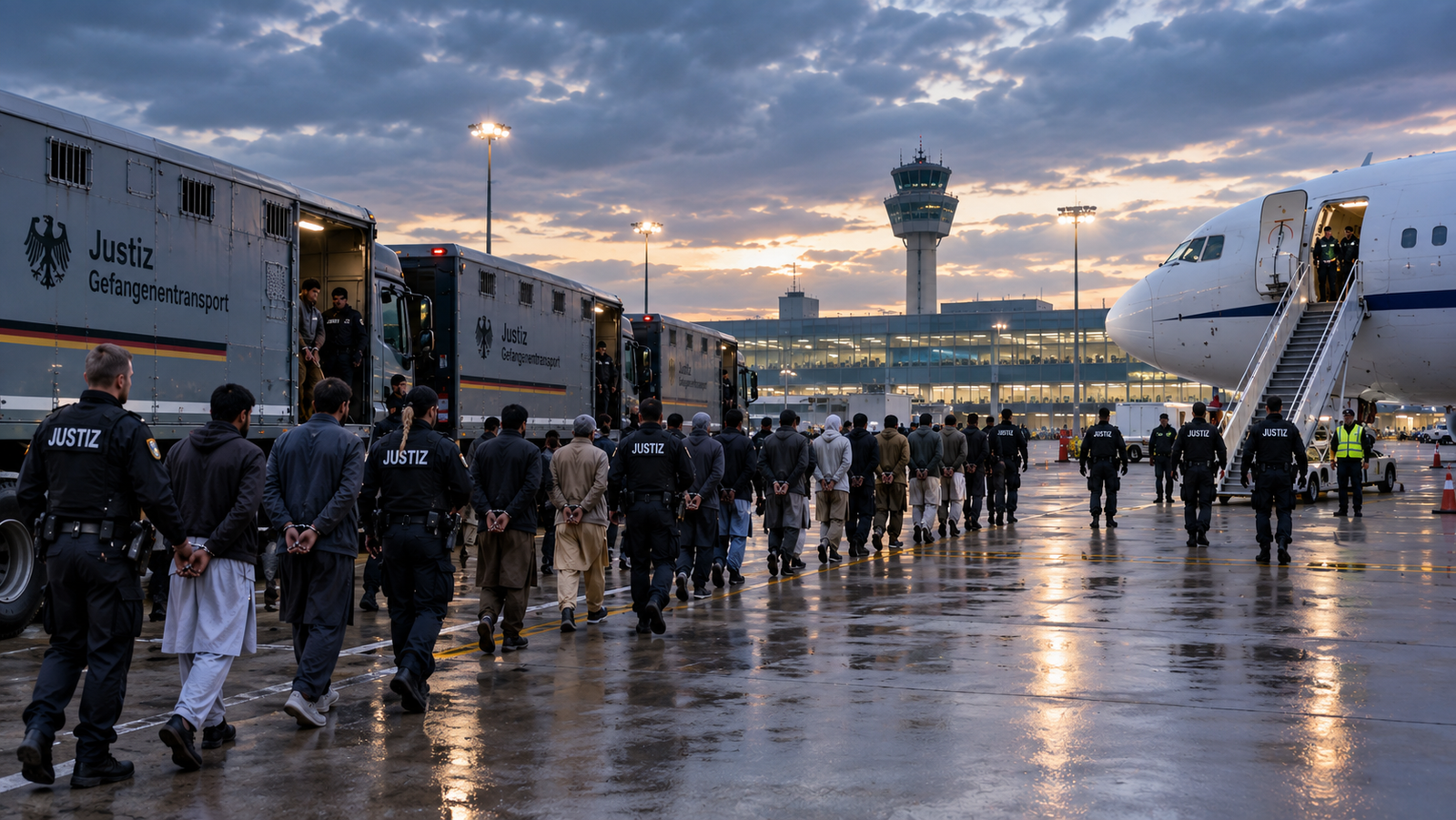

This was by no means the first such flight for Germany. The flight continued a series of deportations that the federal government has been ramping up in the face of protests from ultra-left activists.
Who was on board
According to a spokesperson for the Federal Ministry of the Interior, most of those deported were convicted criminals who had served sentences for serious offences, including sexual assault and causing bodily harm. The remaining passengers on the flight had also previously come to the attention of law enforcement. The Ministry described the deportation as having been carried out successfully.
The Bavarian Ministry of the Interior confirmed, in response to a query from broadcaster BR, that five Bavarian residents were among those deported, adding: “In all five cases, these were convicted criminals.”
In addition to the Bavarian residents, the flight also returned former residents of five other federal states to their country of origin:
- Baden-Württemberg
- Hessen
- Lower Saxony
- North Rhine-Westphalia
- Rhineland-Palatinate
228 deportees
Federal Interior Minister Alexander Dobrindt (CSU) wrote on the platform X that it is in society’s interest for criminals to leave the country. He stressed: “A person with no right to remain in Germany must be prepared to leave it, and the government is consistently pursuing this course.”
According to the Ministry spokesperson, a total of 228 Afghan male nationals have been deported from Germany to Afghanistan since the start of the current Bundestag term.
According to politicians from the Left Party faction: “The paradox is that the overall number of deportations from Germany actually fell in 2026. According to the government’s response to a query from the Left Party faction, 9,700 people left the country in the first half of the year – 18.2 percent fewer than the year before. The reason is a drop in the number of asylum applications. Since the start of 2025, noticeably fewer asylum seekers have applied to enter Germany.
At the same time, around 259,000 people obliged to leave German territory were in the country at mid-year; 77% of them held “tolerated” status, meaning their deportation is temporarily not possible for various reasons.
Each charter flight to Afghanistan is far from cheap for the budget: two such flights, in April and June, cost more than 300,000 euros each, without any financial contribution from the EU border agency Frontex.
Resistance is also growing at a technical level: in the first half of 2026, pilots refused 280 times to carry passengers facing deportation on scheduled flights. For the whole of 2025, there were 514 such cases. The government states that it does not keep statistics on the reasons for refusals to carry this category of passenger.”
But there is also the question that this particular flight was carrying criminals, while the Left Party faction is citing general asylum-seeker statistics. It is not clear by what logic they are connecting the two. (- Ed.)
A shift towards regular flights
In mid-June, the Federal Ministry of the Interior announced its intention to expand deportations of criminals to their home country. According to information obtained by journalists, up to three charter flights a month are now planned going forward.
This is based on arrangements with the Taliban, who in practice control Afghanistan. Official Berlin is conducting direct negotiations with them, while refusing to recognise their government as legitimate.
“On the previous flight, at the end of July, 31 people were deported to Afghanistan. Among them, for the first time, was an Afghan who had committed no crimes but was nevertheless subject to deportation from the country,” Dobrindt explained at the time.
The first collective deportation of Afghan criminals was organised two years ago, in August 2024, with Qatar acting as intermediary. That flight from Leipzig took 28 people on board, at a time when Nancy Faeser (SPD) held the post of Interior Minister. Almost a year’s pause followed that flight, broken only under the new government of Chancellor Friedrich Merz. The next flight carrying out criminals, also organised with Qatar’s involvement, deported 81 people from the country. Since then, the frequency of flights has gradually increased, and the present one, with 23 passengers on board, is one of those planned for this year.
Criticism of deportation policy
Bundestag member Shahina Gambir of the Greens criticised the government’s arrangements with the Taliban: “Instead of standing up for human rights, this government is fighting only for its own deportation policy.”
Perhaps it’s time to remind the ultra-left and the Greens that human rights apply only up to the point where a person breaks the law? Or does she intend to release every criminal from prison over a supposed violation of their right to choose their place of residence and freedom of movement? (- Ed.)
On Monday evening, a protest against the upcoming deportation took place at Leipzig Airport. According to the organisation “Alliance Against Deportations,” as many as 50 people took part. Alliance spokesperson Kai Adeel stated: “People from Afghanistan who sought protection here are today being deported into the Taliban regime, where discrimination, torture or even death await them.” He described what was happening as extremely dangerous for the deportees.
It’s time to remind these activists that the democracy behind which they hide their minority position is rule by the majority, not rule by 50 people over an entire country. (- Ed.)
Afghanistan is experiencing a humanitarian crisis
Afghanistan, with a population of more than 48 million, is in the grip of a severe humanitarian crisis. The UN World Food Programme recently warned that malnutrition levels in the country have reached unprecedented levels. According to the International Labour Organization, only around 33 percent of Afghanistan’s working-age population is employed.
Human rights defenders report a rise in the number of public floggings in the country. The Canadian organisation Afghanistan Human Rights and Democracy Organization (AHRDO) provided the following figures:
- 593 cases of flogging recorded in 2024;
- the number rose to 1,100 in 2025;
- 553 cases already recorded in the first four months of this year.
According to this organisation, most of the floggings documented between February 2022 and April 2026 were imposed for extramarital relationships, alleged sexual offences, and homosexuality.
Why this matters
Germany finds itself in a situation where the practical logic of a deportation policy aimed at removing convicted criminals with no right to remain in Germany has run up against protests from a few dozen activists. The populism of these activists, and its support from certain Bundestag members, is unsettling the government. As is well known, our government lacks the political will to run the country without bending to blackmailers and populists. Official Berlin is holding direct negotiations with an authority it itself refuses to recognise as legitimate, and is planning to triple the number of deportation flights. But the practice of conducting secret negotiations for the sake of extraditing criminals is standard the world over. It’s a shame these activists’ lack of education prevents them from understanding this. And populism, after all, is loud criticism of everything, without offering any solution to the problem.
Germany stands at a crossroads. Either we rid ourselves of populists in power and stop letting a couple of neighbourhood activists dictate life for an entire district and city to suit their views, or we sink to the level of third-world countries. Not tomorrow, not next year – but the history of humanity clearly shows where such domestic policy leads.