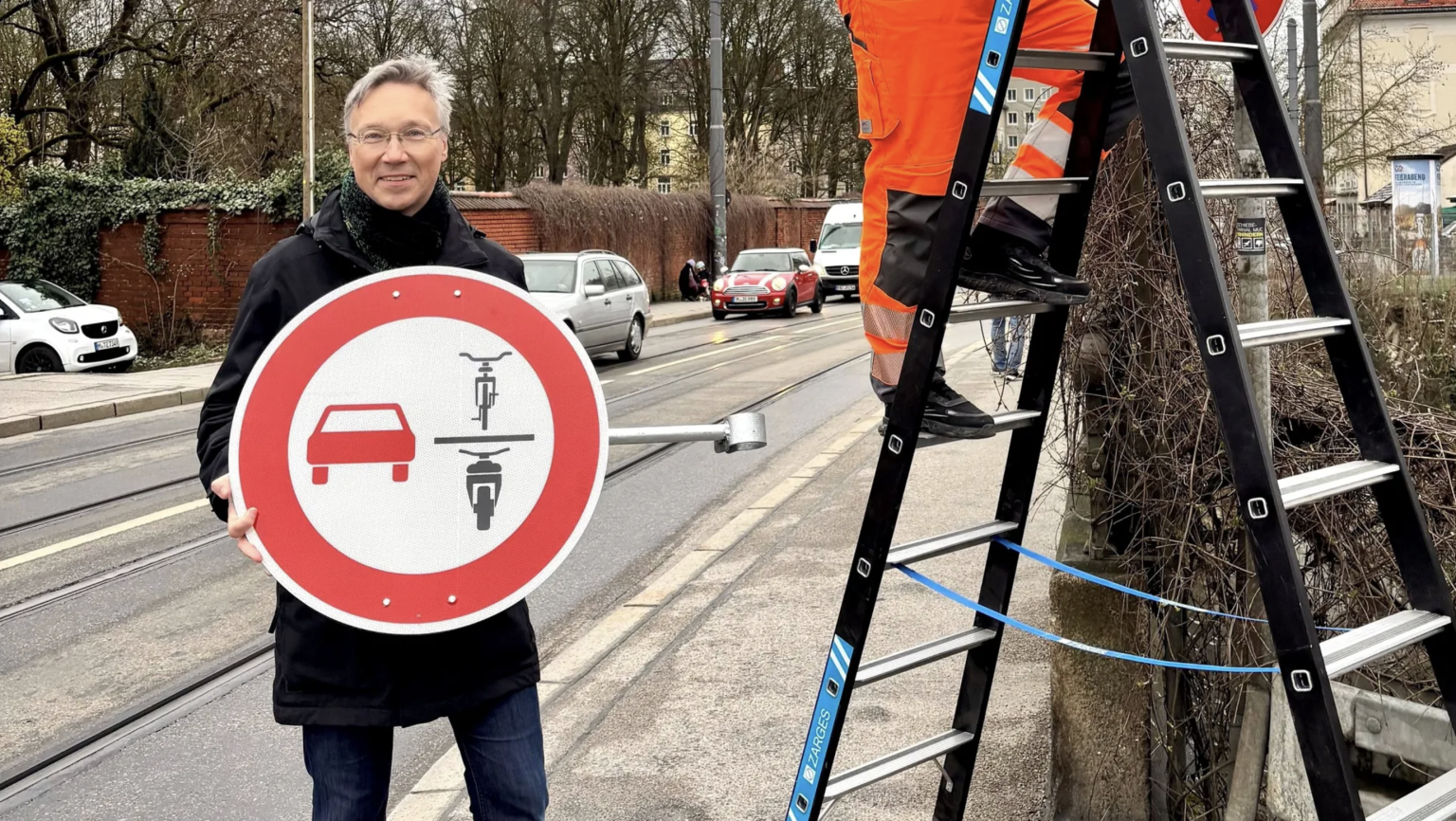

Complaints from local residents and press coverage have for years described this stretch as one of the most contentious spots in Munich‘s pedestrian infrastructure. This week, city authorities finally began installing new signs and markings here – but whether this will actually solve the problem, given cyclists’ tendency to disregard other road users and their blanket disregard for traffic rules, is something nobody is prepared to say, including City Hall itself.
The decision to begin restoring order in the Laim tunnel came out of the work of the “Laim Tube Round Table,” which included the mobility officer, the building officer, the disability advisory council, and the police.
We should note that the Laim tunnel, under an earlier City Hall decision, has pedestrian-only status. At the same time, a bike path leads to the tunnel from both entrances. Inside the tunnel itself, cyclists have taken over exactly half the tunnel’s perimeter as bicycle parking, leaning their bikes against the walls but perpendicular to them. Cyclists have divided the remaining stretch themselves into a lane for bikes and a separate one for pedestrians. Meanwhile, a sign at the tunnel entrance states that this is a pedestrian zone. But as is well known, for our cyclists, neither the law, nor traffic regulations, nor signs – not even a clip round the ear – carries any weight.
What Will Change in the Passage
On the north side of the passage, signs marked “25 metres” and “40 metres” will appear, indicating the distance to the end of the bike lane; on the south side, a similar sign will read “20 metres.” At the tunnel entrances and inside the tunnel itself, signs reading “Walking pace” will be installed against a bright yellow background.
The markings will be supplemented with pictograms of pedestrians and cyclists, along with the words “Walking speed.” According to City Hall’s thinking, visual cues are supposed to work faster than text warnings: a cyclist is presumably meant to see the special symbol and, naturally, will react automatically, without wasting time reading the sign. And perhaps will even comply with the requirement.
Naive City Hall officials – or perhaps cyclists themselves, the very sort who break Germany’s laws. – Ed.
A Tunnel With a Complicated History
The Laim tunnel opened back in 1891 as a replacement for an at-grade railway crossing. It runs beneath the railway tracks from the Laim side toward Nymphenburg. Originally it had only a single tube, but as the number of cars on the roads grew, residents nicknamed it the “Laim Poison Tube” – for the exhaust fumes supposedly accumulating in what was thought to be an enclosed space. In reality, there is a constant draught through this tunnel, and no fumes accumulate there at all.
The second tube, used today by pedestrians and cyclists, was only built in 1988. The passage is about 225 metres long, and its cramped conditions are largely what has caused the current conflict created by cyclists.
Cyclists Are Guests in Pedestrian Territory
Legally, the passage has long been classified as a pavement bearing a sign reading “Cycling permitted.” This means cyclists are obliged to take pedestrians’ interests into account, avoid obstructing them, and travel no faster than 5-7 km/h – essentially, walking pace. In other words: cyclists have the right to use the tunnel provided this does not inconvenience pedestrians, and naturally without having right of way or the right to ring their bells at other road users and demand they give way.
To remind people of this generally accepted rule, special banners will be hung at the tunnel entrances in the coming weeks. This autumn, an event will be held here as part of the “Travelling Together, With Respect” campaign, dedicated to mutual respect on the road. Will this help, when even “physical correction” hasn’t worked on the most brazen of cyclists?
Abandoned Bicycles Removed From the Passage
At last, order and cleanliness will be restored to the tunnel. In July, the company P+R Park & Ride launched an initiative called “Radlramadama,” under which the company is to clear illegal bicycle parking in the tunnel of abandoned and defective bikes:
- 125 presumably abandoned bicycles;
- 1 bicycle fit only for scrap.
According to City Hall, this will make the parking areas in the passage tidier and more orderly. Previously, frames and wheels piled against the walls narrowed an already cramped passage. On the other hand, City Hall has arguably legitimised illegal parking along the tunnel walls, and new bikes will simply take the place of the ones removed. Indeed, cyclists have already begun parking their bikes even in the middle of the passage to the suburban rail station, well away from the illegal parking area.
Permanent Separation of Traffic Flows Not Before 2028
Fully separating bicycle and pedestrian traffic in the tunnel will only be physically possible once construction of the so-called “environmental tube” (Umweltverbundröhre) is complete – expected by the end of 2028. The new tube is meant to take on part of the traffic flow.
Until then, the new signs and markings will presumably remain the main tool for reducing conflicts between cyclists and other road users. In other words, the city has acknowledged that the problem exists and has finally placed responsibility on those actually at fault, rather than politicians inventing excuses, as before, for why cyclists behave this way toward others. At the same time, however, a technical solution has been postponed for years, and the current measure is a temporary one, banking on a nonexistent sense of conscience among cyclists rather than on physically separating the flows.
Why This Matters
The situation in the so-called “Laim Tube” shows what Munich is now forced to deal with, thanks to years of City Hall’s leniency, its habit of listening to activists rather than experts, and the fact that, although city authorities acknowledge the problem exists, they have no real intention of solving it physically any time soon. It would seem our Mayor is very afraid of hurting the feelings of the many members of his own party who happen to be exactly the cyclists that all of Laim – and not only Laim – is outraged by.
A space designed more than a century ago for entirely different purposes is now forced to accommodate both pedestrians and cyclists. And that would be fine, if not for the antisocial, and at times criminal, behaviour of cyclists. Until a full reconstruction of the tunnel is complete, markings and signs remain the only available tool – though most likely not an effective one.
City Hall has called the current measures an important step toward getting cyclists to pay closer attention to pedestrians in the passage. The problem situation will continue to be monitored even after the work is finished – especially by our reporters. The installation of the warning signs was deliberately scheduled for the holiday period, when traffic through the passage is lower than usual, which should reduce inconvenience for everyone.
Source: City of Munich (Landeshauptstadt München)