
The vote passed despite open objections from Munich’s Lord Mayor and organisations working with refugees — though the composition of the board had made the outcome predictable long before the meeting itself.
The project did not emerge in a vacuum.
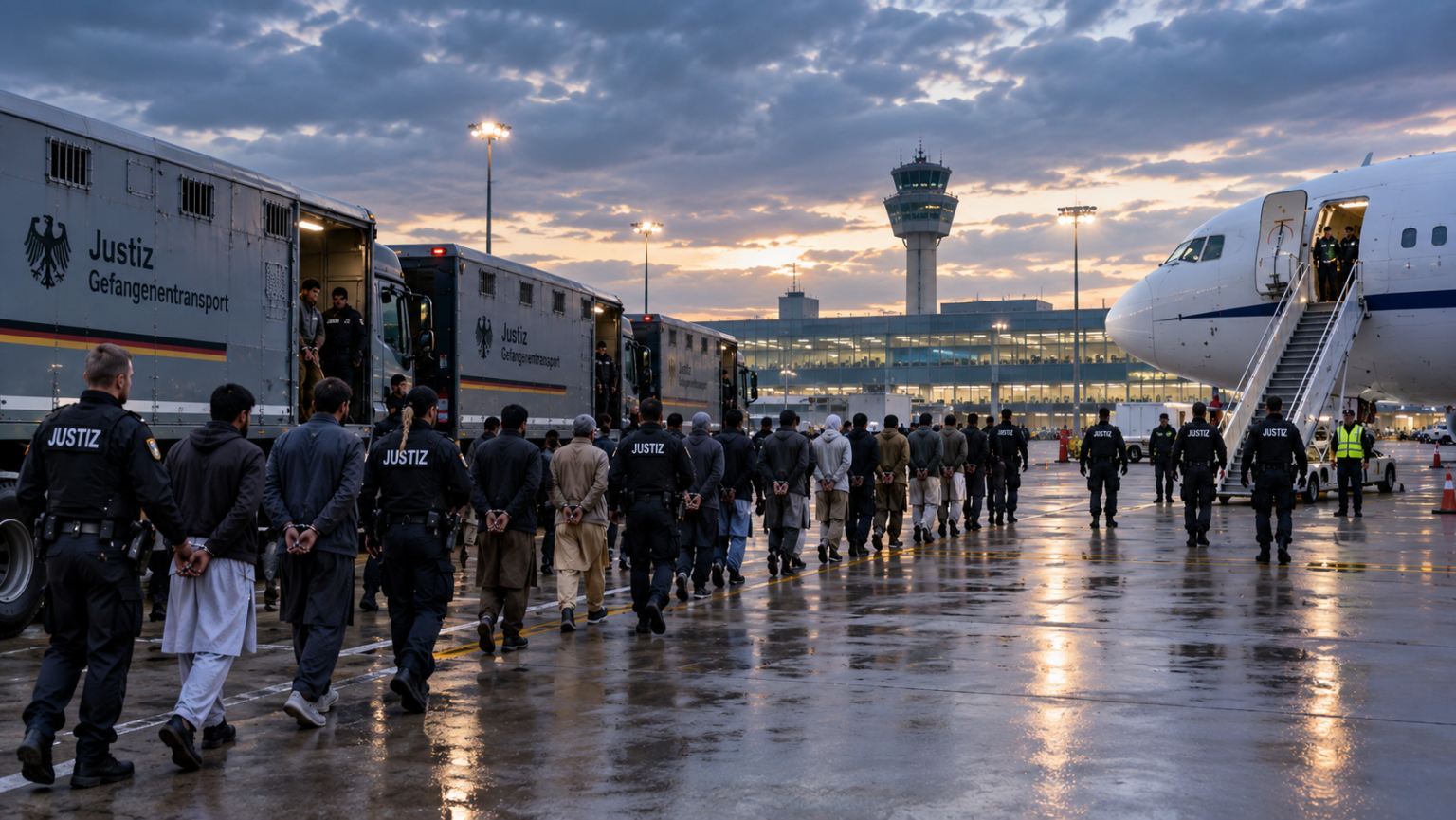
Deportations from Germany have risen for the fourth consecutive year: according to the Federal Ministry of the Interior, around 23,000 people were forcibly removed from the country in 2025 — 15% more than the year before, and nearly half again as many as in 2023, when the figure stood at 16,000. Meanwhile, the pool of individuals slated for deportation but still remaining in the country is estimated at nearly 220,000 — a figure cited by Die Welt with reference to the Interior Ministry, which explains the logic behind the project: existing airport infrastructure clearly cannot handle the load the authorities plan to place on it.
Terminal Specifications
The capacity of the new facility has been calculated in advance, and quite precisely. According to the Federal Ministry of the Interior, the terminal will be able to process up to 100 people per day departing on scheduled flights, with provision during peak periods for two charter flights daily dedicated solely to group deportations. In other words, this is not a temporary measure but a permanently operating hub, designed for a growing rather than shrinking flow of deportations.
It is precisely this scale that has caused the greatest concern among the refugee aid organisations opposed to the construction. Their concern is stated with striking clarity: a terminal conceived as a Bavarian and federal project could, over time, come to serve the deportation flows of neighbouring EU countries, turning into a transit hub for expelling migrants from far beyond Germany’s borders. Ahead of the meeting, human rights advocates appealed to board members to reject the project — the appeal went unheeded.
The Airport’s Position: Infrastructure Only
The management of Flughafen München GmbH, the airport’s operating company, has sought from the outset to distance itself from the political substance of the project. According to the company, the building will be constructed using the airport’s own funds and then transferred under a long-term lease to the federal government; the terminal will be operated exclusively by the Federal Police.
The wording here is essential: the airport insists on its role as developer and lessor, not as organiser of deportations — responsibility for the flights themselves and the deportation procedure rests entirely with the federal police authority. At the meeting, this division of roles was confirmed through two separate votes: the board approved both the construction contract and the lease agreement, treating the two documents as a single package.
The Lord Mayor’s Protest Failed to Change the Outcome
Ahead of the meeting, Munich’s new Lord Mayor, Dominik Krause, of the Greens, publicly announced his intention to vote against the project. “Mass deportations must not become part of Munich Airport’s business model,” he told the newspaper Abendzeitung, stating the city administration’s position in the starkest terms. This statement turned a vote that had until recently been described as a formality into a matter of close press attention in the final days before the meeting.
But the city’s position could never have swayed the outcome — the reason lies in the airport’s ownership structure. The controlling stake belongs to the Free State of Bavaria — 51% — with a further 26% held by the German federal government, and only 23% by the city of Munich itself. Bavaria and the federal government thus jointly hold a stable majority on the supervisory board, which also includes several union representatives, leaving the city’s vote purely symbolic on any decision of substance.
Construction of the terminal is scheduled for completion by 2028. If the current pace of deportations continues, and the pool of 220,000 people awaiting removal fails to shrink, the new facility will become not a one-off political decision but a permanent element of infrastructure shaping Germany’s migration practice for years to come.
Sources: dpa, AFP, Reuters