
Seated at the negotiating table will be 17 interior ministers of EU member states and EU Commissioner for Migration Magnus Brunner; the participation of Irish Minister for Justice Jim O’Callaghan is also expected. The occasion for the new meeting is the outcome of a year in which EU migration law changed more than it had over the preceding decade as a whole – and it is precisely these changes that have set the agenda for today’s meeting.
What has changed in the year between the two meetings
The year separating the first Munich summit devoted to migration from the second has proven pivotal for EU migration policy. Back in February, the European Parliament removed the so-called connection element from the legislation – the requirement under which an asylum seeker could only be deported to a third country if they had a demonstrable connection to it. That condition no longer exists.
On 12 June, a reform of far greater scope entered into force – the Common European Asylum System, known by the abbreviation GEAS.
It is meant to change all three pillars on which the previous system rested at once:
- the procedure for registering and reviewing applications is now uniform across all EU member states and provides for an accelerated procedure;
- the Dublin rules for determining the responsible state have been replaced by a new mechanism;
- control of the EU’s external borders has been strengthened.
Fewer asylum applications – but policy has nothing to do with it
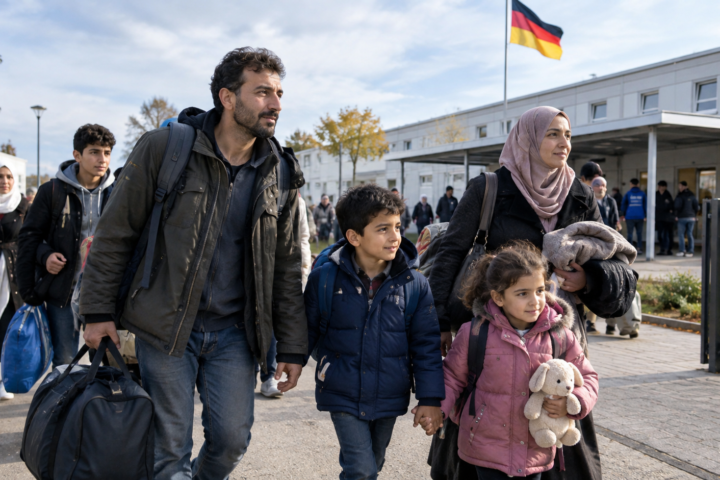
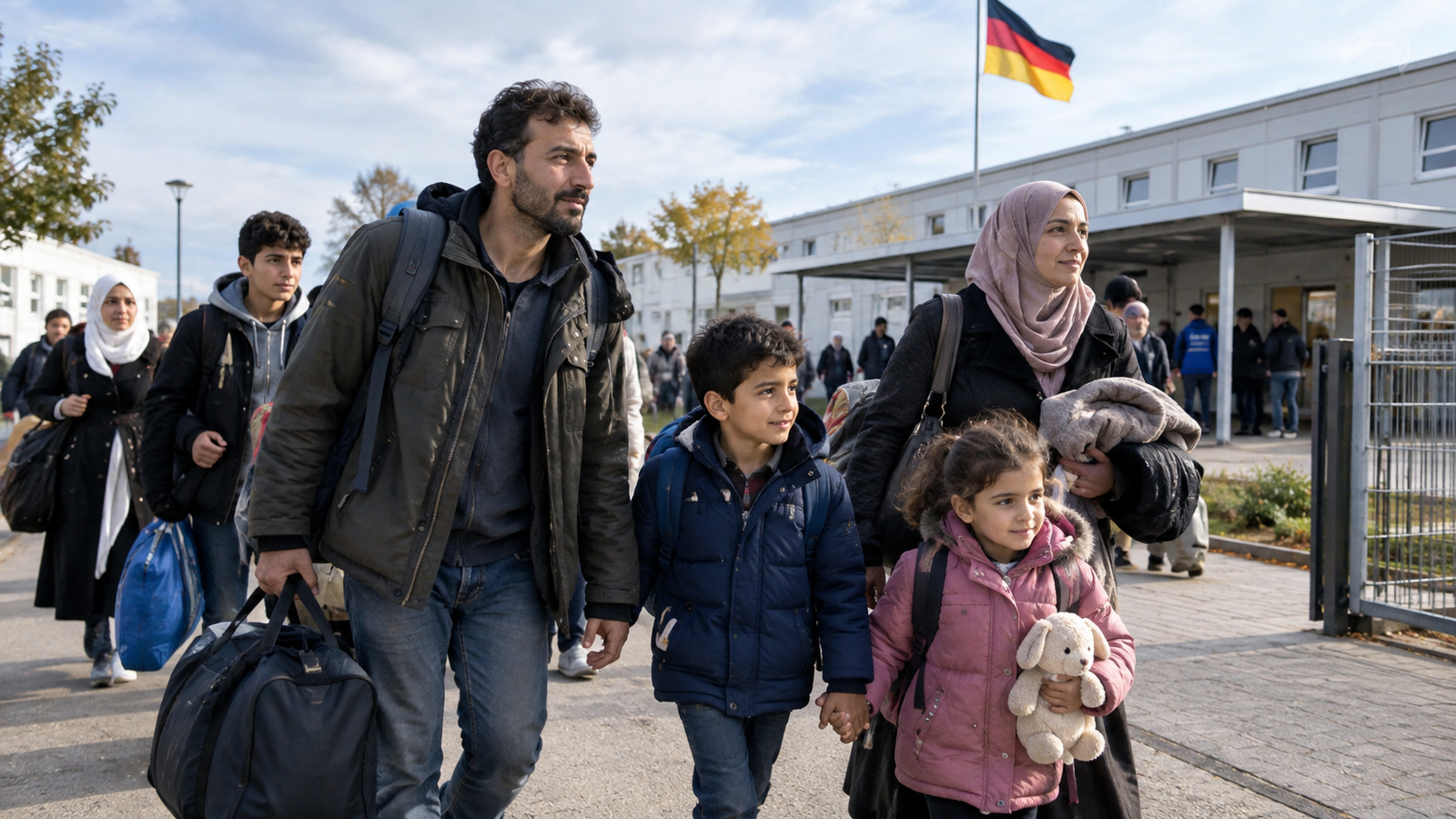
The first data since the reform took effect look encouraging for advocates of a tougher migration policy, albeit with one caveat. Germany’s Federal Office for Migration and Refugees (BAMF) recorded roughly 68,300 asylum applications between January and August: 47,300 initial applications and around 21,000 follow-up applications. Nearly 8,300 of the initial applications concerned children under one year of age, already born on German soil.
GEAS has also changed the methodology of the count itself: BAMF now records, as a separate line item, new entrants to the system – those who had already sought asylum in another EU country. Since June, around 2,400 such applicants have been recorded, and since the start of the year roughly 49,700 new entrants to the asylum system have been counted in total.
A year ago, over the same period in 2025, the immigration authority recorded around 78,200 initial applications. These figures indicate that the rate of initial applications has fallen by more than a third. But the reason for the decline, according to political scientist and migration researcher Hannes Schammann of the University of Hildesheim, does not lie in Brussels offices: “The dynamics are determined by processes in migrants’ countries of origin, and the connection between the falling numbers and decisions taken by European politicians is, in his assessment, minimal.”
At the scale of the European Union as a whole, the statistics look different: across the 27 EU member states together with Norway and Switzerland, around 332,000 applications for international protection were filed in the first half of 2026. It is this Europe-wide statistic, not the German figures alone, that should form the basis for today’s Munich debates.
Pro Asyl sees the reform as only the beginning
Ahead of today’s meeting, Germany’s Federal Ministry of the Interior made no secret of its purpose: according to the official statement, the discussion will concern the so-called “further tightening of the European migration pact.” For the human rights organisation Pro Asyl, that formulation sounds like an alarm signal rather than a technical detail.
Pro Asyl’s executive director, Karl Kopp, believes that EU migration policy already poses a threat to human rights. Speaking to BR24, he described GEAS not as an endpoint but as a prologue to a second wave of tightening measures, citing in support the plans to establish “return hubs” – centres for returning migrants located outside the European Union. In his words: what is happening amounts to “surrealism surrounding the right to asylum, and ultimately surrounding the entire European project.”
Political scientist Schammann strikes a calmer note: no one plans to abolish the individual constitutional right to asylum, although, in his observation, the subject itself is being raised increasingly often in political circles. A similarly measured view is offered by Constantin Hruschka, a specialist in social and migration law at the Evangelical University of Applied Sciences Freiburg, who interprets the new rules less as a retreat from the right to asylum than as confirmation of commitment to it, coupled with the exclusion of attempts at abuse and manipulation of human rights, since the key principle has been preserved – no one may be expelled without an assessment of their need for protection. In his formulation, EU member states have ended up with legislation that is strict but still respectable from the standpoint of international law.
The one thing uniting all 17 ministers – the border
The Federal Ministry of the Interior’s own stated objective sounds more sweeping: “Contributing to the realisation of a migration turnaround in Europe.”
In practice this means two things:
- strengthening the EU’s external borders
- speeding up deportations.
To this, according to available information, will be added the question of expanding the powers of the border agency Frontex. At present it only assists EU member states in operations to return irregular migrants, but Dobrindt intends to discuss a more active role for the agency specifically in deportations.
Schammann calls protection of the external borders the lowest common denominator – the subject around which it is easiest for the 17 countries to find agreement – and for that reason he describes the Munich meeting above all as an attempt to project visible unity. Hruschka, by contrast, expects that disputes will be unavoidable behind closed doors, chiefly over financing and over the stance to be taken on push-backs at the borders. But beyond the confines of the European Union, he predicts, only a demonstrative consensus will be presented to the outside world; without it, EU migration policy would simply lose its capacity to function. “Public disagreements,” he notes, “serve the interests of neither the domestic nor the foreign policy of any of these countries.”
It also remains unclear why the option of adopting migration processes that have already proven effective elsewhere – in Canada, Australia and many other countries, for example – is still not being considered. Why is it only in the EU that we swing from one ultra-left extreme to the ultra-right and back again? Who benefits from that?
Why this matters
Today’s Munich meeting is no longer a one-off initiative by a single minister but an established annual format of debate in which Germany, in effect, sets the tone for the pan-European discussion of migration. In the year between the first and second summits, the European Union managed to carry out the most far-reaching reform of the asylum system in recent years, and – without waiting for the first practical results of GEAS – is already preparing to discuss the next package of measures.
The divergence between the position of Pro Asyl and that of migration policy researchers frames the central unresolved question: whether what is under way amounts to bringing order to an overburdened migration system, or to a gradual erosion of the right to protection itself.
The answer to that question will not be heard today at the Bayerischer Hof – it will take shape over months, as it becomes clear how the new rules function in practice and what will be included in the next package of tightening measures against which Pro Asyl is warning.
Source: BR24
Похожие записи

Munich students launch a service for finding companions to help newly arrived migrants at their appointments
Munich Airport Supervisory Board Approves Construction of Deportation Terminal for Illegal Migrants

Germany’s Federal Cabinet approves bill on the use of artificial intelligence in migration procedures