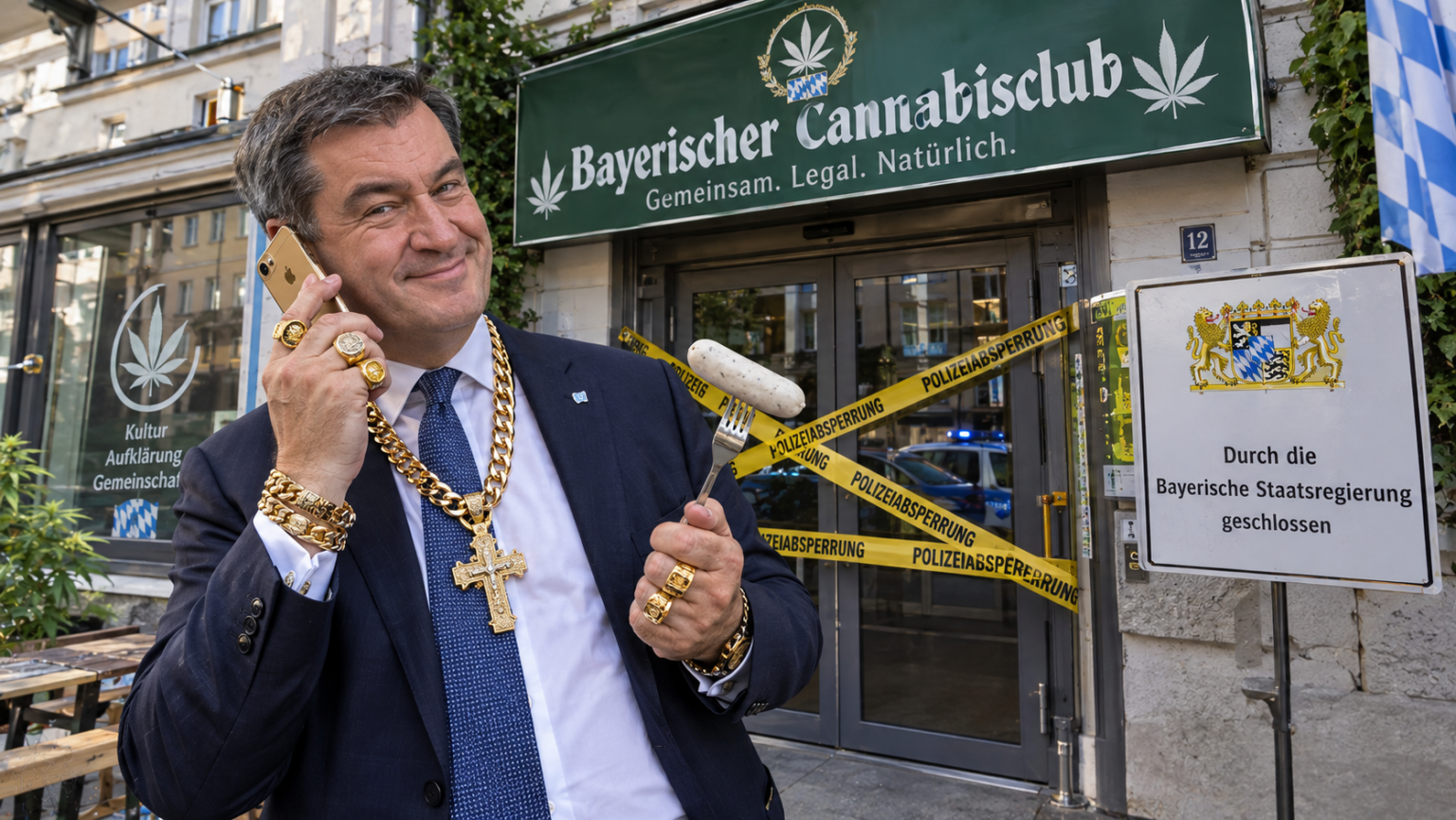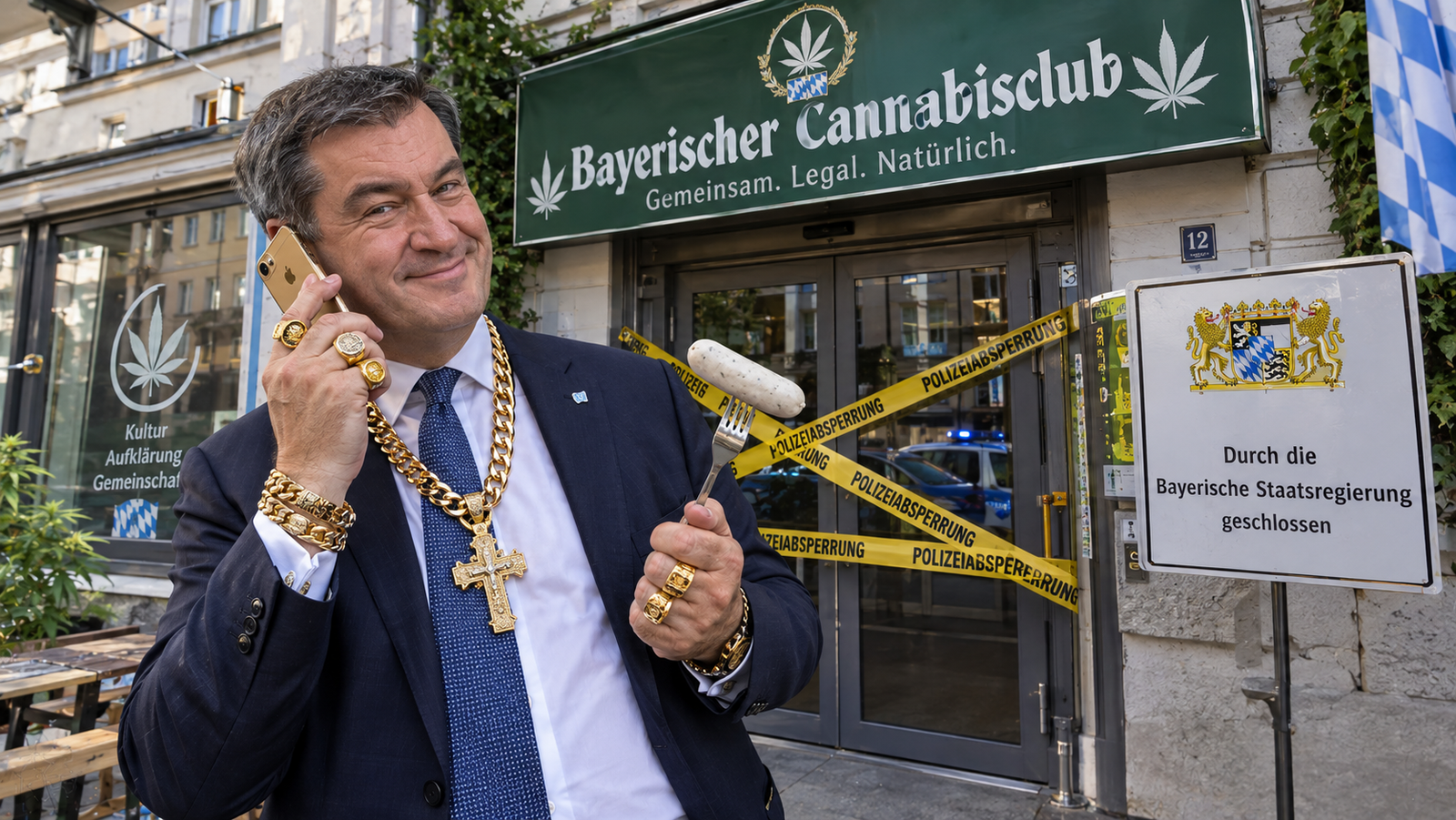

This time, the food blogger known throughout Bavaria and, in his other role, CSU chairman and Bavarian Premier Markus Söder came forward with a new proposal: taxing cannabis consumption – by analogy with the existing taxes on alcohol and tobacco.
Söder’s argument
At a closed session of the party leadership, Söder drew his colleagues’ attention to the fact that the state has long and steadily earned revenue from taxes on such drugs as alcohol and tobacco products. According to him, the federal government is already considering the possibility of eventually taxing sugar-sweetened beverages – a topic regularly raised by various activists in discussions about healthy lifestyles, and so the government has started wondering whether it might as well seize the opportunity and start filling the budget on the back of the activity of some of Germany’s perpetually dissatisfied residents. At the same time, for reasons no one can quite understand, Söder finds himself greatly troubled by a plant such as cannabis – from its cultivation right through to its consumption.
“The fact that smoking cannabis remains tax-free is absurd. We should think about how to change that,” – Söder said.
One wonders, though, just where Dr. Markus Söder is getting his free cannabis. – Ed.
If one follows all of Söder’s statements on cannabis, one could safely conclude that the topic has become something of an obsession for him. Any psychologist would say that, judging by his statements and behaviour, Söder is simply a latent smoker himself. On the other hand, Söder has already tried making populist statements of this kind about immigrants, refugees and other subjects on which the AfD’s ratings have been growing. It is possible that this new statement, too, has been made purely in an attempt to lure away AfD sympathisers. In previous attempts, Söder only lost ratings after such statements.
The question of the fiscal potential of a legal cannabis market has been debated in Germany for several years. Even before the law on partial legalisation was passed, researchers at Heinrich Heine University Düsseldorf calculated that the federal budget could gain up to €1.8 billion a year from a new levy, while the courts, police and penal system could save around €1.4 billion annually through a reduction in the number of criminal cases linked to cannabis possession. Before cannabis legalisation, police recorded more than 100,000 cannabis-related offences each year – a statistic that was cited as one of the arguments in favour of the reform.
Why the idea of repealing legalisation is stuck in the coalition
The CDU and CSU had already promised to repeal partial cannabis legalisation before the 2025 Bundestag elections, describing the current law as a gift to organised crime. And although statistics, academic research and statements from law enforcement say the opposite, the CSU and CDU’s voters – religious grandmothers and grandfathers, along with religious communities – sincerely believe in their politicians’ populism rather than the opinion of professionals. After the elections, the parties formed a federal government in coalition with the SPD, which, unlike the CDU/CSU alliance, had supported keeping this law in place. In the final coalition agreement, the parties did not go as far as a full repeal of legalisation, but agreed to first carry out an evaluation of how the law was working – a compromise that leaves cannabis regulation in force until that evaluation is complete.
This concerns the Consumer Cannabis Act (KCanG), which came into force on 1 April 2024. It removed non-medical cannabis consumption from the scope of the narcotics law and established a separate legal regime.
The key provisions of this regime are as follows:
- adults are permitted to carry up to 25 grams of cannabis in public places and to keep up to 50 grams at home;
- joint non-commercial cultivation is permitted only through cultivation associations – so-called “cannabis clubs”;
- a single association may have no more than 500 members, none younger than 18;
- a permit for an association’s activity is issued for seven years;
- cultivation sites must be located no closer than 200 metres to schools and children’s and youth facilities and playgrounds.
Söder’s proposal to tax cannabis came after his loud pre-election statements about a future repeal of the law, which led not to a rise but to a fall in the CDU/CSU’s ratings. And although his proposal is one of the few that sounds logical, it is unlikely that anyone will still believe his ideas and proposals. On the other hand, there is a paradox here: the leading representative of a conservative party mentally still living in the 19th century is pushing for the repeal of cannabis legalisation while simultaneously proposing to tax a product whose legal status it is itself contesting. This is precisely why this statement, like all the others, can be regarded as populism. Until the coalition agreement with the SPD is revised, the law on partial legalisation remains in force, and it is within the framework of this existing law that a new tax could, in theory, be applied.
No legal basis for a tax in Bavaria
As of the beginning of the month, eleven cannabis cultivation associations had been approved in Bavaria. Not one of them had an officially authorised area for cultivation. Attempts to get around the restrictive tactics of the Bavarian building authorities have so far been unsuccessful.
Those wishing to grow cannabis for their own use have had to turn to neighbouring federal states, where local authorities take a less strict approach to the matter and are more willing to approve plots of land for such associations. The result is a paradoxical situation: the law applies across the whole country, but it is precisely in Bavaria that its practical application has effectively been blocked at the level of the land-use and building authorities, on orders from above.
Why this matters
Söder’s proposal has emerged within a narrow window of possibility: a full repeal of legalisation at the federal level is blocked by the coalition agreement with the SPD until the evaluation of the law is complete, and ordinary citizens are unlikely to support it in any case, which means the law and the legal cannabis trade linked to it remain in force. In theory, it is precisely this pause that opens up room for Söder’s initiative.
In practice, however, there is currently nothing to realise it with in Bavaria: not one of the eleven approved cannabis cultivation associations has begun growing cannabis. This means that there is simply no legal cannabis in the region that could be taxed. As for the reason why the shadow market has started growing precisely in Bavaria, Söder and his health minister would do well to look in the mirror. In other countries and other German states, where a similar law has long been in effect, police statistics show that the shadow market has, on the contrary, begun to shrink.
Söder’s initiative, in this sense, looks more like a political signal following the AfD’s success in elections in several German states than a realistic fiscal plan for the near term.
But the main question remains: is Söder actually prepared to go any further than his latest statement?
Based on materials from the CSU leadership meeting at Banz Abbey