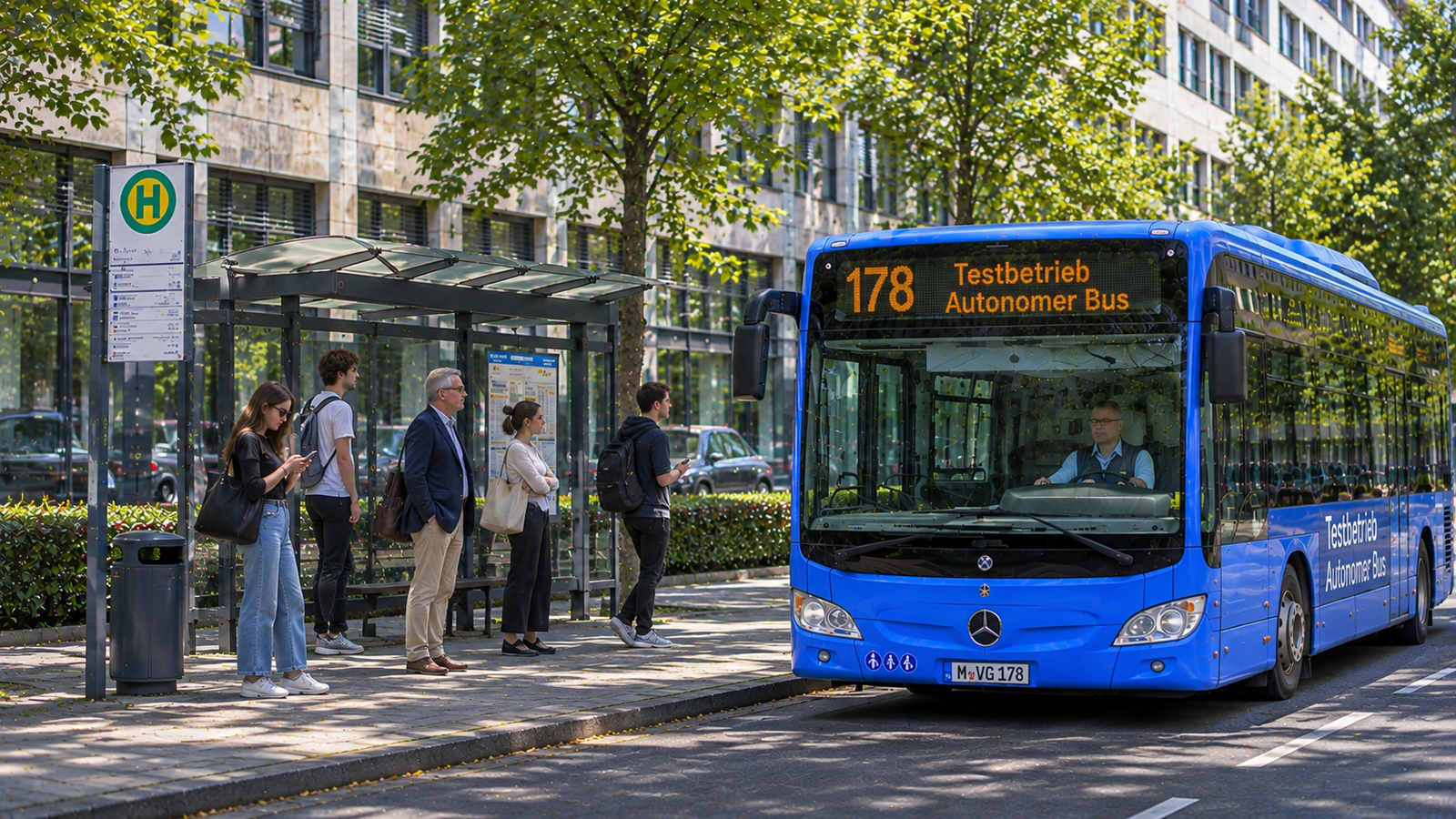

As early as November 17, such a bus will begin carrying test passengers along line 178 in northern Munich. Munich’s transport company MVG, manufacturer MAN Truck & Bus and city authorities will test whether buses without a driver can operate on selected routes. During the test runs, and for some time after the results are obtained – if they are positive – a safety driver will be on board on every trip. Testing of the new buses will continue until June 2027.
The “Minga” project
Residents of northern Munich will more often encounter a blue MVG bus bearing the words “Minga” and “Autonomous bus in operation.” “Minga” means “Munich” in the Bavarian dialect, and the same word has become the name of the research project. MAN Truck & Bus and MVG are working on it.
The project is meant to show whether it will be possible in the future to do without drivers on selected bus lines. The launch of such buses is expected to partially ease the burden on drivers amid an acute staffing shortage at transport companies.
Supporters of the new type of bus cite two arguments in defense of the project: lower personnel costs and operation of a line that does not depend on staff shortages. But before MVG puts autonomous buses on the Middle Ring Road, one of the city’s main arteries, they will undergo lengthy testing.
The Munich way
That is what the project is called at MAN Truck & Bus. For industry professionals it has become a difficult task: instead of laboratory tests, the bus will go straight onto city streets. MVG considers the chosen route simple, while at MAN it is assessed as fairly complex. But given that the pilot project will launch in the coming days, one can safely say that the company has apparently overcome the difficulties in designing and assembling the autonomous bus.
The vehicle is based on a production MAN electric bus for urban transport. It has been equipped with lidars and cameras that read the situation around it. A lidar determines the distance to objects using laser pulses, and the autonomous control system processes this data and decides how to move next. With each trip this system will learn, like a real driver-trainee.
The route and the drivers
The autonomous bus will travel a designated section of line 178 between Petuelring and Freimanner Hölzl. A safety driver will always be on board, ready to take over control if necessary. Sixteen drivers who volunteered for the pilot project – but with additional financial incentive – are receiving extra training for this.
How the bus behaves
On noticing an obstacle, the bus brakes rather sharply. Therefore no more than 30 passengers will be able to ride in the cabin, and where possible they had better be seated, since sharp braking is possible at any moment of the trip – especially given the state of affairs with the behavior of cyclists, taxi drivers and even care workers on the roads. Because of this, the driver will always be on board.
On some sections, for example at a large intersection, he will briefly take over control. The rest of the time, the cabin will hear the hum familiar from electric buses, no different from an ordinary bus.
How to become a passenger
Test passengers will be able to ride the bus and leave feedback starting November 17. The rides will be accompanied by researchers from the Technical University of Munich (TUM) and the University of Stuttgart. You can become a test passenger through a special MVG portal.
During the trials, the driver will remain on board on every trip. Whether autonomous buses can operate on lines without him will be shown by the tests, which will continue until June 2027.
Why this matters
The driver shortage has affected many transport companies for years now; it strongly influences schedules as well as delays and cancellations, which affects the life of every city resident and visitor. Autonomous buses are seen as a possible way to maintain service frequency. In Germany, a 2021 law permits the operation of highly automated vehicles in designated zones, provided they are monitored by technical supervision. The Munich project will take place on a limited section and with a driver on board, so for now it is a test rather than regular operation of autonomous transport.
The pilot project’s results will show whether the technology is ready to work on city lines without a person behind the wheel, or whether more time is needed for scientists to develop safer transport and a safe control system. Only one question remains open: what will a machine without intellect or thinking do in the non-standard, always different situations created by cyclists, taxi drivers and certain other representatives of transport?