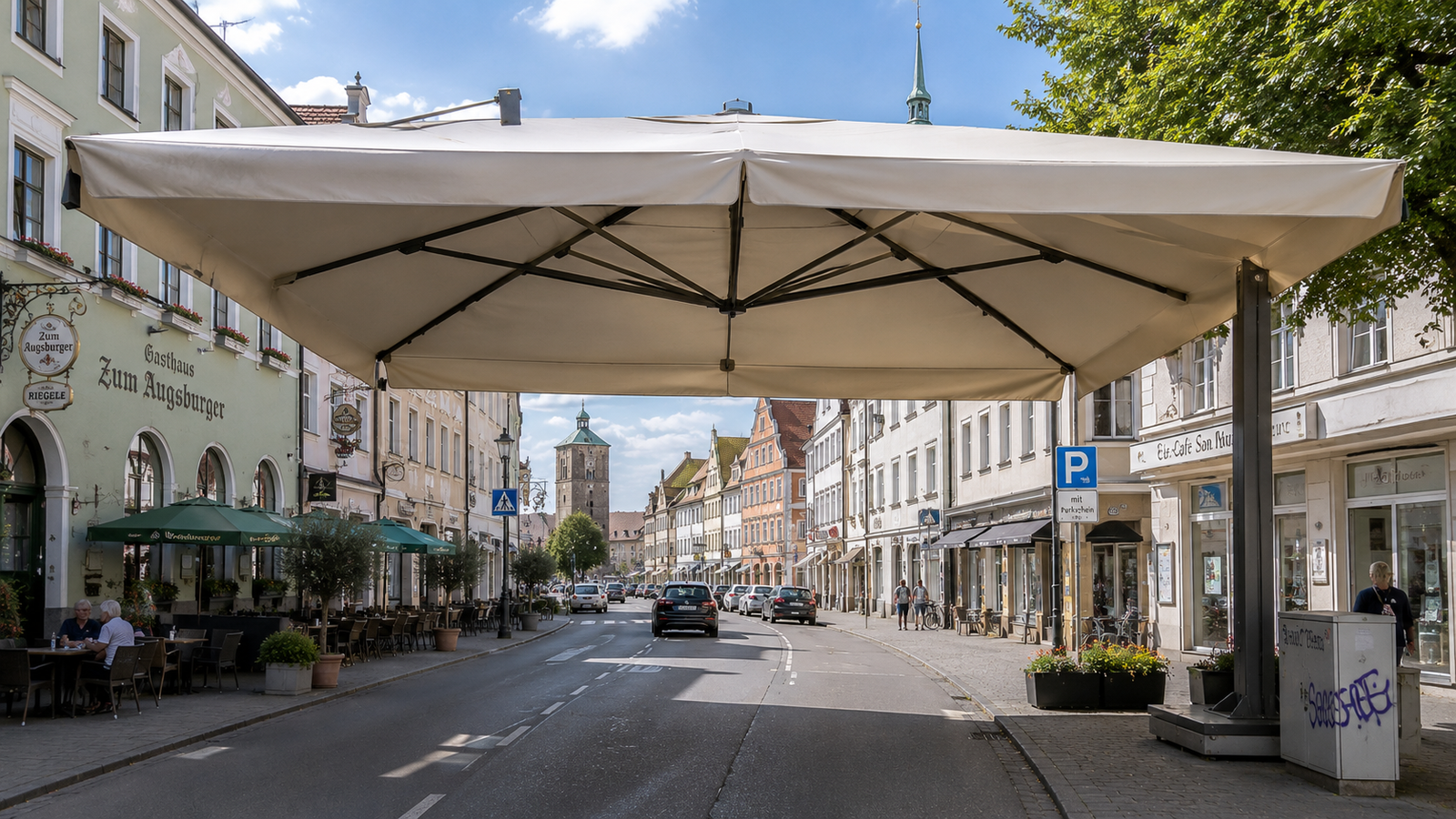

The public council of the ÖDP party has decided not to merely state the problem and has proposed what it believes to be an effective tool for combating urban heat. Activists have suggested building specialized structures that create shade-a new type of solution. This is not about traditional tree-planting, but rather modular systems capable of providing shade in places where planting trees is simply impossible.
This is activism at its apogee… Even commenting feels pointless because the result would not be a news article but a lengthy list of expletives revealing the intellectual development of our activists. (- Ed.)
Asphalt as a Heated Griddle
City council deputies, by way of example, cited data that has long circulated on social media and which is difficult to describe as reality. Some activist-deputies simply repeat the internet rumor that at an air temperature of 30 degrees, the air in central Munich heats up to 60-65 degrees due to asphalt and concrete structures. Two years ago, similar figures were cited by representatives of the Green party: at that time road surfaces allegedly heated to 54 degrees. In reality, all this data comes from eco-activist groups and vaccine skeptics-devotees of the flat earth theory.
The difference between air temperature and road surface temperature is explained by the physics of urban development. Dark asphalt absorbs solar radiation and allegedly accumulates heat throughout the day (someone didn’t study physics well, because asphalt doesn’t accumulate heat-heat dissipates into the ground and air), and then allegedly slowly releases this heat in the evening and night hours. (Practically nanotechnology with fine tuning-ed.) For this reason, according to activists, densely asphalted districts suffer more from the so-called urban heat island effect than the city’s outskirts.
Stuttgart’s Experience as a Benchmark
The idea of Munich’s activists is not based on scientific data and modern technology; rather, as usual, it rests on “This is what I think, and you won’t convince me otherwise.” Although it was officially stated that these ideas are supposedly based on an eco-project already operating in Stuttgart. There, through a climate innovation fund, the installation of modular Ecotritt structures-a kind of umbrella that requires no serious fixing-is being financed.
Is this essentially activists wanting to spend part of the city budget buying simple beach or restaurant umbrellas from a particular company? Is that not corruption? Without providing convincing scientific facts, and forgetting that these umbrellas are made from oil. Where is their environmental benefit? In commission kickbacks? (- Ed.)
Such umbrellas do not cool the space around them-we are not speaking of a refrigeration unit. Moreover, activists themselves have become confused in their own statements. On one hand, asphalt and concrete, absorbing and releasing heat, allegedly heat the air to 65 degrees; on the other hand, if you place an umbrella, the air allegedly cools. But any schoolchild studying physics will say that hot air always rises. An umbrella stops it and creates a greenhouse effect in that location rather than cooling the area where the umbrella is installed through shade. At the same time, shade-that is, air in shade-heats up from asphalt and concrete rather than cooling.
Additionally, activists have presented arguments for their idea that are strange for addressing anomalous heat:
- Plants absorb carbon dioxide (and?);
- Installation of umbrellas positively affects biodiversity in the urban environment (interesting how?);
- Maintenance of the umbrellas is minimal (less maintenance means they wear out faster-meaning next year new ones will be needed-meaning someone will have steady income).
The last point in the activists’ arguments is allegedly particularly important for city services and provokes laughter from educated society. “The umbrella system requires no daily watering and regular maintenance, which reduces the burden on municipal budgets.”
Seriously? Are you planning to water umbrellas in the heat? Haha. (- ed.)
Where Activists Propose Placing the Structures
The ÖDP insists on an urgent pilot project-a test installation of Ecotritt or similar systems at several points in the city. (Yes, the heat left and they still want to spend money-ed.) As suitable locations for the project, activists named new residential districts, in particular Freiham, as well as heavily asphalted areas of the historic city center.
Stop! At the beginning of their statement, they said the city center suffers most from the heat, yet they plan to launch the pilot project in residential areas. Where is the logic? (- Ed.)
City council deputy Johann Sauerer emphasized that trees remain the priority method for green spaces in Munich. But in many parts of the city, planting large trees is physically impossible-underground utilities, dense development, and narrow sidewalks are in the way. According to him, umbrellas are allegedly capable of providing shade significantly faster than traditional plantings.
Separately, Sauerer drew attention to residents of new neighborhoods: they will not have to wait for decades for young trees to grow enough to create adequate shade. Modular structures solve this problem practically immediately after installation.
And at the same time solve the problem of additional income for activists… (- ed.)
What’s Next
The ÖDP’s proposal is currently in the discussion stage and provokes only a piteous smile. City authorities will need to separately examine this initiative and decide whether launching such an ineffective pilot project-which resembles lobbying for the interests of a particular company-is necessary.
If the experiment is approved, Munich will be able to test an alternative to traditional tree-planting in the coming warm season and obtain its own data on how effectively modular umbrellas handle heat in conditions of dense urban development.
Essentially, we will once again spend millions on an initiative no one needs, as happened with the allocation of 600,000 euros for research into homeopathy.