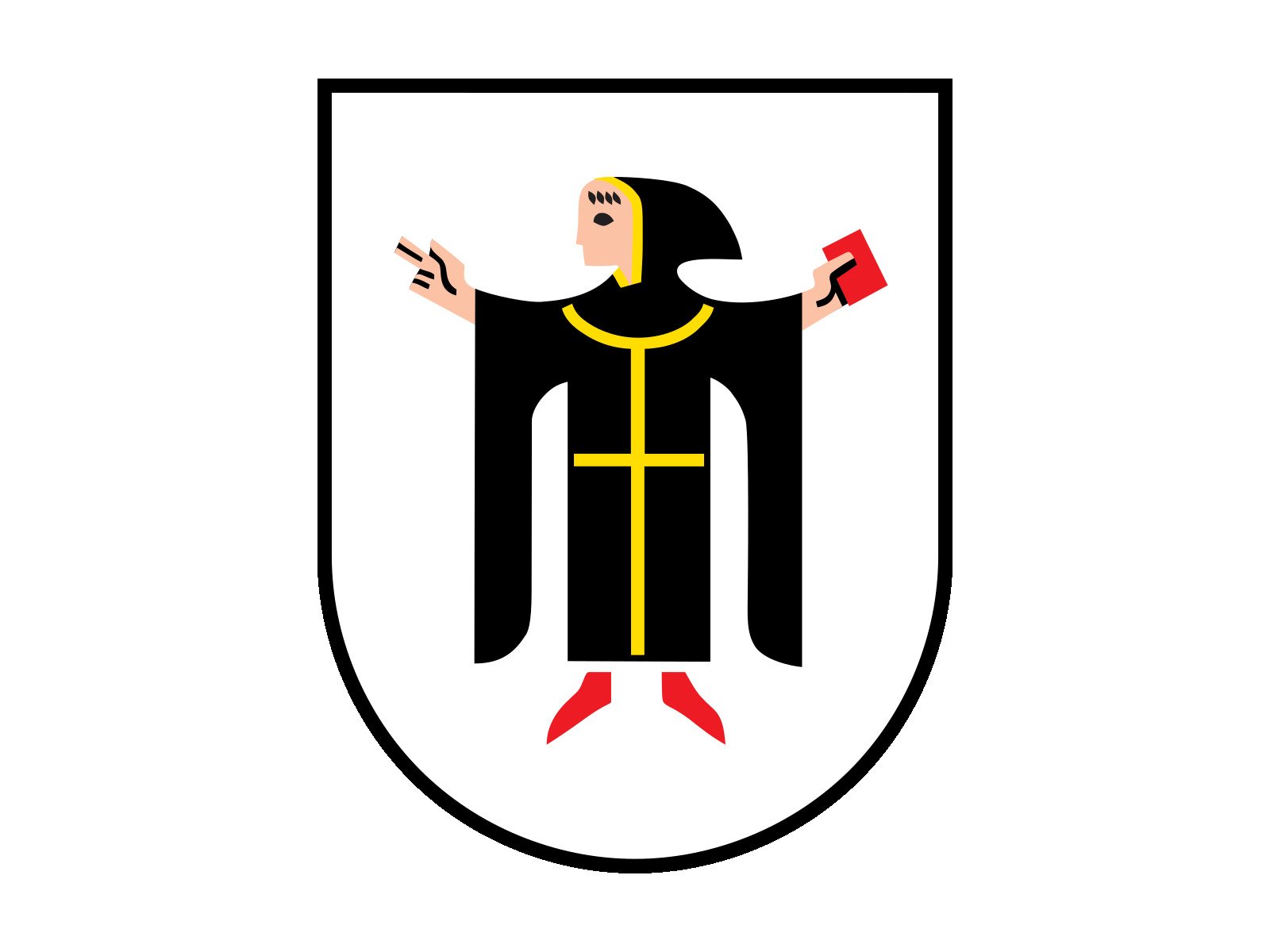

The Münchner Kindl is traditionally depicted as a monk wearing a black robe and holding a red book, just as shown on the city’s coat of arms. This motif can be traced back to the year 1239.
The name “Munich” derives from the Old High German word “munichen,” meaning “by the monks.” This term referred to a monastic settlement in what is now Munich’s Old Town, as archaeological discoveries from 2012 confirmed. This settlement gave the city its name and also influenced the city’s coat of arms: as early as 1239, the oldest known city seal showed a monk’s head with a hood inside a battlemented city gate. A similar seal exists from 1268.
By 1304, a full figure of a monk appeared on a city seal, wearing a robe, raising his right hand, and holding a book in his left. The so-called “Great Seal” of the city, documented since 1323, also depicts the monk holding a book and raising his right hand. This image shows the figure within a battlemented gate topped by a lion. These depictions are preserved in a historical document now held at the Ludwig Maximilian University of Munich’s library.
From Monk to Kindl
Over the centuries, the monk’s image in the city’s coat of arms evolved. By the 15th century, the figure began to take on more childlike features. By the 18th century, records mention the figure as the “Münchner Kindl” (Munich Child).
From the mid-19th century onward, the Münchner Kindl increasingly appeared on beer steins, postcards, and festival posters. Its depiction varied—sometimes the Kindl held a beer stein instead of a Bible, or wore an oriental hat.
Different Interpretations of the Coat of Arms
The exact meaning of the city coat of arms remains debated. The official interpretation, enshrined in Munich‘s coat of arms statute, holds that the raised right hand symbolizes a pledge, and the red book in the left hand represents the city’s oath book.
Historian and former city archive director Helmuth Stahleder challenged this view. Based on older archival sources, he argued that the outstretched hand was more likely a gesture of blessing and the book was the Gospel. For him, the Münchner Kindl is more closely tied to Munich’s Christian heritage.
The Large and Small Coat of Arms
Munich has two coats of arms: the small and the large. The small coat of arms shows only the Münchner Kindl in black robe with a raised right hand and red book in the left. This version is the most commonly used today, appearing on official documents and municipal buildings.
The large coat of arms, based on the Great Seal of 1323, is more elaborate and is reserved for special occasions such as formal receptions or monuments.
The Living Kindl at Oktoberfest
Since 1938, the Münchner Kindl has not only existed as an image but also as a live character. Each year at the opening of the Spring and Oktoberfest celebrations, a young woman from Munich dressed in a black robe leads the parade on horseback.
The first to play this role was Ellis Kaut, who later became famous as the creator of the children’s character Pumuckl.