
“The new support program will benefit the environment, the automotive industry, and families who otherwise would not have been able to purchase an electric vehicle,” Minister Schneider declared.
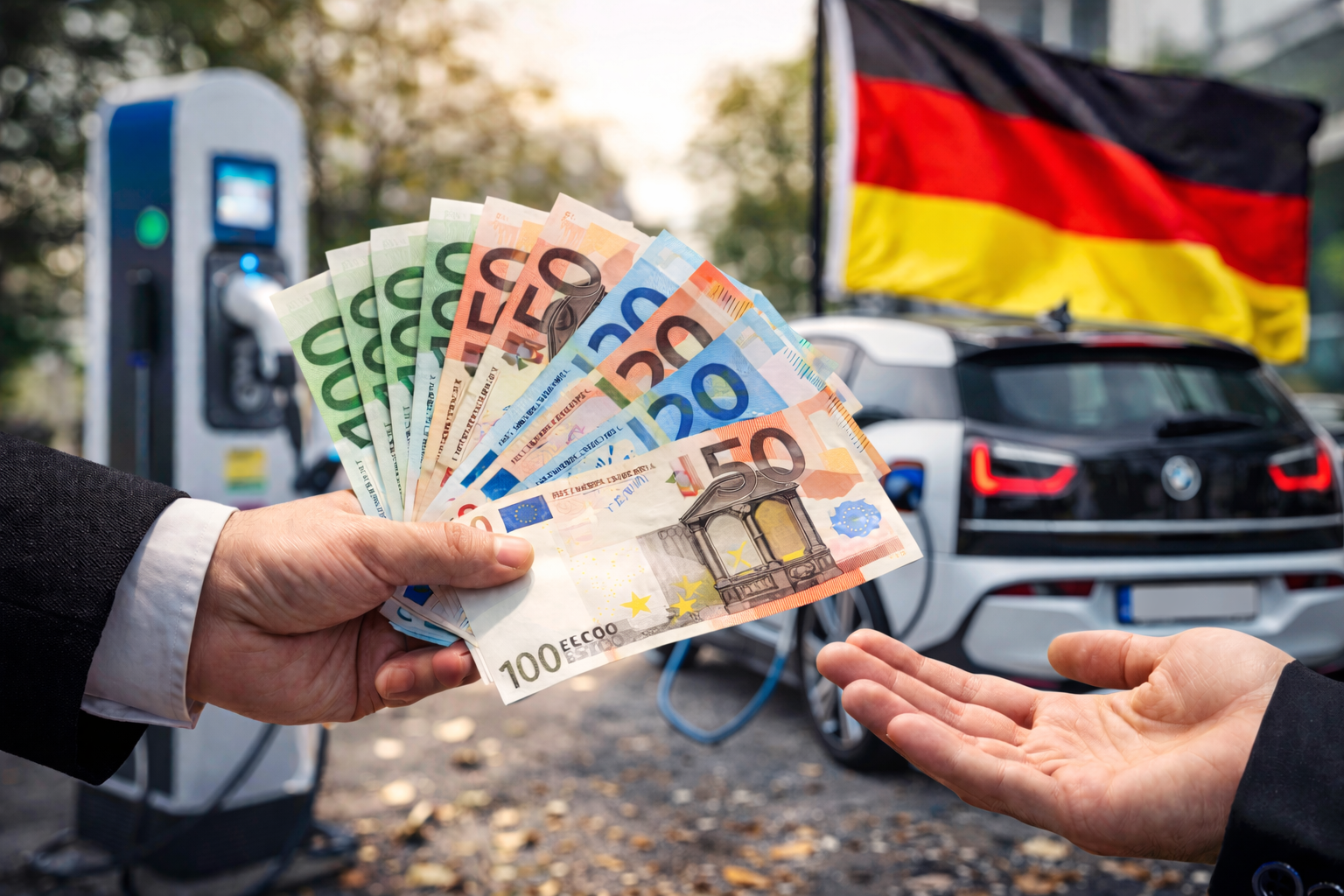
Financial support is making a comeback: those planning to buy or lease a new electric car can receive a subsidy from the federal government. The payments are distributed based on a social scale and are simultaneously intended to help the German automotive industry overcome a sales slump. Critics, however, argue that the premium will assist neither the environment nor the industry.
From January 1, 2026: How the EV Support Program Works
Subsidies apply to pure battery-electric vehicles (BEVs) and “plug-in hybrids” (PHEVs), provided the latter can travel at least 80 km exclusively on electric power and emit less than 60 grams of $CO_2$ per kilometer. Classic plug-in hybrids can run on a battery but use an internal combustion engine once the charge is depleted. Vehicles with a “Range Extender” (REX) feature an electric drive and an additional gasoline engine solely for recharging the battery. Both types are eligible for payments.
Social Distribution of Payments
The subsidy amount ranges from 1,500 to 6,000 euros per household. The purchase of pure electric vehicles is subsidized by at least 3,000 euros, while plug-in hybrids receive 1,500 euros. These conditions apply to families with a taxable annual income of up to 80,000 euros (up to 90,000 euros for those with children). The maximum amount of 6,000 euros is reserved for those whose income is below 45,000 euros, have at least two children, and purchase a pure electric car. The program covers vehicles registered from January 1, 2026, and applications can be submitted starting in May 2026, including retroactively.
Criticism from Environmental Organizations
Environmental groups have expressed dissatisfaction with the program. Greenpeace, for example, criticized the lack of a maximum price cap. According to the organization, support should only be granted to those buying small, resource-efficient electric cars costing under 30,000 euros. Deutsche Umwelthilfe pointed out that the program supports plug-in hybrids, which are often operated using the internal combustion engine and ultimately emit more $CO_2$ than officially stated. Furthermore, the lack of efficiency requirements means that large, heavy vehicles with high energy consumption are being subsidized, which provides no benefit to climate protection.
Industry Analysts Express Doubts
Whether the support will actually help the German automotive industry remains a subject of debate. Ferdinand Dudenhöffer from the Center Automotive Research (CAR) emphasized that manufacturers are already forced to sell as many electric cars as possible to meet $CO_2$ emission targets and avoid EU fines. Conversely, he sees a risk that manufacturers will simply factor the subsidy into the vehicle’s price. In his view, cheaper electricity for charging would be a much more sensible measure to stimulate demand.
2025: Fewer Combustion Engines and More EVs in Bavaria
The transition to electromobility is gradually gaining momentum, although the process is slightly slower in Bavaria. In the first half of 2025, approximately 130,000 new vehicles with classic internal combustion engines were registered there, according to the Bavarian State Statistical Office. This is roughly one-fifth less than in the same period of the previous year. Meanwhile, new registrations of pure electric vehicles rose by 27 percent to approximately 50,000 units, and plug-in hybrids surged by 46 percent (about 25,000 vehicles). Across Germany, primary registrations of pure electric cars increased by 35 percent during the same period.
Source: dpa