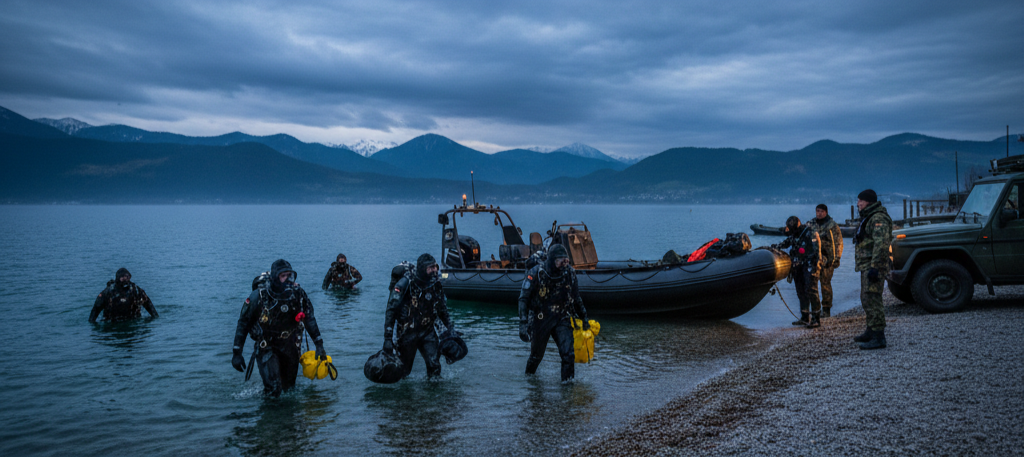

Starnberg – Bubbles of air rise to the surface, clouds of smoke drift across the water, and blue flashes are visible in the depths. A diver in an olive-green suit, a full-face mask, and a black visor climbs a ladder out of a five-by-five-meter steel tank. Less than a hundred meters away, despite the overcast weather and cool temperatures, an elderly woman in a swimsuit calmly slips from a jetty into the 18-degree water of Lake Starnberg.
We are at the center of the Bundeswehr Engineering School’s diving training facility in Percha, near Ingolstadt. In the tank before us, an underwater welding course is underway, led by Chief Petty Officer Oliver Suttner (51)—the man in the diving suit. “If a steel bridge is damaged in a defensive scenario, or if a pontoon for an engineering bridge is breached, that’s when you need skilled underwater welders,” explained Suttner.
Only the Best Can Do It: Welding in a Heavy Suit, Underwater, and in Turbulent Conditions
They are being trained for precisely this in a three-week course. It’s not for everyone: “Underwater welders must be good divers and excellent welders on land,” clarified the head of the diving training center.
The diving suits are sealed with rubber, as welding is conducted using a powerful 65-volt electrical current with up to 180 amps. On the working arm, a leather glove provides additional protection against slag, which can reach temperatures of 2000 degrees Celsius and burn through the rubber. The suits are typically custom-made, and the divers are secured by a safety line that also contains a telephone cable—a comrade at the other end coordinates the underwater welder’s actions via a terminal.
Soldiers from France and the US Also Train with the Bundeswehr in Percha
Underwater welding is an art: “In the air, liquid steel solidifies much more slowly than in water, which draws heat away rapidly,” explained Suttner. This time, a diver from the Wilhelmshaven navy is also participating in the exercises. Suttner added, “There, visibility underwater is extremely poor—you can only see about ten centimeters.” They also have to contend with sea swells, while combat engineers in rivers must work against the current.
Soldiers from other NATO partners, such as the US and France, also train in Percha. Military divers have been trained here since 1960. A pontoon raft is also available for exercises on the lake. “We train there in mine disposal, using dummies of course, as well as in underwater demolition work,” reported Suttner. The new security situation, according to Suttner, is also felt in Percha: “We have a major need to replenish our numbers to train divers and underwater welders.”
Other locations are also responding intensively to threats in the shadow of the war in Ukraine; for example, Airbus is urgently building new Eurofighter jets in Manching near Ingolstadt.
The Starnberg District
The Starnberg district stretches from Lake Starnberg to Lake Ammer. To the east, it is bordered by the A95 Munich-Garmisch-Partenkirchen motorway, and to the north, it is crossed by the A96 Munich-Lindau route. The district’s only town, Starnberg, with a population of 24,471, is also the largest municipality, followed by Gauting and Gilching with 21,860 and 19,062 inhabitants respectively. The district leads Germany in price-adjusted disposable income per capita—over €35,000.