
In 2024, authorities recorded a total of 213 Islamophobic offenses, up from 171 in 2023 and just 66 in 2022. This represents a more than threefold increase in only two years.
The data, published in response to a parliamentary inquiry by the Green Party, reveals that 80 percent of these crimes were committed by individuals affiliated with far-right extremist groups. Experts are increasingly concerned about the growing intersection between anti-Muslim sentiment and right-wing ideologies.
Cemal Bozoglu, a Green Party member of the Bavarian State Parliament who submitted the inquiry, expressed deep concern over the findings.
“Islamophobia is not just on the rise in Bavaria, it is exploding,” Bozoglu said. “It is primarily right-wing extremists who are threatening our Muslim fellow citizens.”
Bozoglu called for decisive political action to protect affected communities. He advocated for more support and counseling centers, as well as dedicated contact persons within law enforcement and the judiciary. Additionally, he proposed appointing a central representative within the Bavarian justice system to address anti-Muslim hate crimes specifically.
In response, the Bavarian state government stated that it had already implemented various measures to counteract xenophobia and far-right extremism. The State Office of Criminal Investigation (LKA) had been tasked with monitoring developments and recommending further action if necessary.
At the national level, the Green Party also criticized what they see as insufficient efforts to combat right-wing violence. Konstantin von Notz, a Green member of the Bundestag, accused the incoming federal government—formed by the CDU/CSU and SPD—of failing to establish a coherent strategy against extremism in their coalition agreement.
“Right-wing extremism remains, according to our security agencies, the greatest threat to democratic security in Germany,” von Notz told the Redaktionsnetzwerk Deutschland. “While the agreement includes some general commitments, concrete projects to tackle this issue are largely absent.”
Understanding Hate Crime
Hate crimes are criminal acts motivated by prejudice against individuals based on attributes such as religion, ethnicity, sexual orientation, or other defining characteristics. These crimes aim not only to harm the direct victims but also to intimidate the broader communities they represent. In Germany, the term “Hate Crime“ is not a formal legal classification, but such offenses are addressed under laws including the German Criminal Code (StGB) and the General Equal Treatment Act (AGG).
National Figures Show Alarming Increase in Hate Crimes
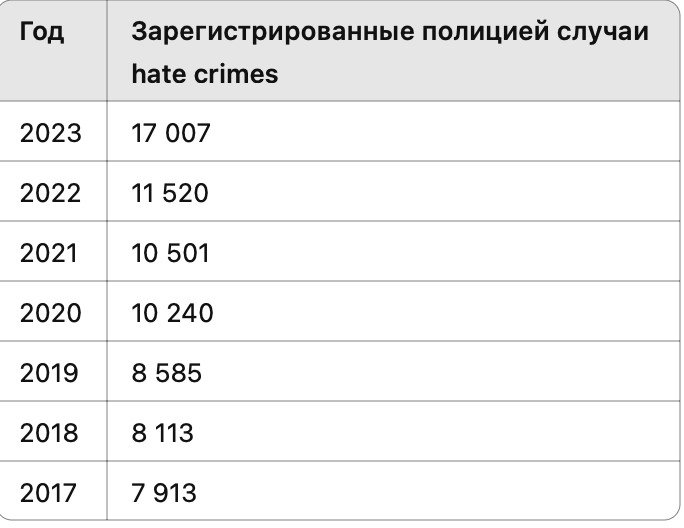
Across Germany, the rise in hate-motivated crimes has followed a similar trend. In 2023, police registered a record 17,007 hate crimes nationwide. In comparison:
- 2022: 11,520 cases
- 2021: 10,501 cases
- 2020: 10,240 cases
- 2019: 8,585 cases
The continued rise underscores the urgent need for comprehensive political and societal responses to combat hate-driven violence, both in digital spaces and on the streets.