
This systemic issue is gaining particular urgency as the new school year approaches: legal rights to childcare are now enshrined in law, providing parents of first-graders with substantial legal leverage against local authorities.
Starting in autumn 2025, a new legal standard grants families the right to demand a place in after-school care. Should these places not be provided, municipalities risk facing lawsuits. Furthermore, the legislation allows parents to claim compensation for lost earnings if they are forced to reduce their working hours due to a lack of school-based supervision.
Currently, Bavaria demonstrates a coverage rate of just under 60%, placing it among the laggards in a list compiled by the Evangelical Press Service. Only Lower Saxony (50.4%), Schleswig-Holstein (approx. 55%), and Baden-Württemberg (40.5%) rank lower. In contrast, eastern states like Thuringia and Brandenburg boast provision rates exceeding 90%.
A Deficit of 100,000 Places: An Infrastructural Challenge
The problem is multifaceted. A survey by the Forsa Institute among school administrators confirms that one in four primary schools in Germany cannot offer enough places for all incoming first-graders. In Bavaria, the deficit is measured in the thousands, and when considering primary schools as a whole, the figures are even more concerning. Experts from the German Economic Institute predict that the region lacks approximately 100,000 places to fully implement after-school care programs.
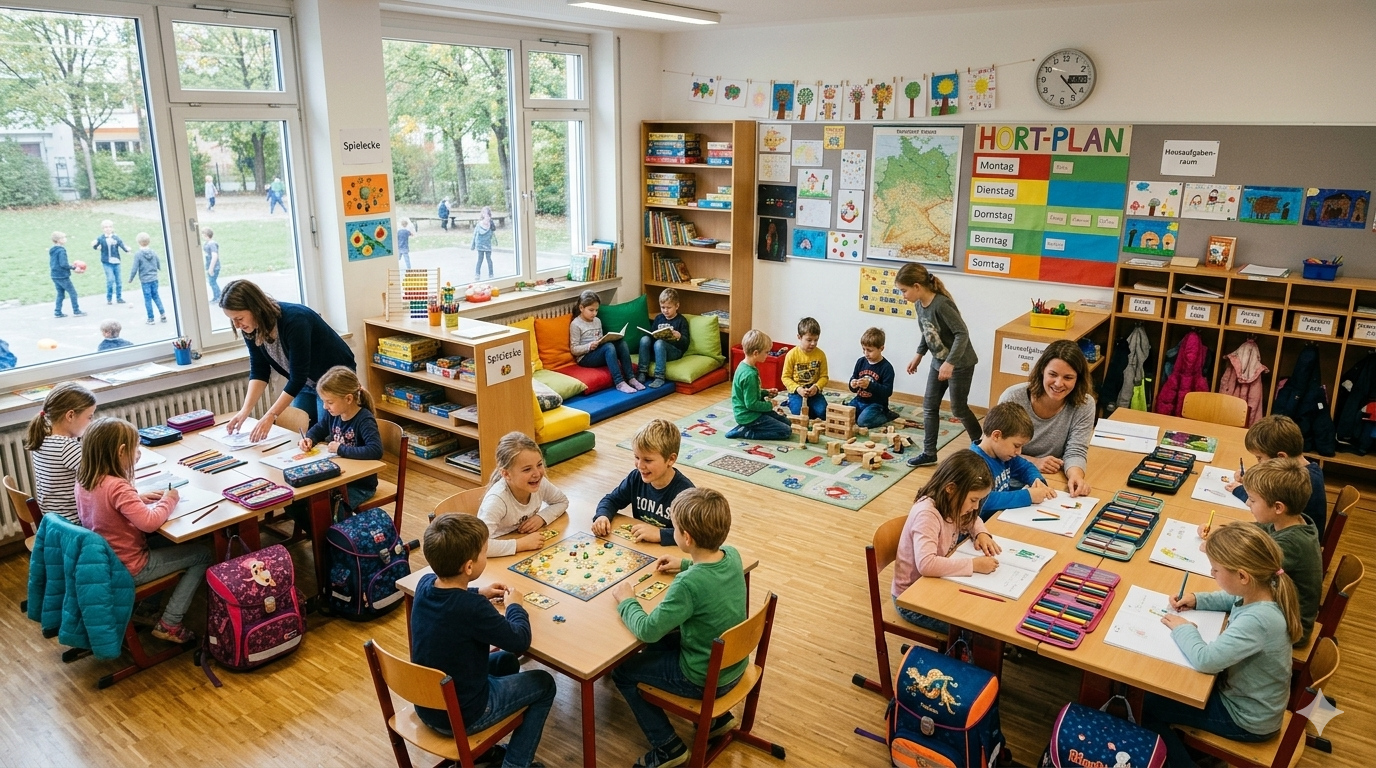
The primary responsibility for creating this infrastructure lies with the municipalities. Although the federal government provides significant funding to support these initiatives, the Bavarian Parents’ Association reports a paradoxical situation: millions of euros remain unspent. Local authorities often fail to utilize available subsidies to develop various care models — ranging from traditional after-school centers (Hort) to innovative supervision programs directly within schools or kindergartens.
Projections and Financial Guarantees from the Free State
The Bavarian Ministry of Family Affairs expects the demand for after-school care to rise to 80% by 2029. This is a long-term trend seen across Germany, where the demand for childcare services continues to grow steadily. It is important to note that the right to care will be introduced in stages: starting this autumn for first-graders only, and extending to all primary school pupils by 2029.
Bavaria’s Minister for Family Affairs, Ulrike Scharf (CSU), recently reaffirmed the government’s commitment to its social obligations. According to her, the Free State guarantees municipalities “powerful financial support” for investment costs. For every new care place created by 2029, local authorities can expect targeted grants. However, the question of whether the pace of construction and staff recruitment can keep up with the increasing legal demands of parents remains to be seen.