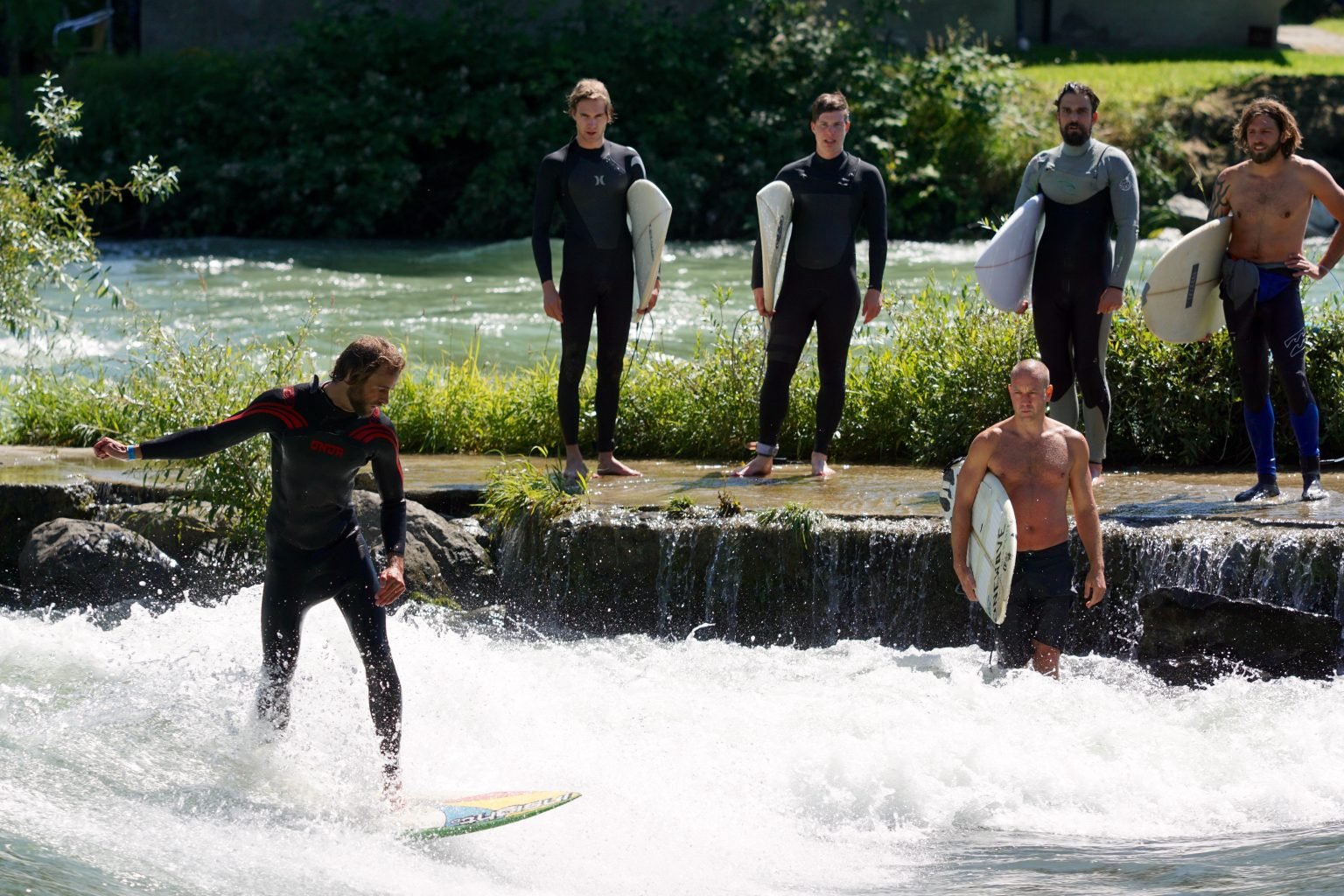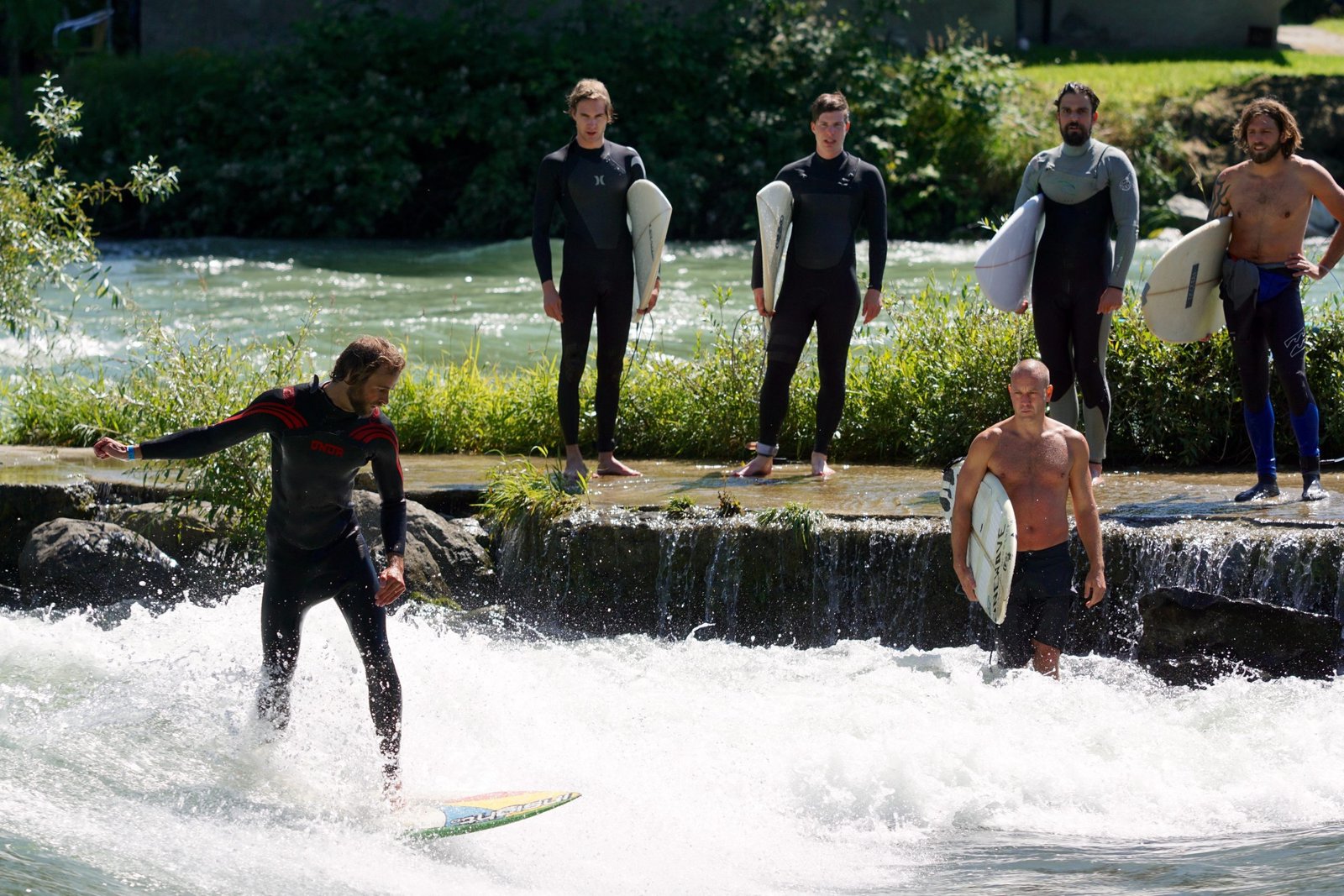

Specialists have developed a new plan to restore the famous surfing wave on the Eisbach in Munich‘s English Garden. By strategically placing gravel in the riverbed, the aim is to recreate the conditions that existed before a scheduled cleaning was carried out, the Munich administration announced following a meeting with experts from the Public Works Department.
In October, the Public Works Department cleaned the riverbed of debris and sediment. Since then, the wave has disappeared and no longer forms as it did before. The exact cause has not yet been determined.
University Working on an Eisbach Wave Model
The question of whether gravel placement can genuinely help will first be investigated through a model experiment. The Helmut Schmidt University in Hamburg has been working since June on a 1:5 scale model to obtain scientifically sound data on the hydrological conditions required for creating a consistently surfable wave. The model could be operational next week. It will also allow for realistic testing of short-term measures to restore a surfable wave on the Eisbach, the department reported.
A specific start date for placing gravel in the riverbed has not yet been set. Any construction intervention in the water system requires the responsible parties to obtain a permit under water law.
Mayor Reiter: “I Am Optimistic”
Mayor Dieter Reiter (SPD) expressed optimism: “I know that everyone’s patience is being severely tested here. However, I remain confident that we will succeed in restoring the wave in the near future, so that the many surfing enthusiasts can once again pursue their hobby—and Munich residents and numerous visitors from around the world can once again watch the athletes.”
Robert Mayer-Staude, Professor of Resource-Efficient Construction at the Munich University of Applied Sciences, explained the technical prerequisites. A surfable standing wave arises from an abrupt transition from fast-flowing to slower-moving water in a body of water. This transition creates waves or, at the very least, foaming water. The latter is currently observed on the Eisbach instead of the wave. Mayer-Staude will lead the experiment to restore the wave using gravel.
The Eisbach wave is considered a challenging surfing spot and attracts water sports enthusiasts from around the world. Even Californian surfing star and multiple world champion Robby Naish has tried to ride a board on the Eisbach.