
The Bavarian Alps and their picturesque foothills traditionally attract millions of tourists. Such locations as the famous body of water Königssee, the pilgrimage Church of Saint Bartholomew, or the ancient Church of Saint Sebastian in Ramsau, year after year head the lists of the most popular places for creating visual content on social networks on the territory of Germany.
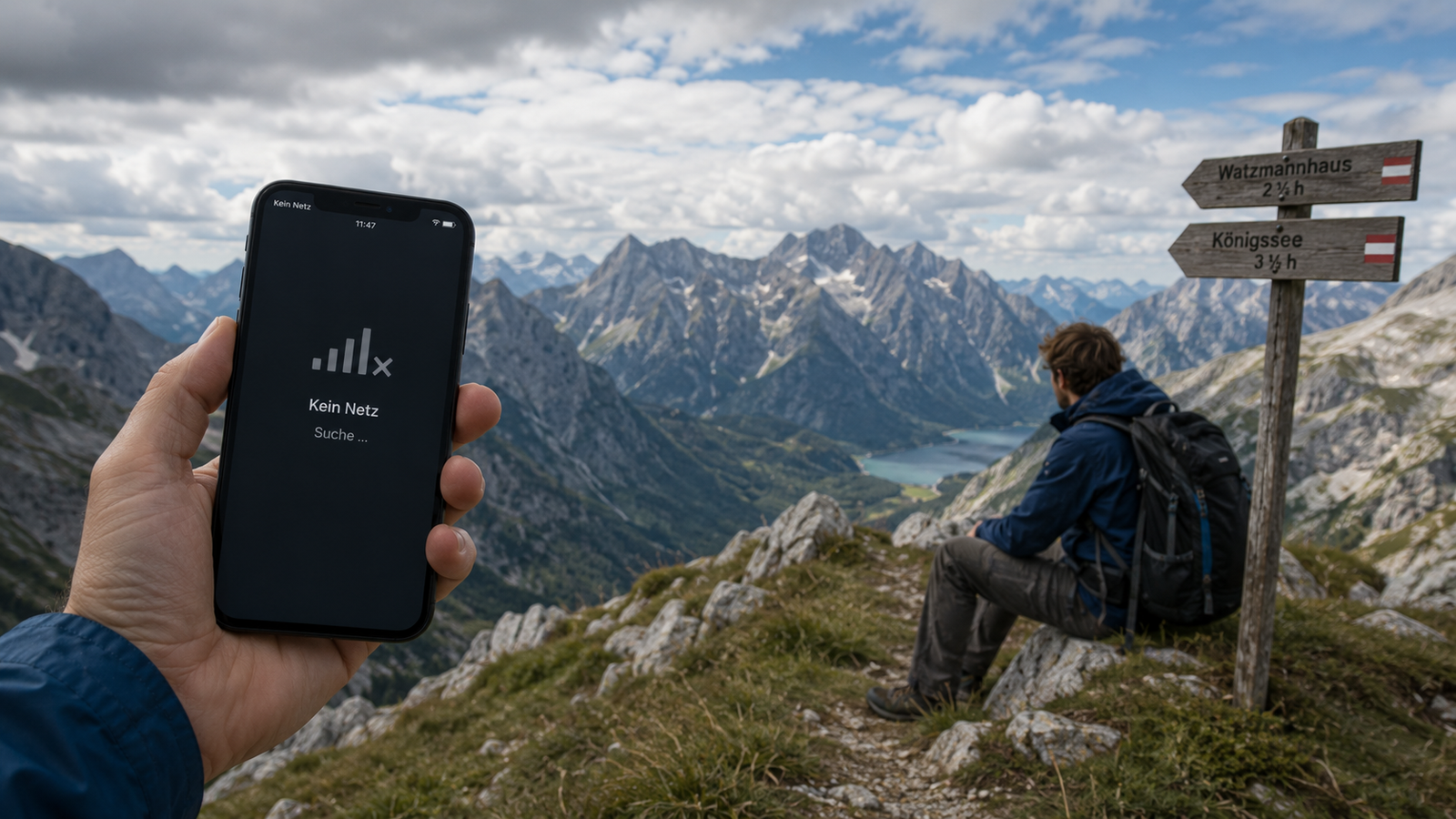
However, behind the beautiful digital picture hides a paradoxical technical reality: precisely at these iconic points of the Berchtesgadener Land district, cellular communication breaks down particularly frequently, leaving users isolated from the network. In modern realities, an unstable connection brings not simply domestic annoyance or the impossibility of updating a news feed. The situation is capable of becoming truly critical and dangerous for life in those emergency cases when tourists who have lost their way or been injured in the mountains do not succeed in making a call to the rescue service.
The Largest Dead Zone in Germany Is Located in the Berchtesgaden National Park
Official data from the Federal Network Agency of Germany confirm the systemic character of the problem: the most extensive area without any mobile network coverage on the scale of the entire country is located precisely in the Berchtesgaden National Park.
On an area exceeding 100 square kilometers, a maximum of the obsolete and low-efficiency 2G communication standard is available here, which does not allow transmitting packet data. In general, the southern federal state demonstrates weak results in the field of digital environment development: seven out of ten of the largest zones of complete absence of communication in the state are located precisely on the territory of Bavaria, with the overwhelming part of them being concentrated near the Alpine mountain range.
The Federal Network Agency officially classifies such territories not simply as “white spots” but assigns them the status of “areas with a deficit in network expansion.” This means that in these locations, modern mobile broadband access of 4G or 5G standards is currently completely absent, and works on technological modernization in the coming 12 months are not even planned by operators. At the same time, infrastructure failures are recorded far from only in difficult-to-pass mountainous terrain. On flat territories, for example, in the northern part of the Traunstein district, the signal of cellular towers also regularly disappears.
Specialists in promoting economic development in this region note that such a digital vacuum creates serious operational difficulties for local entrepreneurs. Businessmen need to constantly conduct important telephone conversations in cars during trips or operatively send impressive volumes of commercial data with the help of mobile devices, which is currently technically unfeasible.
Experts isolate two key reasons for such a slow pace of infrastructure deployment.
First, these are the highly complex features of the Bavarian relief. If a transmitting antenna is installed at the bottom of a valley, the broadcasted signal frequently simply does not reach the peaks. At the same time, mountain massifs are capable of physically blocking the passage of radio waves, creating extensive shadow zones. To level this natural effect, operators are required to design and install a significantly greater number of communication masts than on a plain.
However — and this is the second, purely social reason — precisely in the picturesque southeastern part of Bavaria, local residents most frequently and actively oppose the erection of new high-rise objects.
Position of Researchers: Cellular Communication Within the Established Norms Is Harmless
A classic example of such a civil confrontation can be called the commune of Palling in the Traunstein district. Here, for more than two years, a new cellular communication tower has been completely assembled and ready for operation; however, its launch causes sharp dissatisfaction among local residents. Owners of neighboring plots are angered not only by the aesthetic view of the massive metal construction that disrupts the habitual pastoral landscape.
There exist persistent fears that continuous high-frequency radiation can negatively reflect on health, especially if in the foreseeable future other major telecommunications operators place their additional transmitting antennas on this same mast. It is noteworthy that the joint use of one site by several competing companies was initially embedded in the state concept of federal network development to minimize expenses.
In its turn, the Federal Office for Radiation Protection in Munich argumentatively refutes similar fears of the population, relying on verified data. According to the current state of fundamental scientific knowledge, electromagnetic fields applied in civil mobile communication do not lead to any long-term damage to the human organism and do not provoke oncological diseases.
Mobile communication and data transmission remain absolutely safe for the population as long as the limit values of electromagnetic field strength established by law are strictly observed. In Germany, these sanitary regulations are traditionally among the most stringent in Europe, and actual measured indicators on the terrain frequently turn out to be significantly lower than the officially permissible safe thresholds.
The Head of the Commune Is Between the Dissatisfaction of Citizens and Complaints About Bad Communication
In this situation, representatives of the local authority find themselves before a complex choice. The leadership of Palling is forced daily to act as a difficult mediator between the diametrically opposite interests of their voters. On the one hand, there is an understanding of the arguments of those who do not wish to live in the immediate proximity of powerful emitters. But simultaneously with this, the administration of the community fully shares the position of another, no less active part of the citizens who regularly express harsh dissatisfaction with the low quality of communication and the absence of the internet.
For this reason, the practice in which operators are obliged to jointly use already erected constructions is seen as the only reasonable compromise — this would allow significantly reducing the total number of sites necessary for coverage. In addition, in the opinion of representatives of the commune, commercial companies frequently act detachedly and insufficiently coordinate their development plans with local communities.
Representatives of the Telecommunications Company Disagree with the Criticism and Give a Promise to Launch 5G at Königssee
Communication operators categorically disagree with the reproaches addressed to them. Representatives of the Telekom company assert that business always strives to find compromise sites for construction on the basis of a broad social consensus. However, in addition to the objectively complex topography in the foothills of the Alps, the erection of new masts is prevented predominantly by protracted protests and lawsuits on the part of the local population. Complaints that providers allegedly do not wish to share infrastructure with competitors are also called groundless by the company. Joint use of objects has long become a standard and economically advantageous practice in the industry. Nevertheless, each concrete site must preliminarily pass a complex technical expertise for the subject of the possibility of integrating equipment into the mobile network of a concrete operator.
In one aspect, service providers nevertheless admit a share of objective responsibility: in sparsely populated localities and difficult-to-reach Alpine villages, the construction of new objects is economically less profitable than in major cities where a colossal number of paying clients is concentrated. Nevertheless, management expresses tempered optimism regarding the further digital prospects of the region. The company officially declared that within three years, a modern high-speed network of the 5G standard will guaranteed appear, including around Königssee. Thus, the elimination of digital inequality in Bavaria remains a question of time, the effectiveness of the authorities’ dialogue with citizens, and the financial readiness of operators to invest in complex areas.