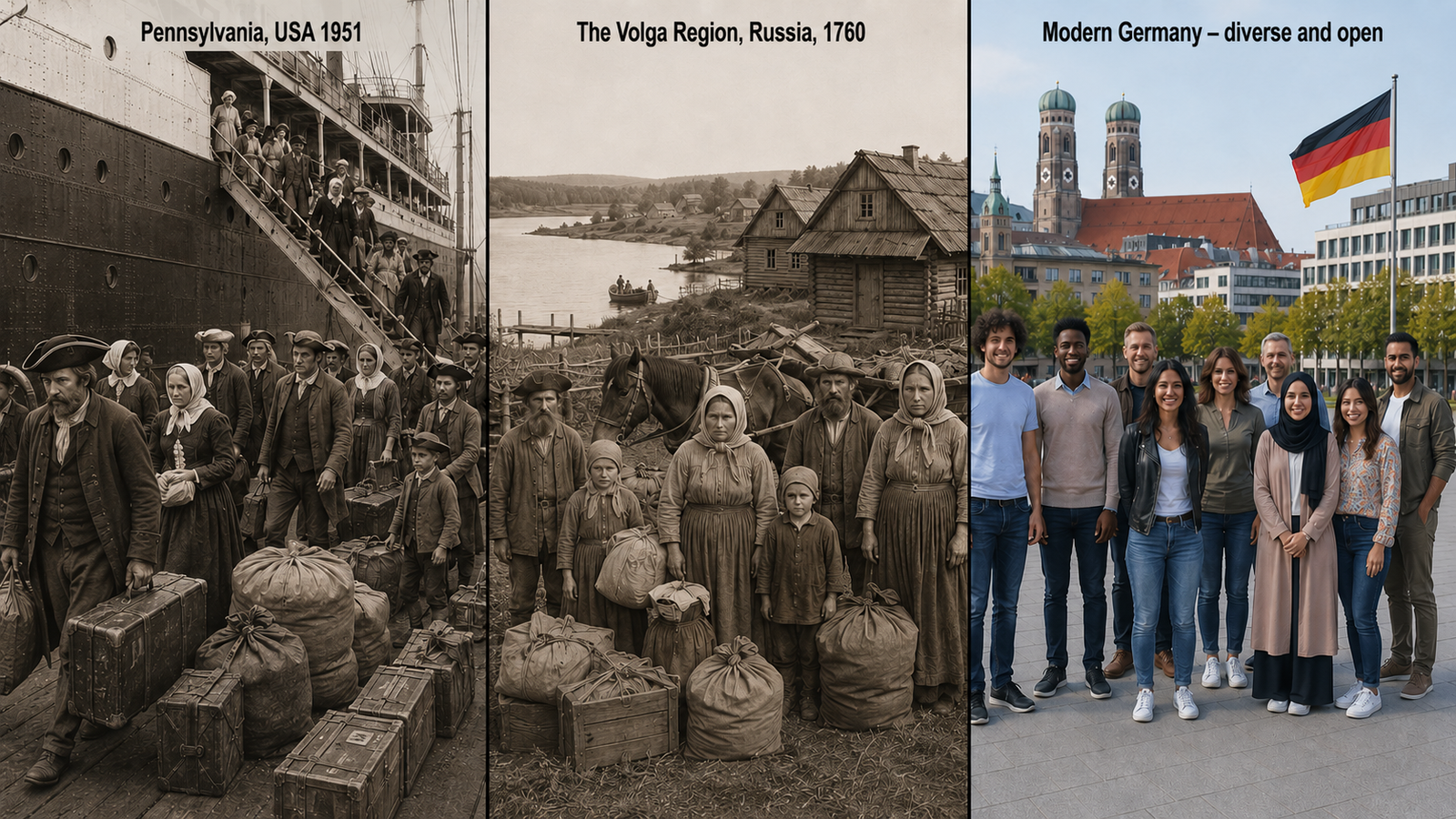

In fact, they were written in the eighteenth century about settlers from the German lands by Benjamin Franklin – one of the founding fathers of the United States, and one of the men who helped draft the US Declaration of Independence, with its famous assertion that all men are created equal and endowed with unalienable rights to life, liberty, and the pursuit of happiness.
Franklin set out his harsh views on German colonists in his 1751 essay Observations Concerning the Increase of Mankind, in which he called the settlers from the Palatinate “boors” incapable of learning English or adapting to the customs of the Pennsylvania colony.
Pennsylvania at the time really was taking in migrants by the tens of thousands. By the mid-eighteenth century, German-speaking settlers made up nearly a third of its population, published their own newspapers, and openly refused to switch to English – much to the irritation of the colonial elite.
Three centuries later, the rhetoric once aimed at Germans is echoed almost word for word in today’s debates over migrants. And it is precisely this historical paradox that makes the story of Germany’s emigration and immigration so instructive.
A country whose citizens formed the backbone of migration to other lands for centuries has itself become one of the world’s main magnets for newcomers.
Bound for the New World
For centuries, the pursuit of happiness and a better future for one’s children has driven people to leave their homeland in search of a better life. Wars, political persecution, discrimination on grounds of faith, origin, or sexual orientation, natural disasters, poverty, and a lack of prospects – all of these drove people into foreign lands long before modern state borders existed. There was only one difference: back then there were no visas and no integration rules.
“Migration is not a modern phenomenon at all, but a normal condition of human existence,” explains historian and migration researcher Jochen Oltmer, professor at the University of Osnabrück and one of the directors of the local Institute for Migration Research and Intercultural Studies (IMIS). According to him, the phenomenon has accompanied human history ever since anatomically modern humans left Africa and spread across the planet some 100,000 to 120,000 years ago.
History even speaks of a “Great Migration of Peoples” – an event that, by this reckoning, occurred twice.
During Franklin’s lifetime, the number of Germans who moved to America remained modest. By 1820, there were no more than 150,000 of them. But measured against the population of the countries involved at the time, the migration rate was far higher than it is today.
Germans’ decisions to emigrate were often fuelled by recruiters who boasted of their supposed success and swiftly acquired fortunes overseas. Few of the recruits knew that these agents were paid a fee for every new settler, regardless of how the migrant’s fate turned out in the new land.
Today such middlemen would be called smugglers and traffickers, promising illegal migrants the proverbial mountains of gold. Today’s life-threatening crossings on overcrowded rubber boats across the Mediterranean have their historical parallel too.
“Passage on a sailing ship cost roughly a craftsman’s annual wage,” says Simone Blaschka of the German Emigration Center in Bremerhaven, opened in 2005 on the site of the former port from which transatlantic steamers once departed. According to her, families had to sell everything they owned to raise that sum.
A Voyage into the Unknown
Settlers could scarcely have imagined what awaited them aboard ship during a voyage lasting many months: cramped lower decks, fleas, bedbugs, and rats, hunger, and a lack of water. Provisions usually consisted of rock-hard biscuit, salted meat, and rancid porridge, while the drinking water was often contaminated and tasted stale.
Diseases rampant aboard ship included:
- dysentery;
- typhus;
- smallpox;
- scurvy.
Schoolmaster and organist Gottlieb Mittelberger spent nearly four years in Pennsylvania and, on returning to Germany, published a book in 1756, Journey to Pennsylvania in the Year 1750. The book was meant as a warning to his countrymen against any rash decision to emigrate. He described how, aboard ship, many people groaned pitifully and pined for home, and how crushing homesickness, combined with disease, claimed dozens of lives every day. Hundreds of passengers inevitably died along the way and were thrown into the sea. Only a few made it to America’s shores.
If one compares the number of German migrants who reached America with the survival statistics for the crossing, the shocking scale of how many Germans were trying to get there at the time becomes clear.
According to Mittelberger, most of his fellow travelers were, upon arrival in America, quite literally sold at auction. These were destitute settlers who had been carried across the ocean for free in exchange for years of debt bondage – the so-called redemptioners. It was, in essence, a form of temporary slavery. On arrival, such people were freely bought and sold. Families were torn apart, and impoverished parents were forced to sell their own children into servitude.
The Russian Empress’s Invitation
Alongside the early wave of emigration to America, another large stream of emigrants moved east. These people answered the call of the Russian empress Catherine the Great, who was herself of German descent. On 22 July 1763, she signed a manifesto inviting Europeans to settle in Russia and cultivate the sparsely populated lands of the Volga region.
To the new arrivals, the empress promised:
- free passage to the place of settlement of their choice;
- a plot of land free of charge;
- exemption from taxes for the first several years;
- exemption from military service (which at the time lasted 24 years);
- schooling in their native language;
- special political status preserving the German language and the right to self-government.
As early as 1764, the first German colonies began to appear on the banks of the Volga, giving rise to the Volga German community, which endured for nearly two centuries.
But by the nineteenth century, the American continent had once again become the main destination.
“Germany’s population nearly doubled over the course of the nineteenth century, and you can imagine what that did to the labor market,” says Simone Blaschka. Demographic pressure was compounded by drought (don’t tell me global warming was already a thing back then?), crop failures, and famine. People saw no future for themselves or their children, and decided to leave.
Around 6 million Germans set out for the so-called New World – some of them inspired by Wilhelm Eggerling’s 1832 emigrant guide, A Short Description of the United States of North America. The author enthused that an honest, sensible, and industrious man lived nowhere so well, freely, and happily as in America, and that even the poorest of the poor there lived better than a European two rungs above him on the social ladder.
As it happens, unflattering things are said today about European countries, the United States, Israel, and Russia too – words that have little to do with reality. – Ed.
Migration: Burden or Blessing?
Germans were far from the only ones leaving their homeland. “From the early nineteenth century until the First World War, an estimated 60 million Europeans left the continent,” noted Oltmer. By the mid-twentieth century, the situation had reversed completely: Europe turned from a continent of emigration into a continent of immigration.
“Whether migration is seen as more of a burden or more of a blessing is directly tied to the state of the economy, demographics, and the labor market,” the historian explains. “When people feel positive about their own society’s prospects, attitudes toward migration also become more favorable. When expectations for the future are negative, attitudes toward migrants worsen.” Hostility toward migrants – and toward more successful fellow citizens, other peoples, and so on – also tends to run highest among disadvantaged groups struggling to meet basic needs and lacking access to good education, healthcare, and culture.
During the years of the young Federal Republic’s economic miracle, in the 1950s and 1960s, the future looked bright above all else. Germany saw a baby boom. From the mid-1950s, so-called “guest worker trains” began pulling into the stations of Stuttgart, Dortmund, and Cologne. Aboard them came Italians, Greeks, Spaniards, Portuguese, Yugoslavs, and Turks, drawn by promises of well-paid work. Guest workers were most often recruited into construction. Before the recruitment program ended in 1973, a total of around 14 million so-called “Gastarbeiter” had arrived in West Germany, of whom roughly 3 million remained permanently in the FRG.
A Mistaken Slogan: “We Are Not a Country of Immigration”
Despite this entire history, Germany for a long time did not see itself as a country of immigration – neither at the level of legislation nor in public consciousness.
“For a long time the prevailing view was that, whatever the reason for their arrival in the FRG, these people were not part of society, since sooner or later they would have to leave,” Oltmer explains. “And since they were going to leave anyway, there seemed to be no need to pay them any attention.”
For a long time German citizenship was passed on almost exclusively by descent, and only in rare cases was it granted to certain groups of immigrants. It was only the reform of 2000 that first introduced the notion of migrants’ rights into our society, allowing children of foreigners born in Germany to obtain German citizenship under certain conditions.
According to Germany’s Federal Statistical Office, more than 30% of the country’s population had a migration background in 2025. The historian links the fact that many people of the third and fourth generations still do not feel part of society to the attitude of the host society. In his view, genuine recognition has been rare, and where it has appeared at all, it has usually had to be fought for.
Who Is Welcomed, and Who Is Not?
Germany today actively recruits well-qualified foreign specialists because of an acute shortage of skilled labor and an ageing population. As mentioned above, the 1950s and 1960s saw a postwar economic boom and baby boom in Germany. Those born then are now retiring en masse, and there are not enough young specialists to sustain the economy – or to fund pensions.
Modern immigration has been formalized in particular through the Skilled Immigration Act, most recently updated in 2023. Refugees, by contrast, receive asylum only when political persecution or a genuine threat to their life in their country of origin has been proven. As a migration researcher, Oltmer regularly returns to the question of why society accepts some migrants and not others.
This question became especially acute in 2015, when the influx of refugees from Syria into Germany sharply increased and Chancellor Angela Merkel uttered her famous phrase “We can manage this.” “It went something like: fine, you people from Syria, given the civil war, have a right to protection. But the same society was simultaneously telling people from Afghanistan: in your case, we’re a good deal more skeptical,” Oltmer recalls.
On the other hand, it remains unclear why Germany, having set out to become a multi-ethnic state – for the sake of the state’s own survival – cannot simply borrow the experience of countries that have done this more successfully. Countries that travelled the whole road from rejection to a constructive migration strategy. The experience of countries such as the UAE, Canada, and Australia could long ago have solved almost all of Germany’s migration problems, not least the problem of crime.
Migration and asylum remain a constant theme of political debate in Germany and other European countries, especially among populist politicians. Oltmer believes that moderating this debate is the job of politicians, not activists. According to him, refugees account for only about 10% of Germany’s total migration flow, and the overwhelming majority of relocations have nothing to do with fleeing persecution at all. So when certain negative images get constructed, one has to speak of a serious distortion of the entire debate – bearing in mind that hostility toward migrants is projected not only onto newcomers, but onto roughly 30% of the country’s own citizens.
As for the descendants of the German settlers whom Benjamin Franklin once called “Palatine boors,” they have long since become firmly integrated into American society and today form one of the country’s largest ethnic groups. No one remembers, or pays any attention to, their origins once assimilation has taken place.
A Colossal Delay
In the Federal Republic itself, however, migrant integration proceeds far more slowly. Oltmer calls this a “colossal delay” – many people still have no way to regularize their status and obtain a permanent residence permit, even though everyone involved understands that these people can, and will, remain in the country.
The excuses officials give – you’re not the right age, or your German isn’t good enough – sound illogical on their face. Take, for example, a person who arrives in Germany with three university degrees, speaks four languages, and is learning German as a fifth. Someone whose professional experience would let them live in any country in the world. But this person has family here. And what does he or she get?
Instead of valuing the fact that a top-tier specialist has chosen to build a life in Germany, and giving them real opportunities, all that’s on offer is counseling sessions that sometimes just repeat the person’s own ideas back to them. On top of that come language and professional courses of dubious quality, all while the treasury bleeds money on benefit payments. Germany could easily have borrowed Canada’s approach instead, turning migration into a process that benefits the state – one in which the specialist, business, and the state all come out ahead.
In the historian’s view, German society needs to sit down at the negotiating table as soon as possible and decide what kind of future it wants – what’s needed is a so-called “new social contract.” Such a discussion cannot be conducted solely within the comfortable confines of one’s own information bubble, still less at rallies or on social media. In most cases, such debates are fuelled by foreign lobbies (Russia, Iran, Israel, the United States, China), which makes the discussion harsh and even toxic. This is how both inter-ethnic and intra-national hostility gets stoked. And the inaction or passivity of politicians only makes the problem worse – after which those same politicians express surprise at the growing popularity of far-right and far-left groups and populist politicians.
The history of German migration – from the eighteenth-century settlers who fled poverty across the ocean to today’s asylum seekers and labor migrants – shows that the acceptance of so-called “outsiders” in any country has never been a purely humanitarian process. The preconditions have always stemmed from the state of the economy, demographics, culture, education, and healthcare, from expectations about the future, and from society’s readiness to accept newcomers as part of itself rather than as temporary guests. What is needed for that is a new social contract, engagement with sociologists rather than activists, and a carefully thought-out reform along the lines of those carried out by countries such as Canada, Australia, the UAE, and other multi-ethnic nations in need of both a younger population and skilled specialists.