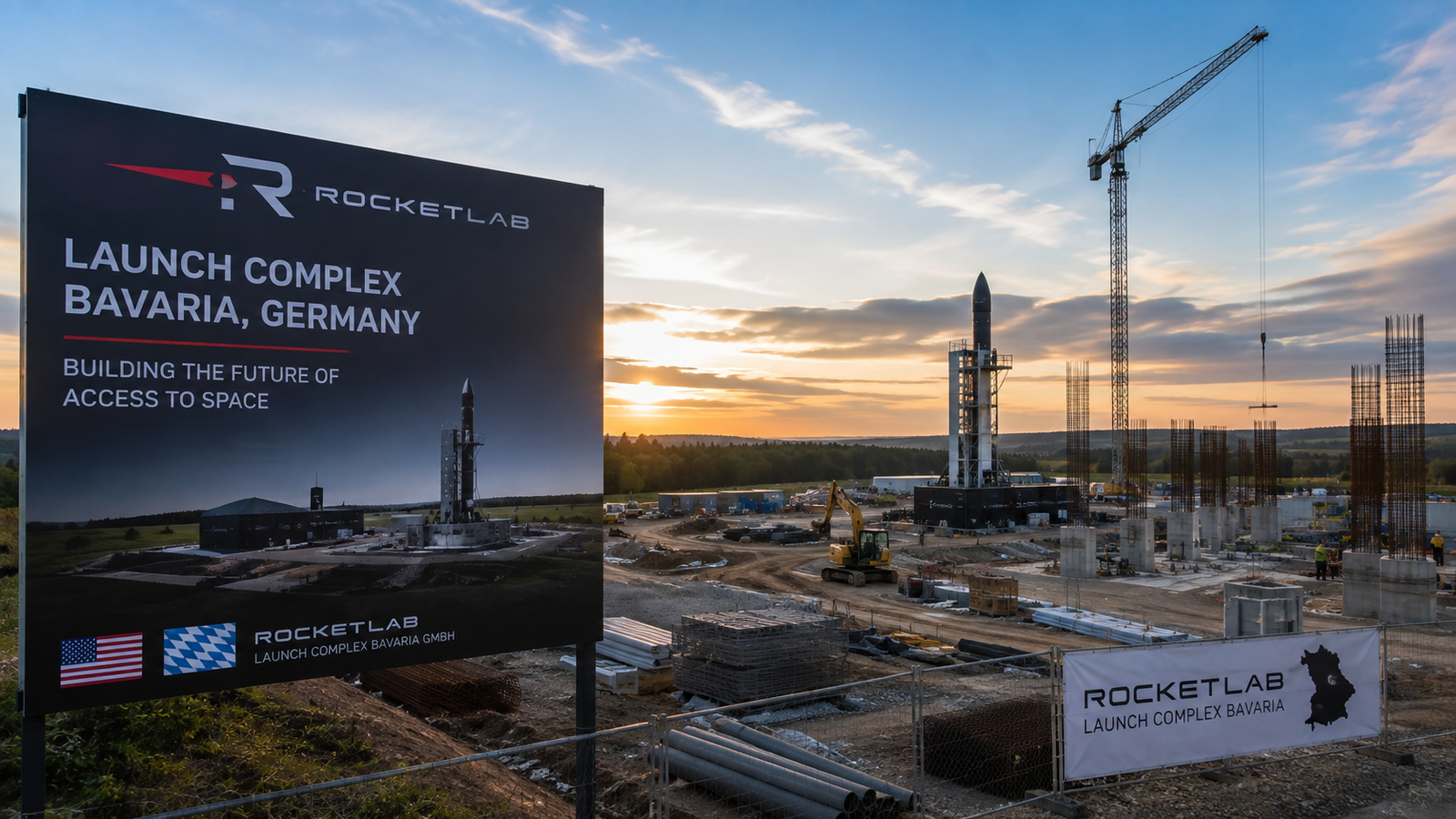

The move is set to accelerate Europe’s space industry development and break a cycle of dependence on American and Chinese space infrastructure.
Rocket Lab is the company that transformed the small-rocket market. Its Electron vehicle has completed over 1,700 flights and holds the world record for commercial small-lift launch frequency. This is not science fiction about some distant future-it is an operational industrial system now relocating to Bavaria.
A Strategic Move Through Mynaric
Rocket Lab’s entry into Europe began with the acquisition of Munich-based Mynaric AG, a leader in laser communication systems for satellite networks. Mynaric had previously developed optical communication terminals essential for next-generation satellite constellations.
Following the acquisition, the company will maintain operational independence while gaining financial backing and access to American venture capital. Rocket Lab’s objective is clear: increase rocket production capacity and lower the cost per flight, enabling European customers to compete freely in global markets.
Rocket Lab Germany’s three strategic pillars:
- Satellite manufacturing and rocket components
- Guaranteed access to space via its own launch vehicles
- Technological independence for Europe in a defence-critical sector
Meanwhile, the Munich region is already home to the successful local rocket startup Isar Aerospace and Airbus manufacturing facilities. The arrival of another major space company is expected to transform the region into a pole of European space industry.
Satellite Production: Europe’s Answer to American Monopoly
The German subsidiary of Rocket Lab will focus on satellite manufacturing, payloads, and rocket components. The company aims to become a European space hub where customers can order a satellite ready for launch and deploy it to orbit without complicated international coordination.
In practice, this means:
- Manufacturing satellites for specific missions of European governments and commercial companies
- Integration of Mynaric’s laser communication systems into satellite constellations
- Coordinated launches using Electron rockets and the future Neutron vehicle
Europe’s space industry model was previously fragmented. Satellites were designed in one country, components sourced from several others, and launches often had to be contracted to Americans, Chinese, or others. This created bureaucratic delays and geopolitical constraints.
Now, at last, Europe will have a vertically integrated solution. Space industry independence is critical for national security and technological autonomy.
Growing Satellite Demand
The satellite market is experiencing explosive growth. Rocket Lab forecasts that demand for space systems will increase manifold over the coming decade.
Drivers of demand:
- Government sovereign space access programmes: France, Germany, the Netherlands, and other nations are investing in their own satellite networks to reduce dependence on American services
- Commercial satellite internet constellations: companies are deploying large networks to provide global high-speed internet coverage
- Climate and Earth monitoring: states and companies are launching systems to track environmental and urban infrastructure changes
- Navigation and telecommunications: traditional but steadily growing demand
Rocket Lab operates two primary rocket platforms.
Electron is a proven workhorse that has been deploying satellites and payloads to orbit for over a decade. Its main strength is low launch cost and the ability to carry 200 to 500 kilograms of payload to orbit.
Neutron is a new heavy-lift vehicle still undergoing development and testing. It is expected to deliver payloads of up to 13 tonnes to orbit and will be fully reusable, substantially reducing launch costs while increasing flight frequency.
From Local Projects to European Infrastructure
The opening of Rocket Lab Germany production in Bavaria signals the EU space industry’s transition to a new level of development. This will create competition for government programmes and drive growth in Germany‘s and Europe’s commercial space sector.
The company is already building a floating platform in the Atlantic Ocean for testing the first-stage landing of Neutron-a milestone many regard as a strong indicator of the company’s development trajectory.
For Bavaria, this means an influx of advanced technology, the creation of thousands of jobs, billions of euros in investment, and most importantly, complete independence from unreliable partners. This will in turn drive increases in scientific research and discovery, reinforcing the region’s status as a global centre for space technology.
For Europe as a whole, this is a tangible path toward technological sovereignty in the space sector-a field critical to defence and economic competitiveness in the decades ahead.