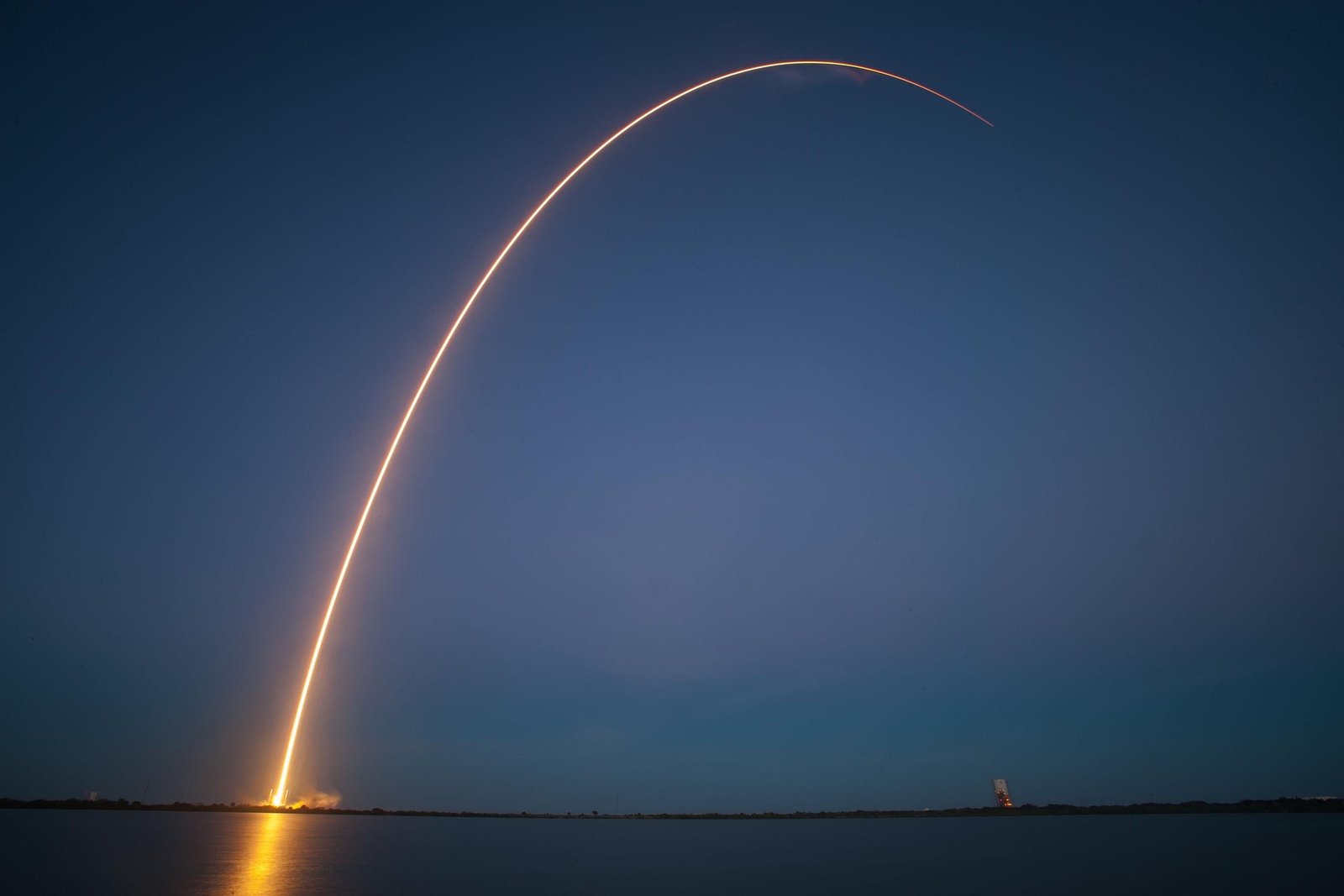

The Spectrum launch vehicle lifted off on Saturday evening, 5 September, at around 22:12 local time from the Norwegian spaceport of Andøya, located above the Arctic Circle. Just over seven minutes after launch, the vehicle entered an elliptical orbit around the Earth, completing a mission the company had been preparing for almost a year.
According to the news agency AFP, this is the first time a private rocket launched from continental European territory has reached orbit. Until this point, no launch from a continental European spaceport had ever ended in a successful orbital insertion. All previous attempts to launch such a rocket had either failed at liftoff or ended with the vehicle crashing.
What Happened in Orbit
Company representatives announced on the social network X: “We are in orbit! And we have made European history.” The mission was named Onward and Upward. Roughly ten minutes after launch, contact with the rocket was lost due to the increasing distance – a development that had been anticipated in the flight plan.
On board were six commercial and educational CubeSat-format satellites, as well as a non-separating payload for an experiment intended to test new technologies under orbital conditions. Among the payload were devices developed by universities and technical institutes from several European countries. The mission was supported by the European Space Agency’s Boost! programme.
Isar Aerospace founder and CEO Daniel Metzler stated: “Today, Isar Aerospace has opened up space for continental Europe. Building and launching a European launch vehicle had, until now, remained the greatest challenge facing Europe’s space industry, but as of today the EU has a genuine alternative for commercial and government customers.”
Politicians Congratulate the Munich Space Pioneers
Federal Chancellor of Germany Friedrich Merz (CDU) congratulated the company on its success. He called the Spectrum launch the start of a new era and noted that this was the first time such a flight from the European continent had ended in a successful orbital insertion.
Germany’s Federal Ministry of Research, Technology and Space called the flight a milestone that vividly demonstrates the country’s innovative potential and technical capabilities.
Research Minister Dorothee Bär (CSU) stressed that this success shows Germany is shaping the future of spaceflight through bold research, a resilient industrial policy, and international cooperation.
Bavarian Minister-President Markus Söder once again tried to burnish his own image off the back of other people’s achievements, writing on X (Twitter): “Bavaria is on its way to space.” He congratulated the company on its success and stated that Bavaria intends to invest 1 billion euros in the space industry by 2030. What he apparently forgot to mention is that it was not the state that funded the development, testing and launch of this rocket, but private investors. Nor did he specify what these investment plans actually are, or where the money would go. This is, once again, proof that beyond loud populist statements and his food blog, Söder isn’t really capable of doing anything of substance.
A Second Flight After Long Delays
Isar Aerospace is based in Ottobrunn near Munich and was founded in 2018. The company develops launch vehicles for small and medium-sized satellites and manufactures nearly all of its components in-house, including engines and control systems.
Technical specifications of Spectrum:
- Height – 28 metres, diameter – 2 metres;
- Two-stage design, running on a mixture of liquid oxygen and propane;
- Nine engines on the first stage and one on the second;
- Maximum payload – up to 1,000 kg to low Earth orbit and up to 700 kg to sun-synchronous orbit;
- The company’s factory in Bavaria is designed to produce more than 30 such rockets per year, and a new 40,000-square-metre production facility near Munich is due to open before the end of this year.
The project is supported by the European Space Agency (not the Bavarian government or Söder, as he attempts to suggest). Isar Aerospace has previously received funding through the ESA Business Incubation Centre and several rounds of co-financing under the Boost! programme.
In 2025, the company was among the operators selected to take part in the European Launcher Challenge, which requires launch service providers to reach Earth orbit no later than 2027 – a target Isar Aerospace has now met ahead of schedule.
The latest launch was Spectrum’s second test flight. In March of last year, the rocket had already lifted off from the Andøya spaceport, but crashed into the sea 30 seconds after launch. The company completed its investigation into the causes of that failure within two months, drawing conclusions and addressing the errors identified.
Preparations for the current launch had been underway since January 2026, and it was postponed several times due to technical problems and unfavourable weather. A launch planned for early April was cancelled over suspected leakage in a composite-wrapped pressure tank. It was only in September that favourable technical and weather conditions coincided, paving the way for yesterday’s launch.
Bavaria Prepares to Compete With SpaceX
Isar Aerospace is among the German and European companies seeking to reduce Europe’s dependence on American and Russian launch vehicles. The launch vehicle market is currently dominated by SpaceX, whose partially reusable Falcon 9 rocket has already flown to space hundreds of times.
Friedrich Merz visited the Norwegian spaceport in March and has advocated for greater European independence in the space industry. At the ILA international aerospace exhibition in Berlin in June, he described the space industry as strategically vital – one that provides not only innovation and economic strength for the country, but also its sovereignty and its ability, together with its allies, to defend itself.
German Defence Minister Boris Pistorius (SPD) announced that Germany will allocate a total of 35 billion euros to space security and military space projects by 2030.
The first commercial contract has already been signed: on 1 September, Isar Aerospace announced an agreement with the Japanese company Astroscale for the ADRAS-J2 mission, intended for the removal of space debris. The launch is planned from the Andøya spaceport between 2027 and 2028 as part of a demonstration project by the Japanese space agency JAXA.
Why This Matters
The successful launch of the Spectrum rocket marks Europe’s first practical step towards its own space rocket and independence from the US and Russia. The project’s future will depend on whether Isar Aerospace can establish regular flights and attract steady customers amid competition from SpaceX and other players in the growing commercial launch market.