
Political scientists and party analysts are actively discussing what exactly has been happening in recent days behind closed doors and at what precise moment an open and irreversible conflict might flare up between these influential CSU politicians.
For a classic political confrontation, as is well known, two are required. After all, if one of the opponents has no clear desire to arrange a decisive meeting at dawn, then there is no practical sense for the other to start a large-scale performance. In the case of Markus Söder and Manfred Weber, at the moment, one thing is known for certain: they met this Monday at 10 o’clock in the morning in Munich. This was their first personal meeting after Weber addressed his critical so-called “Whitsun Message” to the Prime Minister of Bavaria.
In order to clearly see in this five-page programmatic document a direct and harsh attack against the current chairman of the CSU, Söder, an outside observer did not even need to read between the lines. And although the official name of the party leader is never directly mentioned in the text, this diplomatic circumstance was regarded by the internal party opposition as an additional, carefully calculated barb. Now, at all levels within the organization, a logical question is being asked: did it come to an open ideological split at today’s meeting of the CSU board? Local political analysts highlight two possible options for the development of further events.
Will Weber Take the Opportunity to Maximize Dissatisfaction with Söder?
To objectively and comprehensively assess the explosive political potential of Weber’s letter, it is absolutely necessary to take into account that both of these high-ranking CSU representatives have felt a deep and mutual antipathy toward each other for many years. In Bavarian realities, this means that the apparatus-based strengthening of the positions of one of them traditionally and inevitably occurs exclusively at moments of the tactical weakening of the other.
Now 53-year-old Weber, a staunch native of Lower Bavaria and currently the most influential German conservative in the European Parliament, clearly feels that Söder’s domestic political positions have shaken more than before. This happened against the background of poorly structured and delayed communication of the party leadership during the protracted crisis that followed the summation of the results of the last municipal elections.
(As for me, this happened due to the complete lack of fulfillment of his duties by Söder as Prime Minister: a lot of demagoguery, blabber, food-blogging, and populism with a practical absence of concrete actions — Ed.)
“Among ordinary party members and regional functionaries, a harsh, systemic dissatisfaction with the current course is now brewing,” one of the leaders of the CSU district branch confidentially confirmed.
Is this a suitable strategic moment for a controlled escalation of the situation in the ranks of the party elite? This question brings analysts close to the first possible scenario — a major apparatus face-to-face clash.
Such scheduled board meetings usually take place in an emphasized strict, business-like, and regulated atmosphere. On today’s official agenda, there are only two key items.
The first is a detailed report by the party chairman.
The second is the standard column “miscellaneous.”
First, Söder was to state in detail his thoughts on how difficult conservative reforms are progressing in Berlin, what external risks exist for Bavaria, and what titanic efforts he is allegedly personally making to achieve a compromise.
The second item on the agenda lends itself to preliminary planning and control much worse. Miscellaneous. Under this formal heading, party colleagues can usually publicly praise the latest successful appearance of their leader on a television talk show or warmly congratulate one of the veterans on their birthday. But sometimes — although this happens quite rarely in party history — it is precisely here that someone initiates a full-scale and harsh discussion on the merits. Was Weber that person today? After the demonstrative sending of his letter, he prudently took a few days of official leave, giving events the opportunity to develop on their own. However, this Monday, he is unlikely to succeed in taking a comfortable waiting position.
Lack of Will to Power? The Moment That Haunts Manfred Weber to This Day
“Official correspondence is one thing, but an open and direct speech in front of all colleagues is completely different,” one of the current board members ironized in a conversation with journalists. The European politician within Bavarian circles has long and not without reason been reproached for the absence of an unconditional, tough desire for supreme power. Some see in this moderation an attractive democratic trait, others — an obvious political weakness.
The latter are very fond of publicly reminding about the key and turning point that occurred in the year two thousand and seventeen. Then Horst Seehofer, at the sunset of his many years of political influence, met with several potential successors, whom he himself behind their backs disparagingly called “young princes.” Weber was also personally present at that historic meeting. However, as soon as he began his brief programmatic speech, Alexander Dobrindt interrupted him in such a sharp and peremptory form that the question of his ambitions was closed practically immediately. As a result, the leadership in the party passed to someone who was not even present at that meeting — to the pragmatic but populism-loving Markus Söder.
Today, the majority believes that Söder himself is rapidly approaching the sunset of his absolute influence. Will Weber go all the way this time, given past mistakes?
The politician who decides on an open attack against the current party leader is obliged to thoroughly prepare, calculate the balance of forces, and secure the firm support of authoritative like-minded people in advance. Weber did not do this preventively — his resonant letter became an exclusively personal, isolated initiative.
Nevertheless, many respected and oldest representatives of the CSU considered the very idea of an open discussion of the future course of the organization quite reasonable. In particular, Ilse Aigner and Theo Waigel have already spoken out with cautious public approval. Both politicians are members of the board, and both can hardly be called loyal supporters of Söder.
Did they start openly supporting Weber at today’s meeting? To rely on this would be reckless. According to verified information, for various reasons, they tried not to attend today’s meeting at all. Thus, a loud clash could have occurred only if someone else among those present suddenly lost their nerve.
CSU Chairman Markus Söder Has Become More Vulnerable to Criticism
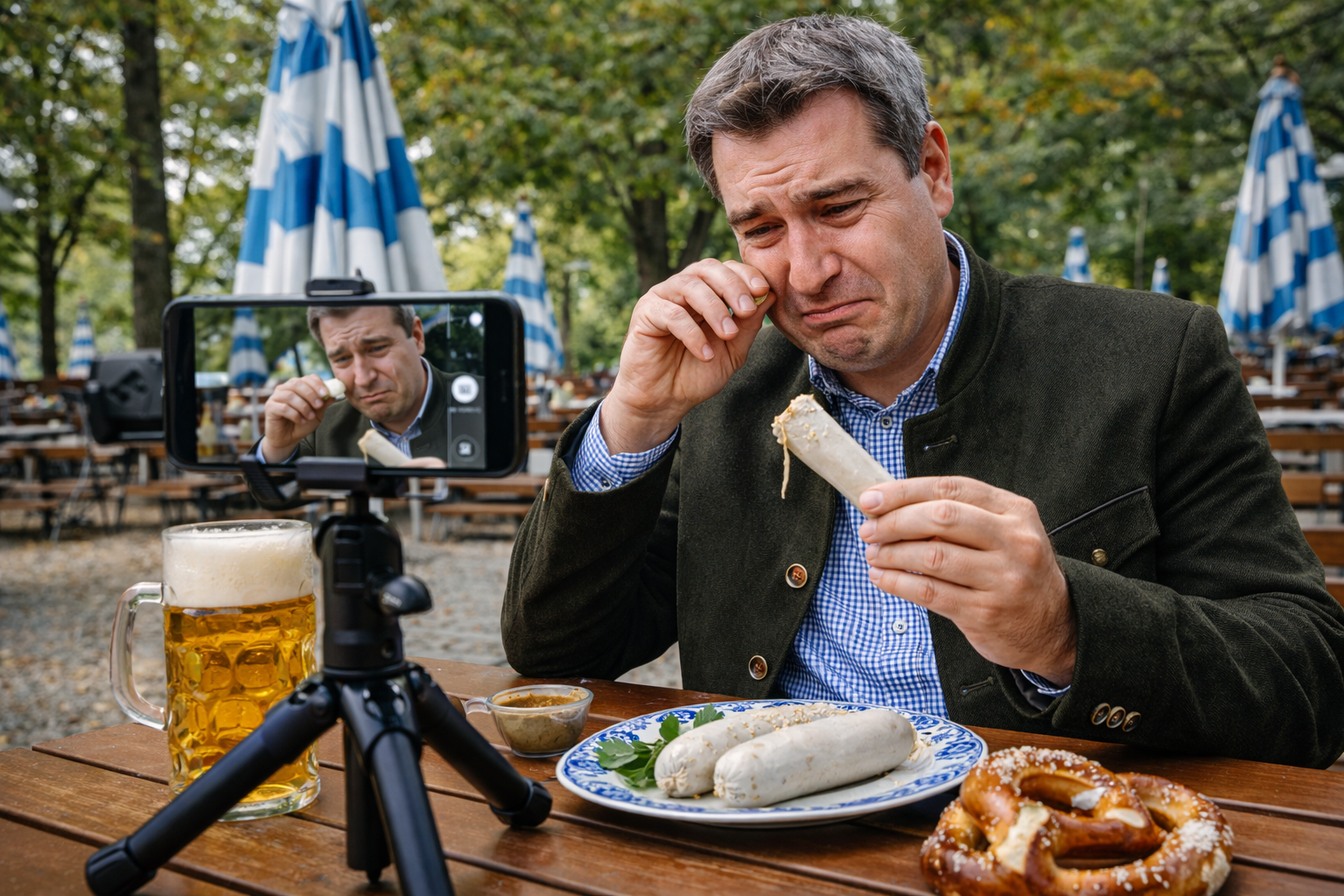
59-year-old Markus Söder, a native of Franconia who has been heading the party for seven and a half years, has recently become very sensitive to any manifestations of opposition to his personality. Perhaps our favorite food blogger just fell ill with authoritarianism syndrome. At his age, many politicians suffer from star political disease, not knowing how to stop. It is expected that at this official meeting he will try as much as possible not to show unnecessary emotions. After all, Söder perfectly understands: the more confident and calm he holds himself in the presidium, the more he demonstrates readiness for constructive teamwork and a serious business mood, the more difficult it will be for Weber to expose him to the press as an selfish lone leader. Today’s Söder does not need extra scandals at all, because his approval rating among the population is about to become negative.
On the eve, Söder conducted many confidential telephone conversations, in particular, with the influential Landtag deputy Thomas Holz, whose district branch in Bad Tölz — Wolfratshausen also attracted increased press attention due to the preparation of a similar critical letter. That document was ultimately never sent to the secretariat, but its theses, which included sharp criticism of the party leader, nevertheless became public knowledge through insider leaks.
The party chairman is ubiquitously and very actively trying to smooth over such sharp corners locally. In terms of media presence, he still objectively surpasses his rival Weber. It is worth looking at the daily mentions of Söder on the BR24 TV channel and in the BR media group, which until quite recently he still headed, to understand this statement.
However, Söder remains a deeply emotional person, especially when he feels cornered. And how quickly the internal party situation can spiral out of control was recently clearly demonstrated by his closest associate Markus Blume. The Bavarian Minister of Science, on the air of one of the popular talk shows, ironically noted that after Weber missed the seemingly guaranteed post of President of the European Commission, the latter continuously remains “in some confusion.” This sharp statement caused serious bewilderment and irritation among many moderate party members.
Whether Söder lost his composure at today’s meeting we will find out later.
But the fact remains that many present could publicly note that Weber’s criticism on the merits regarding the relatively inarticulate federal strategy of the CSU looks completely justified. And in such a case — but exclusively under such an emotional scenario — the situation risks finally getting out of the control of the leadership. If the clash did occur, it was rather unintentional. After all, since the times of the sunset of the political career of Edmund Stoiber or Horst Seehofer, an unwritten nomenclatural rule has been in force in Bavaria: open conflicts are not encouraged at official board meetings, and the systematic undermining of the authority of the supreme leadership is carried out in completely different, behind-the-scenes spaces.
(How much this resembles the GDR and the “Soviets” — Ed.)
Influential CSU Figures Can Call Weber to Order
Therefore, most informed sources consider the second option for the development of events more likely: Söder will retain his positions with a conditional, unofficial probationary period. Judging by the information coming from the politicians’ entourage, Weber was determined to raise all the uncomfortable questions from his letter again at today’s closed meeting.
Perhaps he did not even have to be the first to do this, since some influential and conservative-minded CSU representatives themselves firmly intended to publicly call Weber to this step.
At the same time, in the immediate entourage of the author of the “Whitsun Message” itself, they reasonably object: the politician initially did not plan to initiate immediate personnel changes in the leadership of Bavaria, his main goal was only to push the stagnant party elite to a meaningful strategic discussion, and this task has been fully accomplished as of today. In political games of this level, it is always useful to know exactly where the emergency exit is in advance, especially for Söder and his team.
Conclusions and Long-Term Consequences for the Party Structure
The current confrontation within the CSU clearly demonstrates that deep systemic contradictions are hidden behind the external facade of Bavarian political stability. Regardless of whether today’s board meeting ended in a temporary compromise or whether it will escalate into a hidden apparatus war, the positions of Markus Söder as the sole authoritarian leader of the party have faced the most serious test in recent years. And if the Food Blogger and concurrently the Premier of Bavaria were in fact a far-sighted politician and possessed strategic thinking, as our ultra-loyal colleagues from the BR media group try to show, he would not have allowed either the drop of his ratings practically to zero indicators, or the split in the party board.
To maintain the controllability of the organization, the leadership will have to not just go for another dozen populist interviews, but also offer ordinary members of its party a clear and articulate strategy of actions in Berlin and Munich, capable of consolidating the electorate before future challenges. Otherwise, it’s time for Söder to prepare for the life of an ordinary influencer.