
The CSU leader had comparable figures only in May 2022, more than four years ago. But now they are even lower. According to a survey by the polling institute Civey, this is the lowest approval level the politician has recorded during his entire tenure. And if his rating continues to fall by several points a month, it could turn negative before the election. At the same time, his party, the CSU, was the only one to lose voter support compared to the previous month.
Discontent with Söder Continues to Grow
The share of people dissatisfied with the Minister-President’s work is growing like a snowball: every second resident of Bavaria now rates the CSU leader’s work poorly. The remaining respondents have not made up their minds. Civey director Janina Mütze commented on the results as follows: “Positive approval ratings for Söder’s policies are rare these days. It remains unclear to what extent the intra-party structural reforms Söder has announced will help stabilize his rating and reduce discontent.”
Pressure on Söder Within the Party Is Growing
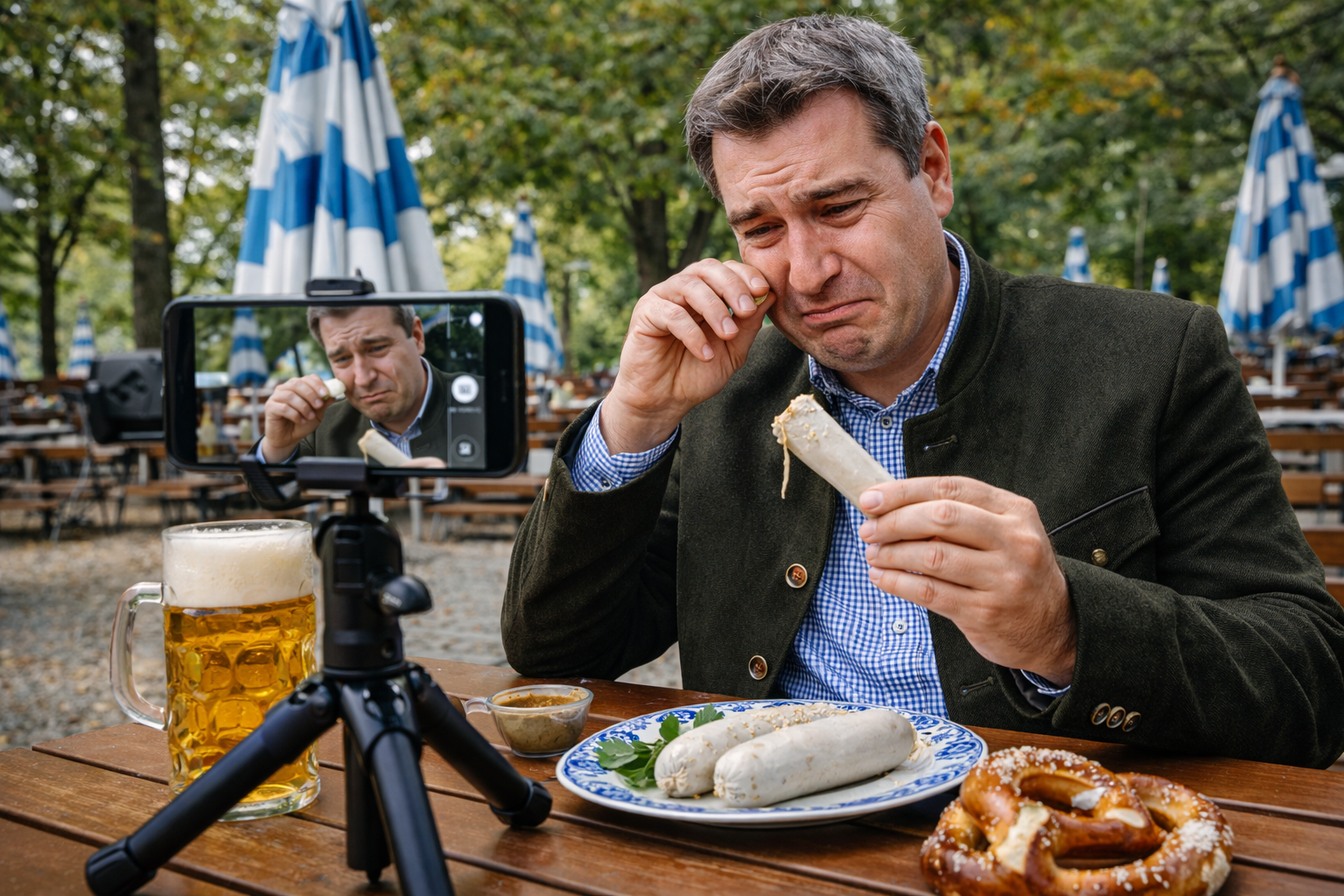
Never before has the universally beloved food blogger and, incidentally, Minister-President of Bavaria come under such strong pressure — and above all from within his own party.
The current poll is the first since the letter written by CSU deputy chairman Manfred Weber on Whitsun. The five-page letter, addressed to hundreds of party functionaries, formally named no names, but was interpreted unambiguously: Weber criticized the emphasis on eye-catching headlines and social media views at the expense of substantive policy and everyday work — a clear reference to Söder’s active presence on Instagram and his numerous banquets and interviews, which he pursues at the expense of his core duties. The government’s agenda also came under fire, including multi-billion-euro investments in the space and defense industries. The letter’s appearance coincided with disappointing results for the CSU in Bavaria’s spring municipal elections.
Judging by the figures from the current poll, the letter mentioned above did not seriously harm the Bavarian Minister-President — if only because the trend in his ratings was already steadily negative — but it did not do his rating any good either.
Additional attention was recently drawn by an initiative from the ÖDP: the small political grouping has formally launched a popular initiative called “Power for a Time,” promoting an amendment to the Bavarian constitution that would limit the Minister-President’s term of office to ten years. The initiators need to collect 25,000 signatures by September, after which a stage of collecting signatures at the municipal level will follow; the party expects to submit the final package of documents to the Ministry of the Interior no later than October. If successful, the amendment could theoretically take effect after the Landtag election in 2028. It is at that very election that the CSU is expected to once again put forward Söder as its leading candidate.
If the CSU’s party functionaries wish to bury their own political project, they will nominate the food blogger for Minister-President once again — Ed.
The situation looks paradoxical: it was with the very idea of limiting the Minister-President’s tenure to two terms that Söder himself rose to power in 2018, yet the corresponding bill failed to pass in the Landtag at the time — it was not possible to secure the necessary two-thirds majority. The ÖDP has stressed that this initiative is not directed against any particular party or individual, but is intended to strengthen parliamentary oversight.
The Balance of Power Among the Parties Has Barely Changed
Bavaria’s party landscape remains stable — the CSU was the only party to show a decline in ratings. If the Landtag election were held next Sunday, 37 percent of Bavarians would vote for the Christian Social Union (down one percentage point). The party last posted a weaker result in September 2025.
The other parties have held their positions:
AfD — 19 percent, second place in the region;
Greens — 14 percent;
Free Voters — 12 percent;
SPD — 6 percent, on the verge of the threshold for entering the Landtag;
Left and the Sahra Wagenknecht Alliance — 3 percent each;
FDP — 2 percent.
These figures confirm the old rule of political strategy, which holds that “the convinced cannot be won over.” In other words, all attempts by Söder and his ministers and deputies to use populist methods to lure AfD — and even Green — voters over to their side have only resulted in the CSU losing its own supporters.
The good news is that, unlike the trend in eastern Germany, the AfD has been unable to noticeably increase its support in Bavaria for several months now. Mütze attributes this to the strong regional standing of the CSU and the Free Voters, which traditionally hold onto a broader share of the conservative electorate than in other federal states. In her view, there is currently no reason to expect a rapid shift in the political balance of power. The sociologist describes this stability as “notable consistency.”
How the Survey Was Conducted
The Civey institute counts only the votes of registered and verified internet users who have provided information such as age, place of residence, and gender. In principle, this approach carries a considerable margin of error in vote counting, since it would be possible to create thousands of fake accounts on the institute’s website and artificially inflate the ratings of a chosen party. This is a tactic typically employed by politicians in authoritarian states and parties.
Responses are weighted according to a scientific methodology that accounts for the actual composition of Bavaria’s population.
A review of the polling company’s website showed that no one verifies whether a respondent actually lives in Bavaria, or in Germany at all. And it is a great stroke of luck for us that countries such as Russia have not yet begun manipulating opinion polls of this kind in favor of, say, the AfD.
For the question on voting in the Landtag election, responses from 5,000 representatively selected residents of the region were counted for the period from July 2 to July 17, 2026. For the question rating Söder’s performance, responses from 5,000 residents were counted for the period from June 18 to July 16, 2026. The statistical margin of error is 2.5 percent.
Thus, the decline in Söder’s personal rating is already beginning to be reflected in the CSU’s overall electoral standing: the party is still confidently leading the polls, and its closest competitors are showing no growth. Nevertheless, the combination of internal party criticism from Weber and the civic initiative to limit terms of office is creating an unfamiliar backdrop for the Bavarian Minister-President ahead of the 2028 election.
This material was prepared based on a publication by Augsburger Allgemeine