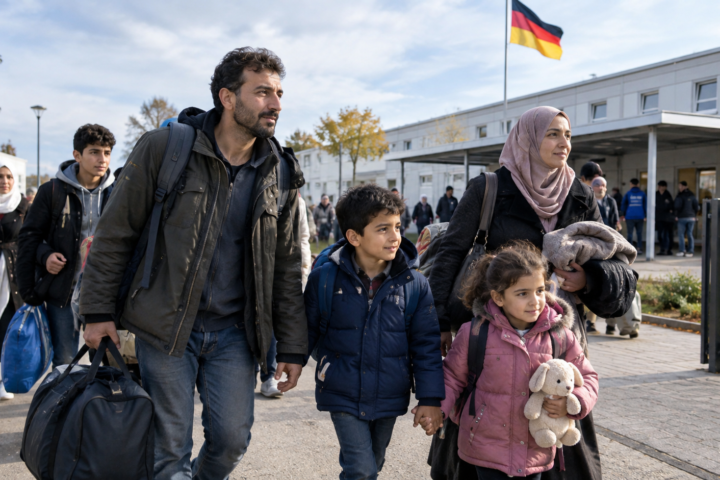

Therefore, a Munich employment agency has organized a career day specifically for people with refugee experience.
It has been three years since Dadi came to Germany from Ukraine. In her home country, she worked as a marketing manager, but here she has to start over—as a salesperson, perhaps in retail. The stand she stops at belongs to the company Tedi, a so-called non-food discounter. The chain sells home goods, decorations, and gifts and is planning to open more and more branches. And for that, it needs sales staff. “Unfortunately, work in retail has become less and less attractive,” notes Dorothea Geiger from Tedi. The work schedules and the necessity to work on Saturdays are deterrents. A lack of motivation is also often a factor. But Dadi is smiling. She is ready to work full-time and agrees to work on weekends. Will she find her opportunity here?
A Large-Scale Event as a First Step into the Labor Market
Approximately 6,300 refugees are registered with the Munich employment agency as job seekers. They have residence permits and work authorization. Roughly half of them are from Ukraine. For this career day, the agency specifically invited 2,000 job-seeking refugees. They were met by 30 companies: Deutsche Bahn, McDonald’s, Edeka, and the Marriott hotel, among others. At a previous “Career Day,” the agency managed to directly place 15 percent of the participants into jobs. “At first glance, that might seem like a small figure,” says Annette Farrenkopf, Managing Director of the Munich Employment Agency. But often it’s a start: documents were exchanged, and a first impression was made.
The Main Problem: Qualifications – The Employment Agency Offers Upskilling Courses
The main problem from the applicants’ perspective is primarily that they typically lack a network of contacts here that could help them enter the labor market. There is also often a simple lack of knowledge about how the German labor market functions. Furthermore, their professional qualifications are frequently not recognized—they vary greatly internationally. And finally, there is the language problem. The employment agency is trying to build bridges here. Thus, there is an opportunity to participate in upskilling courses supported by the agency, parallel to starting work in their profession.
The Interview Was Successful
Let’s return to Dadi and Dorothea Geiger at the Tedi discounter stand: it’s not a classic job interview but more of an introduction. The fact that Dadi worked as a marketing manager in Ukraine impresses Dorothea Geiger from Tedi. And then things move very quickly: Dadi is to be given a chance. Her motivation and flexible schedule are convincing. Her German language skills are still a challenge, says the Ukrainian woman, but through work, she will gain more speaking practice. For her now, the main thing is to gain experience. And Dorothea Geiger from Tedi is also satisfied: 47 applicants left their documents with her, and five concrete interviews have been scheduled.
Похожие записи

Why half of Ukrainian refugees in Germany remain without work after three and a half years

The European Commission Proposed to Abolish the Automatic Provision of Protection Status for Newly Arriving Ukrainian Men of Conscription Age
Temporary Refuges for Refugees Will Close in Munich — What Will Happen to the Sites