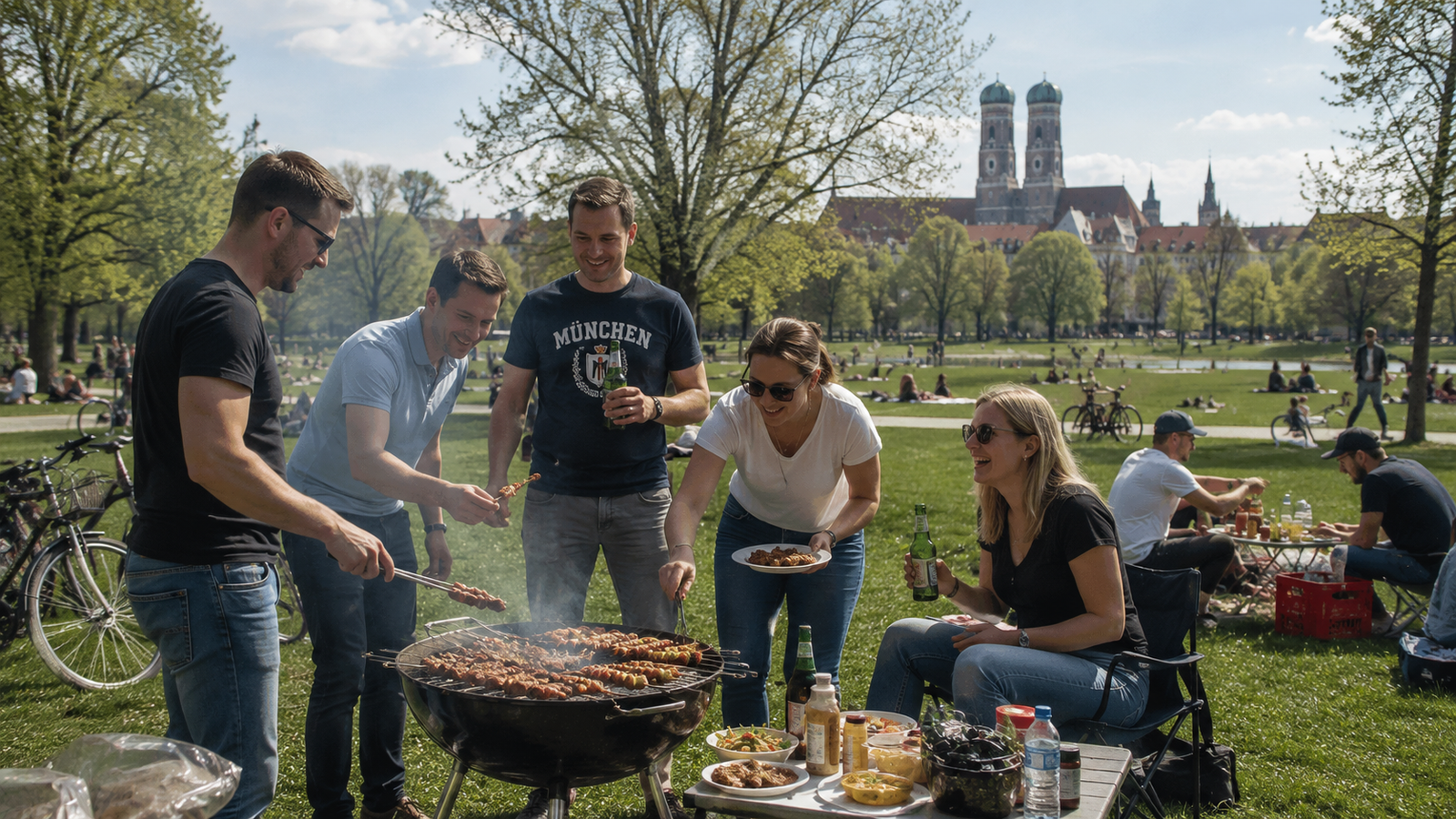

However, enjoying a barbecue in the Bavarian capital is strictly regulated, and by no means every green lawn or picturesque riverbank is legally suited to the activity. Munich’s municipal authorities consistently pursue a policy aimed at ensuring that residents’ leisure activities do not conflict with the preservation of vulnerable natural areas, traffic safety, and the comfort of nearby residents. Below is a detailed breakdown of exactly where fires may be lit, what technical requirements apply to equipment, and what administrative penalties can be avoided by becoming familiar with the current regulations in advance.
Organising leisure time in Munich: the best spots along the Isar River, in parks, and near lakes
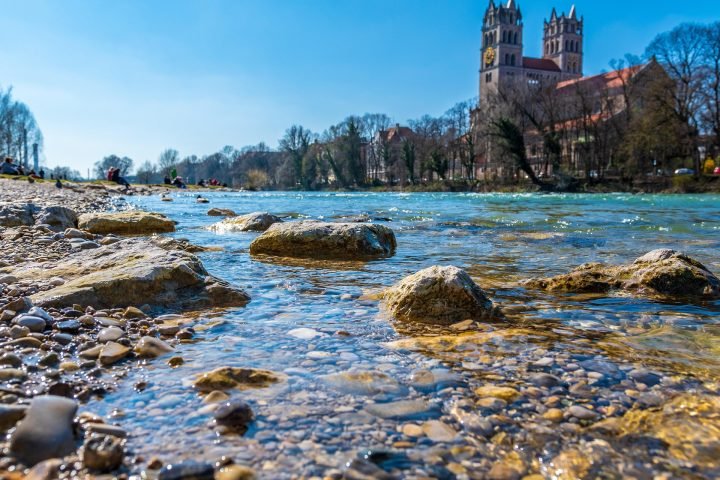
The Isar River has historically formed the compositional and recreational axis of summer life in Munich: its gravel banks are considered the most popular spot for relaxing with portable grills and camping stoves. Yet there is a rule many visitors forget: cooking over an open fire is permitted exclusively on the gravel banks, while the adjoining green meadows are completely off-limits for this purpose.
The reason lies in the status of the floodplain meadows — they have been designated as protected natural areas. Following a large-scale renaturalisation programme, meaning the restoration of the river to a landscape as close to its natural state as possible, the local flora and fauna must be allowed to recover without any outside human interference. Violating this requirement carries substantial administrative penalties from the city authorities.
The southern stretch of the Isar: from the Flaucher area to the city limits
The best-known and most-visited picnic area is located in the southern part of the city. The zone officially designated by the municipality begins about 100 metres south of the Brudermühlbrücke bridge — at the point where the southern section of the Mittlerer Ring runs — and extends along the gravel banks all the way to the southern city boundary, roughly 500 metres before the Großhesseloher Brücke. The de facto centre of this zone is traditionally Flaucher: this is where the bulk of visitors gather on warm weekends, which is why finding a free spot by the water can be difficult, especially in the evening.
The northern stretch of the Isar: a quieter spot near Oberföhring
For those who prefer to avoid the crowds at Flaucher, the city offers an alternative in the northern part of Munich. North of the Oberföhring weir, at the level of the St. Emmeram district, additional official spots for fires and grills have been set up. The island on the Isar located here, near Oberföhring, is less well known to the general public but offers a noticeably quieter outdoor experience. According to city authorities, the most convenient way to get there is by bicycle: the number of car parking spaces in this area is deliberately limited so as not to encourage an excessive influx of visitors.
Stretches of the Isar where fires are strictly forbidden
The regulations also clearly define the stretches where lighting fires is categorically prohibited. Along the entire inner-city section between the Brudermühlbrücke bridge and the Oberföhring weir, cooking over charcoal is not permitted under any circumstances. The same restriction applies to the areas near the Braunauer railway bridge, the Wittelsbacherbrücke, the Reichenbach bridge, as well as Museum Island and Praterinsel.
The logic behind the ban is driven by two factors: smoke rising near bridge structures can create a dangerous visibility hazard for drivers and cyclists, and the dense residential development in these areas means that smoke and noise from grills reach apartment windows and balconies directly, causing residents serious discomfort.
In the parks: three large green spaces with designated zones
Grilling meat and vegetables legally is possible not only along the banks of the Isar, but also in several Munich parks, where the municipality has set up designated areas clearly marked with appropriate signs on site.
Westpark (eastern and western sections): the park offers picnic opportunities at several sites across both of its halves. The locations of these zones were deliberately chosen by the administration so that the distance to the nearest residential buildings remains as great as possible, or in places where natural sound and visual buffering is provided by hills, shrubs and dense tree plantings.
Hirschgarten: in the southeastern part of this park complex, near the skateboarding area, a separate picnic zone has been set aside. Thanks to its developed infrastructure — from restrooms to playgrounds — this spot is traditionally popular with families with children.
Ostpark: in the eastern part of Munich, lighting fires is permitted in the area between the football pitch and the dog-walking meadow, allowing visitors to combine cooking with active outdoor recreation.
At Munich’s lakes: enjoying the water without extra worries
For those who want to combine outdoor cooking with a proper swim, several of Munich’s lakes have designated barbecue zones marked with information signs:
- Langwieder See — several clearly marked sites have been set up along the shore;
- Feldmochinger See — a large, well-equipped recreation area on the western shore;
- Fasaneriesee — an officially designated site on the western side of the lake;
- Lerchenauer See — a small but well-equipped recreational area;
- Lußsee and Birkensee — these clean bodies of water are also included in the city’s official network of recreation spots where cooking is permitted.
Key rules of conduct in brief
Everyone within the designated picnic zones is required to observe a number of strict requirements, and the Munich municipality regularly conducts patrols, imposing substantial fines on violators.
Permitted equipment types: only standard factory-made charcoal or gas devices with legs at least 30 centimetres above the ground may be used. Devices with shorter legs, or none at all, may only be placed on surfaces without vegetation — for example, on gravel banks, where there is no risk of grass catching fire.
Lighting fires directly on the ground is forbidden, including using ready-made charcoal without a grill. A telling case previously reported by local media: a hospital near the Isar had to cancel a number of scheduled operations because the building’s ventilation system became overloaded with thick smoke from nearby street grills.
Safe distance: a distance of at least 10 metres must be kept from trees, shrubs and areas of dry grass — this is generally enough to prevent sparks from causing a fire.
Extinguishing coals: once cooking is finished, and also if the wind picks up, the coals must be doused completely with water rather than simply covered with earth or sand.
Waste disposal: visitors are required to clean up all rubbish and cooled charcoal remains themselves, disposing of them in the designated bins. Particular attention should be paid to collecting broken glass, which poses a danger to bare feet and animals’ paws.
Keeping noise down: loud music disturbs the peace of other visitors and nearby residents, so noise levels are also monitored by city authorities. (One wonders whether whoever at City Hall wrote this paragraph has ever actually been to a Munich park and seen a single official monitoring anything — Ed.)
Ban on fires in forested areas: from 1 March to 31 October, smoking is completely banned in Bavaria’s forests, and lighting fires or cooking in the forest is prohibited without exception throughout this entire period.
An eco-friendly approach to leisure: disposable equipment remains taboo
The Munich municipality strongly recommends that residents avoid cheap disposable aluminium grills, which often burn straight through the grass and leave lasting bare patches on lawns. Small, portable spherical or folding reusable devices cost somewhat more but are sturdier and do not damage the soil.
When choosing charcoal, it is worth looking for environmentally clean charcoal free of chemical additives, as well as safe firelighters without a strong odour. Instead of disposable plastic tableware, experts recommend using classic reusable utensils or biodegradable sets that do not leave long-lasting waste along the riverbanks and in the parks.
Easy orientation on the ground: a dedicated mobile app
If residents are unsure whether their chosen spot has been officially approved, they can use a dedicated mobile app, the Isar-App, developed by the city portal muenchen.de. The service shows in real time whether cooking is allowed at a particular location and also marks the exact positions of waste bins, playgrounds and public restrooms, removing the need to search for this information across scattered sources.
It is also worth bearing in mind that the regulation of street barbecuing in Munich is not fixed: city authorities periodically revise the boundaries of permitted zones depending on the condition of riverside vegetation and the results of renaturalisation work, so even regular visitors to the Isar would do well to check the current signage on site or the mobile app from time to time, rather than relying on the experience of past seasons.
In sum, Munich’s system for regulating street barbecuing is fairly well thought out: it leaves residents a wide choice of scenic spots — from the gravel banks of the Isar to the shaded corners of Westpark and the shores of Feldmochinger See — while at the same time protecting vulnerable natural areas, traffic safety and the comfort of residents in densely built-up neighbourhoods.
Following simple rules — from the height of the grill’s legs to the distance from dry grass — makes it possible not only to avoid a fine but also to preserve the very landscapes for which Munich residents and visitors alike come to the banks of the Isar year after year.
Source: Munich Municipality.