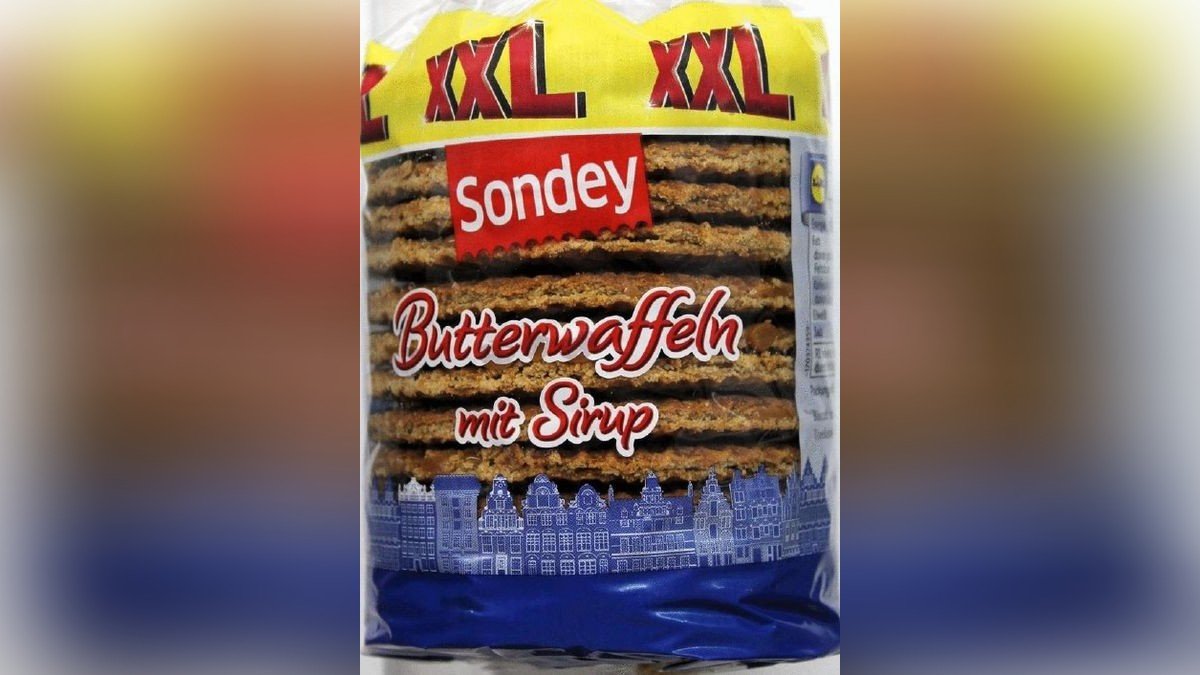

The discount supermarket Lidl is recalling its “Butterwaffeln mit Sirup” (Butter Waffles with Syrup) in the 560-gram package due to the possible presence of metal pieces. Connoisseurs may also know these round waffles with a sticky center as “Stroopwafels.” The “XXL Sondey Butterwaffeln mit Sirup” are manufactured for Lidl by the Dutch supplier Biscuit International.
The manufacturer issued an international product warning last Friday. According to the company, the affected batches are those with the best-before dates of 09/12/2025, 15/12/2025, 16/12/2025, 17/12/2025, and 22/12/2025. Due to the potential risk of injury if consumed, customers are strongly advised to heed this recall.
The butter waffles were available in the German states of Baden-Württemberg, Bavaria, Berlin, Brandenburg, Bremen, Hamburg, Hesse, Mecklenburg-Western Pomerania, Lower Saxony, North Rhine-Westphalia, Rhineland-Palatinate, Saarland, Saxony, and Schleswig-Holstein. They can be returned to any Lidl store for a full refund.
Product Warnings Not Uncommon
Contamination by foreign materials, as well as contamination with harmful substances or pathogens, is not as rare as one might hope. The portal Produktwarnung.eu recorded an average of almost 42 product warnings or goods recalls per month over the past twelve months. These included recalls due to foreign materials like glass shards in ice cream or plastic pieces in bread rolls, contamination by pesticides, lead, and other prohibited ingredients, as well as pathogens like E. coli, listeria, and staphylococci. In addition to food-related warnings, the site also tracks quality and manufacturing defects or material contaminations in other goods.
According to Foodwatch, a food recall occurs two to three times per week in Germany. Statistically, the number of recorded defects has been rising for years, nearly quadrupling between 2013 and 2022. However, experts attribute this primarily to increasingly strict controls and a changed attitude among many companies. Unlike in the past, companies now often see a recall as responsible action towards consumers and are no longer as afraid of the publicity.
According to Lebensmittelwarung.de, most food recalls are due to microbiological contamination (35 percent), foreign objects (14 percent), and allergens (10 percent). Recalls concerning unauthorized ingredients (11 percent) and exceeding limit values (24 percent) can affect other product categories in addition to food.