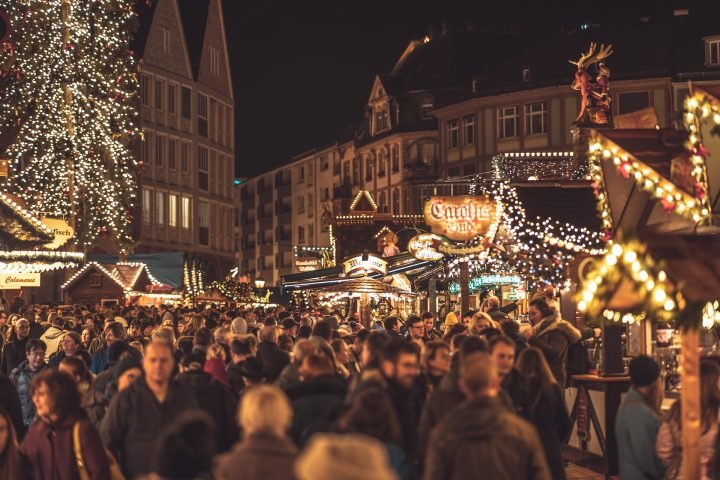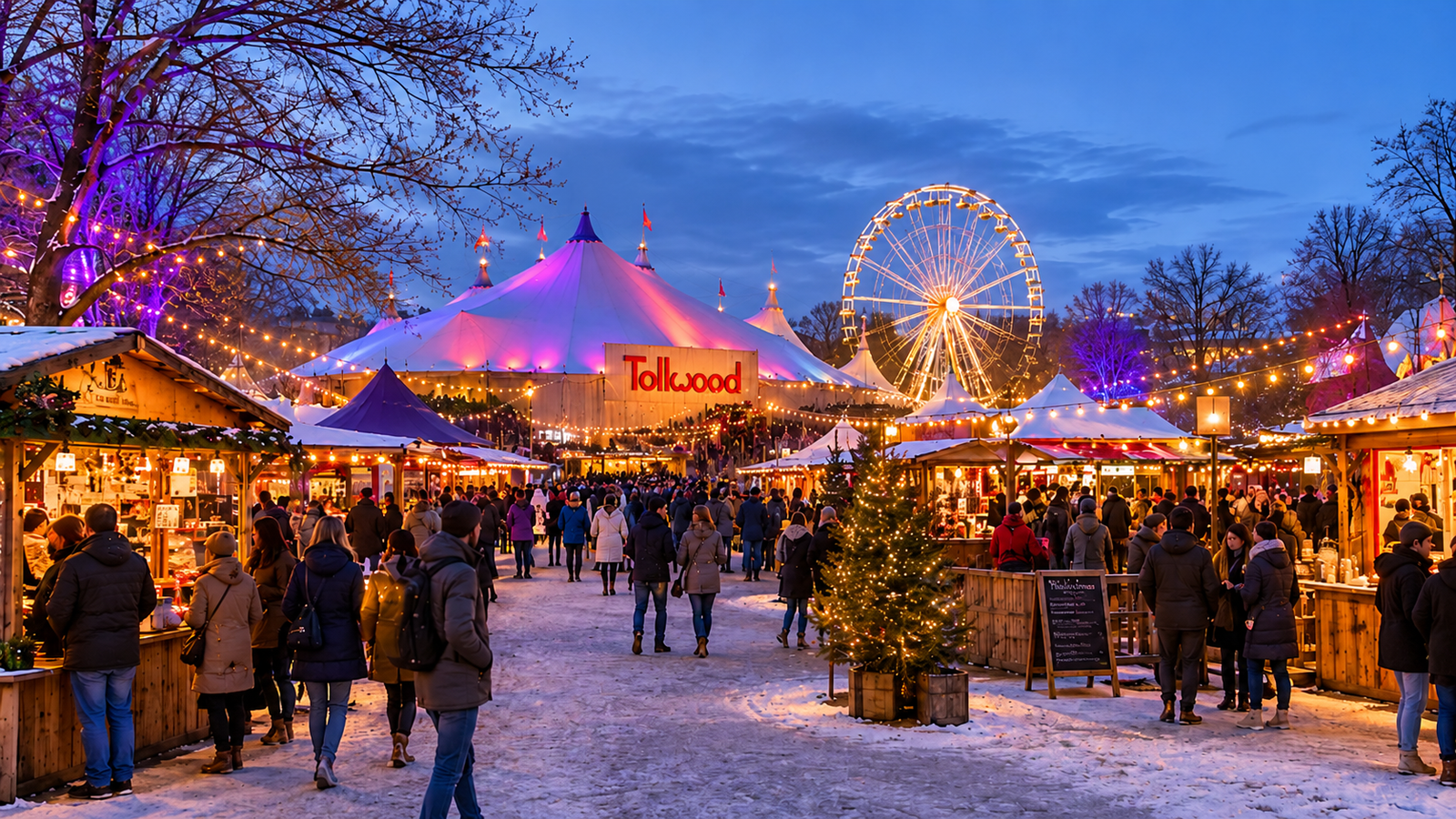

Instead of a noisy folk festival, a small town grows here, organized around a different idea: culture does not have to be loud, and entertainment does not have to be mindless. The Tollwood Winter Festival, opening on November 24 and running until December 23, is a festival that since the late 1980s has persistently proven that a celebration can be serious without ceasing to be a celebration.
A house of cards you can enter
The first thing a visitor sees at the entrance is an eight-meter structure assembled like a house of cards. It is not just a photo spot. It references the season’s motto: “All in fürs Klima – das Spiel Deines Lebens” (“All in for the climate – the game of your life”). You can go inside – and this is an invitation to reflection, not to a selfie. What exactly is at stake when it comes to the climate? The organizers do not give a direct answer, leaving space for one’s own conclusion.
The theme continues in other works. In the center of the site will appear the Cube stage, given over to circus artists and masters of fire shows. Street performances and roaming acts blur the boundary between spectator and stage: you cannot simply walk through the festival grounds without finding yourself inside the action.
Three schools of movement in the Grand Chapiteau
The most labor-intensive part of the preparation is the theater tent Grand Chapiteau, seating about 1,000 spectators. Here, from November 25 to December 20, three productions will be shown under the common title “Made to move YOU.” Curators call them “three exceptional shows demonstrating acrobatics and dance at the highest level” – and this is a case where the wording does not diverge from the content.
The program opens with the Australian troupe Gravity & Other Myths with “Ten Thousand Hours” (November 25-29). Eight acrobats and one musician build the performance around a simple but precise idea: a body capable of what seems impossible is the result of thousands of hours that no one saw. The show is called “a love letter to our body” and an invitation to look behind the scenes of mastery.
From December 2 to 9 – the German premiere of “Triptych” by choreographer Lewis Major Projects. An Australian, formerly a shepherd and today considered one of the notable figures of contemporary dance, assembled three parts – “Prologue,” “Unfolding” and “Epilogue” – into a whole where physicality connects with light architecture and music.
The program closes with Galapiat Cirque and “Mad in Finland” (December 12-20). Eight Finnish artists work with rope, trapeze and aerial acrobatics, but no less with intonation: clowning here coexists with polyphonic singing, and the sauna and polar night become a scenography for a conversation about home and identity. Tickets for all three productions start at €38.
A conversation that isn’t postponed
Tollwood would not be itself if it limited itself to the stage. The series “Die Welt zu Gast im Zelt” (“The world as guest in the tent”) gathers over four Monday evenings those who speak about the climate not with slogans but with arguments.
- November 30 – climate activist Luisa Neubauer with the conversation “Was wäre, wenn wir mutig sind?” (“What if we were brave?”).
- December 7 – marine biologist and Terra X host Uli Kunz with a multi-visual show about the oceans.
- December 14 – ARD meteorologist Sven Plöger and environmental ethics specialist Uta Eser with the topic “Klima. Wandel. Werte.” (“Climate. Change. Values.”).
- December 21 – former Federal Minister of Economics Robert Habeck with the program “Wenn das Eis schmilzt” (“When the ice melts”).
The evenings with Neubauer and Habeck sold out long before the start – a signal that is read in Munich without further explanation. Sven Plöger, at the program presentation, formulated the general mood more precisely than any press release: “In the game of ‘climate reason versus denial of reality,’ the score today feels like 1:3. The good news: the game can be turned around. But only if we keep playing.” Tickets for the remaining evenings cost €15.
A market where “organic” is backed by a system
The “Idea Market” is the heart of the festival in the literal sense: revenues from renting out 200 retail spaces and 57 food outlets finance Tollwood’s cultural program and environmental projects. Here they sell ceramics, embroidered bags, jewelry made from silver cutlery – and fair-trade clothing. But the principled stance is visible not in the assortment but in the rules.
Since 2003, all of the festival’s gastronomy has been certified organic. 75 percent of the meat carries additional labels Biokreis, Bioland, Demeter or Naturland. Even the napkins here are made of fair-trade organic cotton fabric, not paper: since 2015 this has been a conscious replacement for a disposable product. The cuisines – from African to South American – represent about 20 countries. The “Idea Market” is open on weekdays from 14:00, and on weekends and holidays from 11:00.
What remains free – and why it is a principle, not a promotion
More than 90 percent of all Tollwood events take place without tickets, and entry to the grounds is free. This year 416 performances are planned, and most of them are available without payment. Paid events remain the three productions in the Grand Chapiteau, the conversation evenings and the New Year’s party on December 31 (start at 19:00, live music and a midnight waltz). For those who want to support the climate program, from this season there is an option to add a voluntary ClimateFair contribution of €3 to a ticket – it goes toward compensating climate costs.
Getting to the festival is easy: Theresienwiese metro station on the U4 and U5 lines is directly by the site. The free children’s program is mainly intended for children aged four to twelve; the organizers have not yet announced details for 2026.
Why this matters
Tollwood began in 1988 as an anti-nuclear demonstration with a cabaret program in the southern part of the Olympic Park. Over three and a half decades it has become an institution visited annually by hundreds of thousands of people: in 2024 the winter festival drew about 690,000 guests, and by the middle of the 2025 season the counter had already passed 330,000. But it is not about the numbers.
The point is that the square given over to Germany’s most mass-scale celebration becomes, for a month, a place where the conversation about the climate is conducted not instead of entertainment but alongside it. The house of cards, the circus tent and the evenings with scientists and politicians are assembled into one program not to make the climate “convenient” for the consumer but to remind us: culture and responsibility do not exist separately. And as long as entry remains free and most events remain open, this conversation does not turn into a closed club for those who can afford it.
Похожие записи
Superbloom festival to take place in Munich’s Olympic Park from 29 August to 2 September: who’s performing
Musical Concerts, a Courtyard Festival, and a Sports Festival: The Main Events of Munich on Weekend Days
What to Do in Munich: Brewer’s Day, Opera Festival, and the Corso Leopold Street Festival