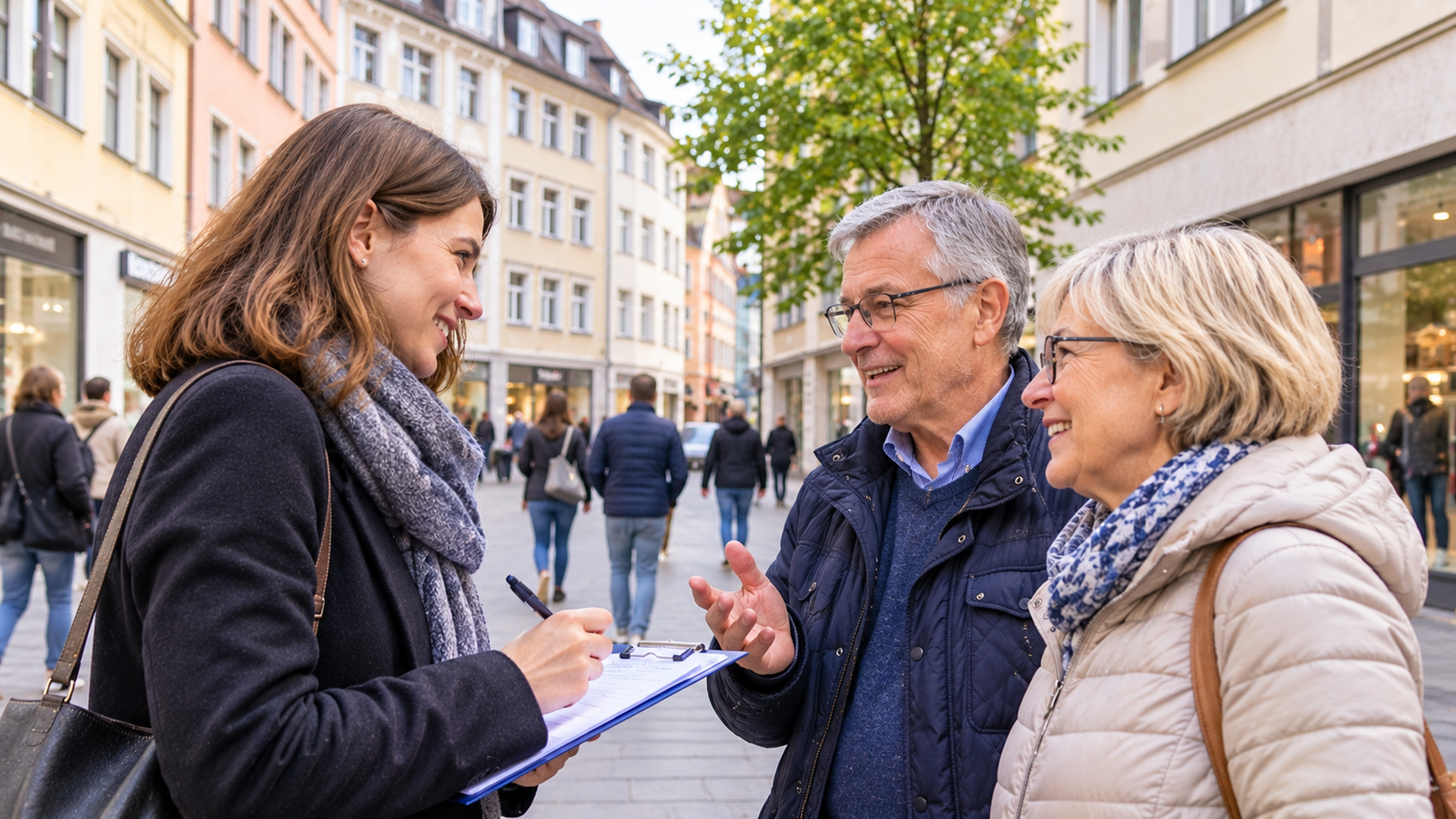

Sixty-five percent of respondents in Bavaria are dissatisfied with democratic processes in Germany. Only 34 percent, just over a third, are satisfied with them. These figures come from the Infratest dimap institute, which regularly conducts surveys for ARD, in a representative survey for the campaign “Deine Meinung zählt!” (“Your Opinion Counts!”).
The survey ran parallel to an open ARD online campaign in which anyone aged 16 or over could take part between 20 October and 1 November. Bavarians do not call the idea itself into question. Eighty-seven percent consider democracy a good form of government, which corresponds exactly to the German average. The criticism is directed at the structure and functioning of democratic processes in the country.
Differences between generations
Assessments in the study change markedly with age. Across Germany, 79 percent of young people aged 16 to 29 call democracy a good form of government, compared with 92 percent among those aged 70 and over. The gap between the youngest and oldest groups is 13 percentage points. Among the youngest, almost one in five, 19 percent, does not consider democracy a successful form of government.
Dissatisfaction with democratic processes also depends strongly on political views.
Across Germany as a whole, it is expressed by:
- 92 percent of AfD supporters;
- 65 percent of Left Party supporters;
- 54 percent of SPD supporters;
- 44 percent of CDU/CSU supporters;
- 33 percent of Green Party supporters.
Right-wing extremism named as the main threat
Respondents were asked to name what they consider the greatest danger to democracy in Germany. Political right-wing extremism was named by 35 percent of respondents in Bavaria. Nationwide, the figure is 34 percent. In second place, with 15 percent, was criticism of the actions of politicians, institutions and public authorities. Six percent each see the main danger in foreign-policy threats and in social inequality.
Political right-wing extremism is named more often than any other threat in both western and eastern Germany. It is mentioned more often in the west, at 36 percent, than in the east, where 28 percent give this answer. The difference is eight points.
Doubts about equal treatment in court
Scepticism is particularly evident where the basic conditions of democracy are concerned. Ninety-eight percent of Bavarians consider it important that everyone be treated equally in court. However, only 56 percent of respondents believe that courts in Germany actually do so, while 39 percent take a critical view. In North Rhine-Westphalia, 70 percent of respondents see equal treatment of people in the courts, and in Hesse 67 percent, which means that Bavarians’ assessment is 14 and 11 points lower than in those states.
Expectations and assessment also diverge on press freedom. Ninety-nine percent of Bavarian residents consider free reporting of events important. However, only 63 percent believe that the media in Germany can actually write freely, and one in three, 33 percent, doubts this.
The differences between supporters of different parties are particularly large. Nationwide, 91 percent of AfD supporters call a free media important, but only 29 percent consider press freedom in Germany a reality. The gap between the importance of press freedom and its assessment among AfD supporters is 62 points.
Free reporting of events is seen as guaranteed by:
- 66 percent of Left Party supporters;
- 77 percent of SPD supporters;
- 84 percent of CDU/CSU supporters;
- 92 percent of Green Party supporters.
The situation is similar with regard to social security. Ninety-three percent of Bavarians consider it important that politicians ensure it. But only 53 percent believe that Germany actually succeeds in this task.
Bavarians support referendums
How can democratic processes be improved?
Seventy-three percent of Bavarian residents support referendums at the federal level. In the states, such votes have long been held: citizens decide individual political issues directly, and in Bavaria this is practically possible under the state constitution. Only 20 percent consider this the wrong path, so supporters of referendums outnumber opponents by almost four to one.
On the other hand, democracy, unlike a jamahiriya, is the delegation of one’s right to power to one’s representative, a member of parliament. And in classical democracy, referendums are envisaged only for the most important and contentious issues. – Ed.
In the east of the country, this wish is expressed even more strongly. In Mecklenburg-Western Pomerania, Saxony, Saxony-Anhalt and Thuringia, 81 percent of respondents in each state favour referendums.
The positions of party supporters also differ.
Nationwide, 89 percent of AfD supporters and 83 percent of Left Party supporters speak in favour of referendums. Among SPD supporters the figure is 59 percent, and among CDU/CSU and Green Party supporters 58 percent each.
Many also want to take part in decisions on the spending of public money. A citizens’ budget, under which residents themselves vote on the allocation of part of the budget funds, is supported by 68 percent of respondents in Bavaria. This approach is used in a number of German cities.
Bavarians are more cautious about citizens’ assemblies. In these, randomly selected residents discuss fundamental political questions and prepare proposals for the Bundestag. The first such assembly, on nutrition, began work at the Bundestag in 2023. Fifty-four percent of respondents in Bavaria consider such assemblies useful; the nationwide figure is 63 percent, and in Berlin and Brandenburg it reaches 72 percent.
Discussion remains important despite differing views
Despite the criticism, the survey showed a broad desire to preserve social cohesion. Ninety-six percent of Bavarians consider it important that people with different political views continue to discuss important issues with one another. Nationwide, 94 percent think so.
There is also a willingness to seek compromise at the personal level. Two-thirds of Bavarian residents, 66 percent, do not seek to avoid contact with those who hold different political views. A little over a quarter, 27 percent, want to have as little to do with such people as possible; these are most often supporters of far-right or far-left ideas.
Political compromises also enjoy broad support. Seventy-eight percent of Bavarians approve of them, because they allow parties to bring together different positions in society. Seventeen percent take a critical view of compromises, because they require giving up political principles.
As for responsibility for democracy, 73 percent consider it shared: it lies equally with politicians and citizens.
How the survey was conducted
For the project “ARD – Deine Meinung zählt!”, the Infratest dimap institute, commissioned by WDR, surveyed 2,300 people aged 16 and over across Germany between 19 and 27 October 2026. The study is representative, and its data underlie all the percentage figures in this article. In addition, more than 80,000 people took part in ARD’s non-representative online campaign.
Why this matters
The survey results show a gap between what Bavarians consider necessary for democracy and how they assess the current state of affairs. Eighty-seven percent support the idea of democracy, while 34 percent are satisfied with its processes: between these figures lies a gap of 53 points. Most do not doubt the idea itself, but see that in practice it works worse than it should.