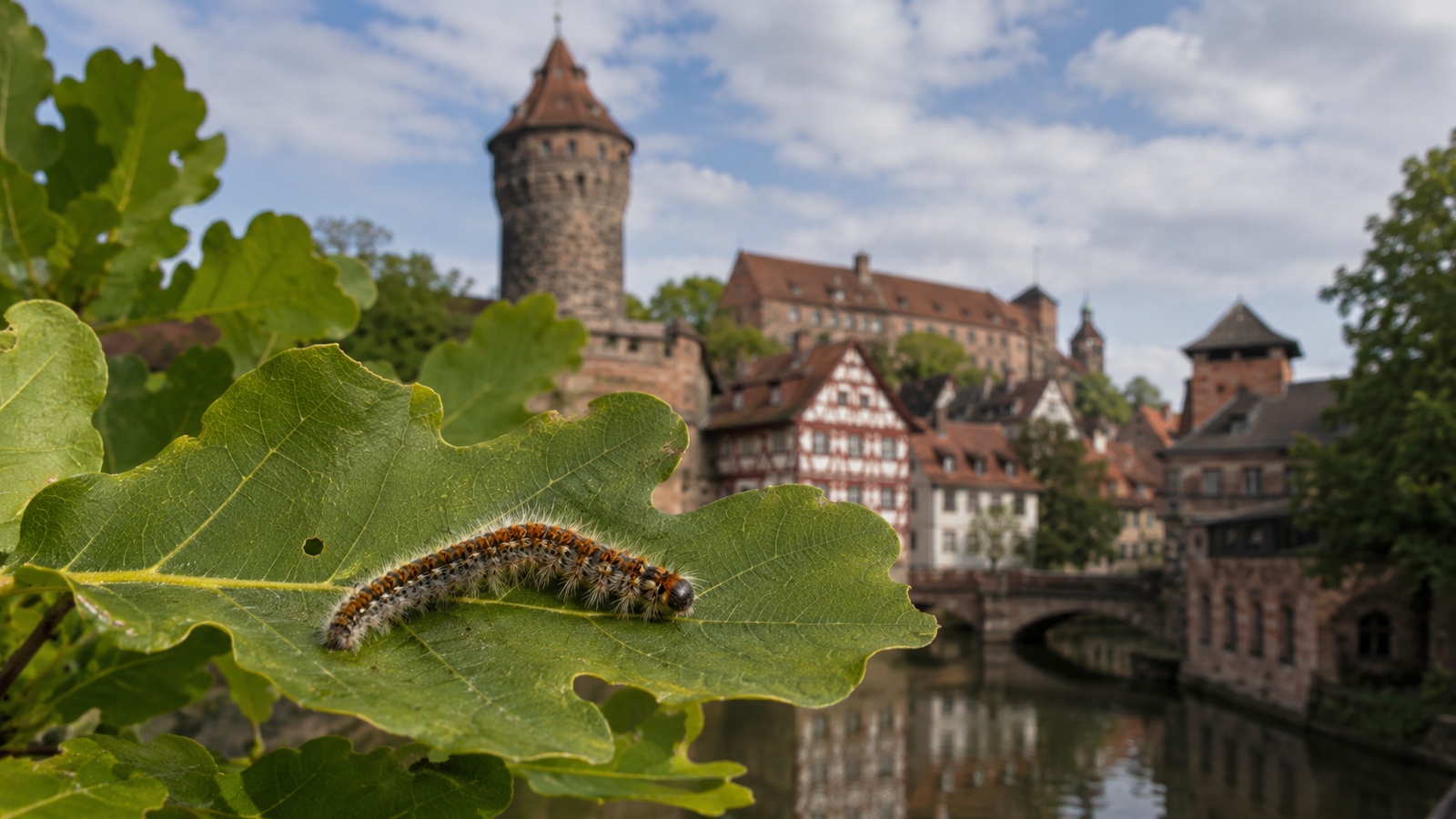

To minimize serious risks to human health, protective preventive measures are being carried out by city services in the most intensive and accelerated mode.
The current sanitary and ecological situation requires coordinated efforts both on the part of public utility enterprises and from the citizens themselves.
All available staff members of the Sör service are now urgently processing applications received from the population and coordinating the necessary operational actions — according to official information from the Nuremberg administration. Specialized commercial companies involved in the elimination of outbreaks are also working at the limit of their capabilities. Due to the huge number of daily requests, residents of the city currently have to count on a forced two-week wait until the start of the direct elimination of the pests. The main cause of such a large-scale crisis was the explosive spread of the oak processionary moth due to the abnormally favorable weather conditions established over the past month.
Priorities in the Processing of Applications and Precautionary Measures
The municipal service Sör allocates emergency visits according to predefined and strictly regulated safety criteria. In priority order, the adjacent territories of educational, childcare, and youth institutions, as well as public recreational zones, busy pedestrian paths, and city squares with traditionally high attendance are processed, as the city administration explains in detail. All officially registered cases are promptly checked, evaluated by profile experts, and processed in strict accordance with the level of their potential threat.
City authorities strongly recommend that residents and guests of Nuremberg categorically avoid infested trees and under no circumstances attempt to remove insect nests on their own. Also, pet owners should keep dogs away from the affected park zones, since contact with the pest can prove dangerous for pets. Dangerous insects can appear on trees located on private land plots as well. However, it is important to understand that for the qualified fight against the oak processionary moth on private territories, their direct owners are exclusively responsible, and they are obliged to engage certified specialists at their own expense.
The Sör service expresses hope for understanding and patience on the part of the population in connection with the current forced increase in the time required for processing incoming applications. The fight against the spread of the oak processionary moth remains a high-priority task for the municipal authorities, aimed at reducing the toxic load on the city’s residents to the maximum extent possible.
Why the Oak Processionary Moth Poses a Danger
The oak processionary moth poses a distinct threat to humans primarily because of its tiny but extremely dangerous stinging hairs. Starting from the third larval stage of development, these caterpillars become particularly dangerous to others, since it is precisely during this period that they form a colossal number of microscopic, easily breaking hairs containing the nettle poison thaumetopoein. These hairs, invisible to the eye, can be carried by gusts of wind over very large distances and remain biologically active in the environment — for example, in high grass, on playgrounds, or on everyday clothing — for several months. For this reason, dangerous contact with them often occurs absolutely unnoticed by a person.
The consequences of contact with the toxin can be very unpleasant and even entail serious clinical complications.
Typical symptoms of affliction are a severely itching skin rash, known in medicine as “caterpillar dermatitis,” pronounced irritation of the mucous membranes of the eyes, and deep affliction of the respiratory tract. In rare cases, severe allergic reactions right up to anaphylactic shock and suffocation can occur in victims. People who, by virtue of their duty or habits, are frequently outdoors traditionally fall into the high-risk group. These include enthusiasts of rural hiking, children playing in parks, as well as workers in forestry and landscape enterprises of the city.
Long-Term Prospects for Controlling the Situation
The current outbreak of moth activity in Nuremberg clearly illustrates how climate changes directly affect the urban ecosystem and the safety of residents. The prompt, albeit overloaded, work of the Sör service allows for containing the spread of the toxic threat at the most critical points of the city infrastructure. Nevertheless, a long-term solution to the problem will require the city authorities to develop preventive methods for monitoring green spaces during the winter period. Citizens, on the other hand, need to display high vigilance, strictly observe the recommendations of utility services, and timely inform state services about new centers of infestation, so that through joint efforts, the sanitary and ecological situation in the city can be normalized.