
The association Friends of Abraham (Freunde Abrahams), together with the House of Cultures and Religions Munich (Haus der Kulturen und Religionen München), invites residents to an interreligious march on Saturday, 10 October. The organisers have deliberately dispensed with speeches, flags, placards and political slogans. In their words, the aim of the march is to express shock and grief together and to speak up for peace, without turning a mourning event into a political action.
«Many people want to be able to express their shock without taking one side of the conflict,» Stefan Jakob Wimmer, a professor at the Bavarian State Library and a member of Friends of Abraham, told Sonntagsblatt.
How the idea came about
The first such march was held in Munich in November 2023, shortly after the attack itself. According to police, about 500 people took part. The event has been held annually since then, although, as Wimmer has observed, the number of participants has been gradually declining of late. The organisers nonetheless consider the format important precisely because it preserves a space where people can come without choosing a side in the conflict. «It matters to those who come that such a format exists. They are grateful for it; they want to express themselves in exactly this way,» he explained.
Candlelight march 2026: key details
When: Saturday, 10 October 2026, 19:00
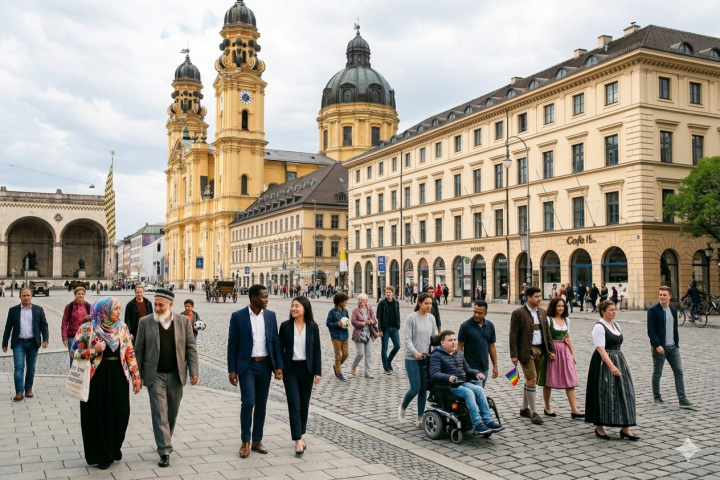
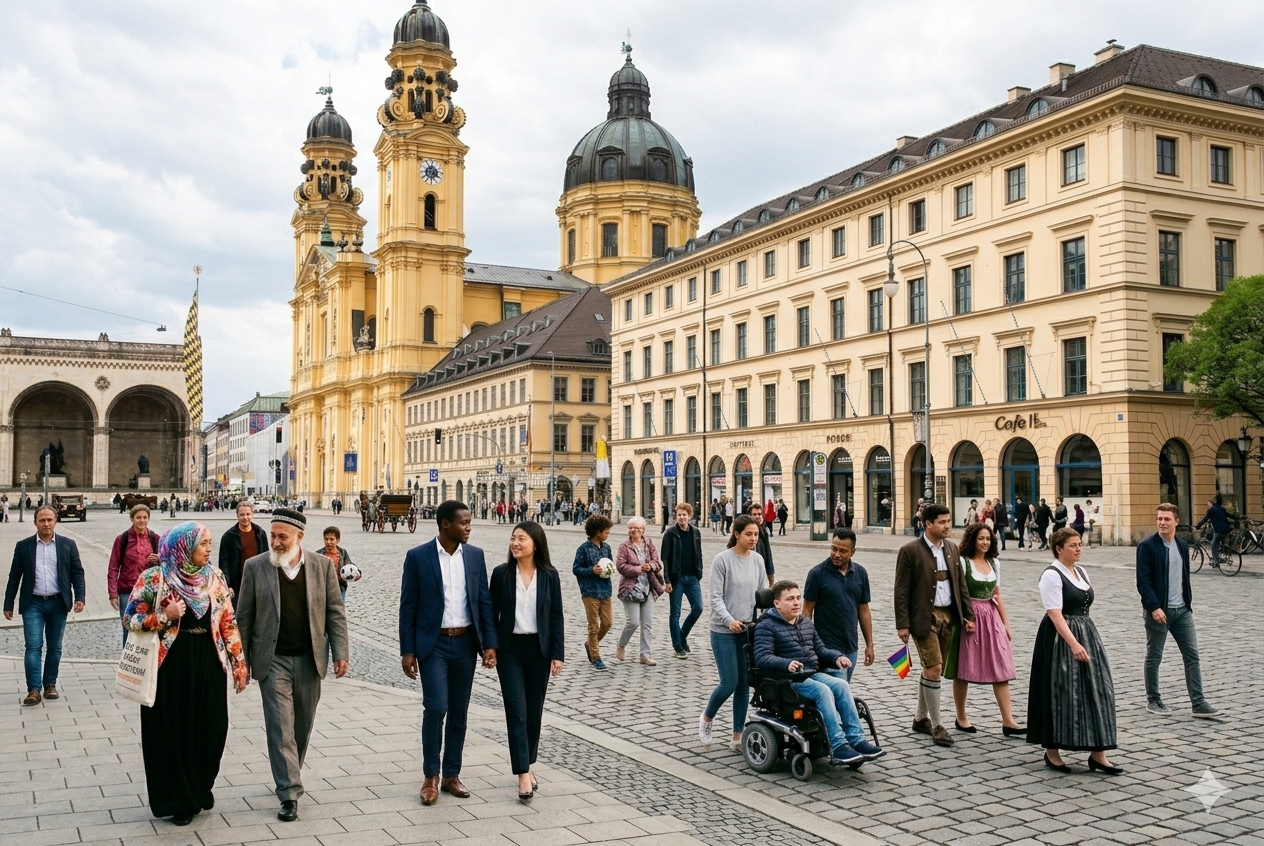
Where: starting in front of the Feldherrnhalle on Odeonsplatz, Munich
Route: Odeonsplatz — Ludwigstraße — Von-der-Tann-Straße — Prinzregentenstraße — Luitpoldbrücke — Friedensengel (Angel of Peace)
Organisers: Freunde Abrahams e.V. and Haus der Kulturen und Religionen München e.V.
Format: a silent candlelight march, without speeches, words of welcome, flags, placards, slogans or leaflets
What to bring: your own candle or a lantern protected against the wind
No rally, no slogans
The organisers conceived the march as the direct opposite of events in which the parties to the conflict and their supporters are the centre of attention. «We believed, and still believe, that the front line should be drawn not between Israelis and Palestinians, but between innocent victims and the guilty,» Wimmer said. In the organisers’ view, this principle applies not only to the conflict in the Middle East but to wars and violence throughout the world.
That is why no political speech will be heard at the event. At the very beginning, participants will be briefly told why the march is being held and how exactly it will proceed. After that, people will walk in silence from the Feldherrnhalle along Ludwigstraße and Prinzregentenstraße to the Friedensengel, a monument whose foundation was laid as early as 1896 in honour of the end of the Franco-Prussian War and which has since become one of the symbols of Munich. There, participants will lay down symbols of the three Abrahamic religions (Judaism, Christianity and Islam), and place their candles around them. «Every time, it also makes for an impressive sight,» Wimmer remarked.
The march is intended to remind people not only of the events in the Middle East. In their official announcement, the organisers mention, besides Israel and Palestine, Ukraine, Sudan, Lebanon, Iran and Yemen. «The conflict between Israel and Palestine took hold of our attention completely at that time,» Wimmer explained, adding that, in his view, other conflicts must not be forgotten either, even if they appear in news headlines less often.
Religion obliges us to be open
The motto of Friends of Abraham is: «Religion obliges us to be open.» According to Wimmer, the wording was proposed by the association’s founder, Manfred Görg, who died in 2012. Openness, Wimmer explains, by no means implies automatic approval of any and all opinions; above all, it requires a readiness to start a conversation with people rather than to exclude them from discussion in advance.
«One has to listen, one has to exchange views and understand whether the limits of what is permissible are being overstepped there or not,» Wimmer believes. He criticises the practice of excluding people from public life, which in his view affects Muslims first and foremost. Such preventive stigmatisation and isolation, he says, lead nowhere.
At the same time, Wimmer stressed, openness does not mean readiness to accept any position without reservation. «When it comes to antisemitism, genuine antisemitism, I am not open to such an opinion,» he stressed. And it is important, he says, not to adopt an aggressive stance towards entire peoples out of emotion; one must first understand what is happening and what its root causes are.
Wimmer sees in this a broader task for society as well. Muslims, he reminded us, are part of German society and will remain so in the future, which means that society should work to make coexistence genuinely succeed rather than turn into a parallel existence. «After all, we have to work on this somehow and help make it succeed,» he said. A policy of exclusion and discrimination, he is convinced, ultimately plays into the hands of precisely those who have deliberately turned away from society.
A march without major organisations and political sponsors
Back in 2023, the organisers of this event deliberately decided not to hold the march jointly with large political or religious groups. This stemmed from a concern that the participation of one prominent organisation might deter people sympathetic to the other side. It was also done so that politicians such as Markus Söder and his team, representatives of the AfD, of the Russian and Israeli lobbies, and of the Hamas lobby could not extract yet more political dividends for themselves by twisting the aims of the march, as they are accustomed to doing daily. This year, for the first time, the event is being organised jointly with the House of Cultures and Religions Munich, which marks a certain expansion of the format compared with previous years.
The event’s promotional flyer also listed the members of the board of trustees of Friends of Abraham. Among them are the former chairman of the Council of the Evangelical Church in Germany and former Regional Bishop of Bavaria, Heinrich Bedford-Strohm; Evelina Goodman-Thau, a modernist rabbi not recognised by Orthodox Judaism; and Imam Belmin Mehić. That is, representatives of almost all three Abrahamic religions are present at board-of-trustees level, and not only among the rank-and-file participants of the march. Apparently, the Hasidim and other strands of Orthodox Judaism declined to take part in this march. If so, it is hardly surprising, for it is precisely Hasidism that fully supports Netanyahu’s aggressive policy, as well as the hatred, imposed by propaganda, not only of Muslims but of the greater part of the world.
Bedford-Strohm himself will not be able to attend on 10 October in person, but supports the event in spirit, Wimmer said. For the organisers, the march remains, on the whole, an attempt to create a space where people of different religious and political backgrounds can gather without first establishing which camp those around them assign them to. «It doesn’t matter to us whether many people come,» Wimmer declared. «It would be very good if that were the case. But we continue to work for those who come and support our ideas.»
Why it matters
The format of a silent march without flags and slogans is a deliberate response to the way the events of 7 October and the wars that followed have changed public debate in Germany. Almost any public mention of the conflict quickly becomes an occasion for splitting into two opposing camps. Friends of Abraham offer a rare alternative: a space where grief is not obliged to be accompanied by a political declaration, and where participation does not require prior agreement with either side.
The decline in the number of participants over three years, noted by Wimmer himself, can be read in two ways: either public attention to the subject is indeed waning, or some people today are looking for more openly politicised forms of expression, while silent mourning has ceased to seem a sufficient response to what is happening. Either way, the organisers themselves stress that they are ready to continue the tradition even for a small group of participants, precisely because, for those who come, this opportunity to express themselves remains meaningful regardless of the overall size of the march. Whether this march and its format will resolve the problem in society itself, nobody knows. But surely it is worth a try.