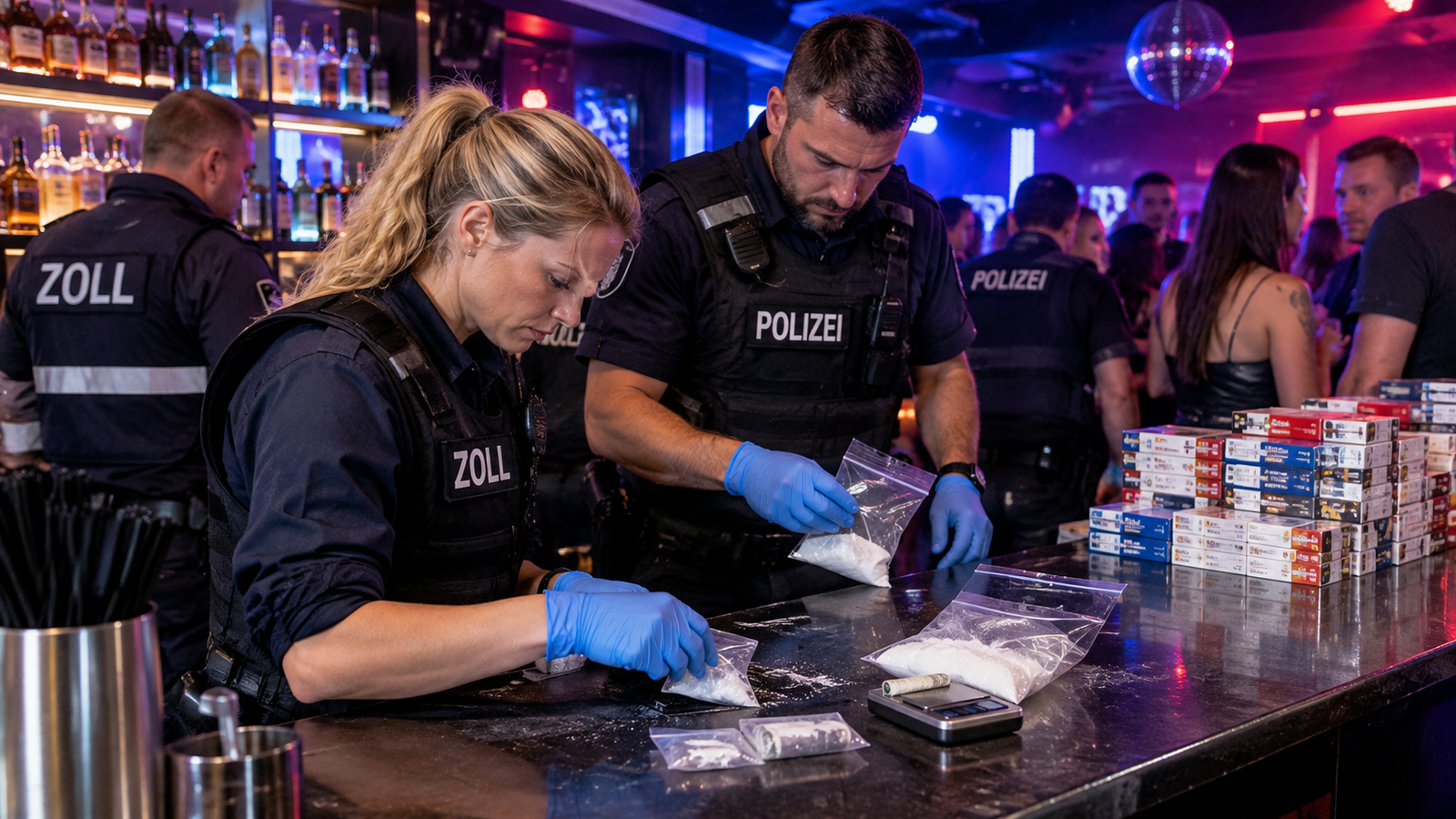

More than 430 customs and police officers came here to look for illegal employment and other violations that every Munich resident knows about but law enforcement apparently does not suspect. However, the results of the inspection went far beyond the main task: the inspectors found drugs, stolen property, counterfeit goods, and wanted individuals against whom arrest warrants had long been issued.
For the quarter around the main station, such a visit is not the first this year. In April, about 400 police officers and 130 customs officials inspected roughly 40 establishments in the Landwehrstraße area. The current operation covered one and a half times as many businesses.
The Munich Police Headquarters reported on its results.
Six and a half hours in Ludwigsvorstadt
The inspection took place in the Ludwigsvorstadt-Isarvorstadt district from 17:00 to 23:35.
It involved:
- more than 110 officers from the Munich Main Customs Office;
- over 320 police officers from the Munich police and the Bavarian riot police;
- firefighters;
- staff from the Mitte District Inspection, which monitors compliance with sanitary and trade regulations.
Early in the evening, several streets were briefly closed, but traffic was hardly affected.
Main goal: work without a contract and without insurance
Customs in Germany is responsible not only for borders and excise duties. Its Financial Control of Undeclared Work unit tracks whether employers pay the minimum wage and whether social insurance contributions are made. This was the main reason for the raid.
The inspectors visited about 60 businesses and checked more than 127 employers and employees.
The results are as follows:
- 14 violations concern rules on illegal employment, minimum wage and social insurance;
- more than 21 additional cases are now being examined by the Financial Control of Undeclared Work.
Tobacco without excise stamps and stolen goods
Customs also seized drugs, cigarettes without excise stamps, illegal shisha tobacco, potency drugs and other counterfeit goods. As a result of the raid, police opened criminal cases for violations of the law on the residence of foreigners, the narcotics law, the medicinal products law and the Criminal Code.
Police filed offense reports against two suspects in marijuana trafficking, one of whom was placed in a detention cell at the Munich Police Headquarters. A man found with a large batch of stolen goods was also taken there.
Cocaine in the club’s kitchen
The most serious suspicions concern nightlife establishments. Police opened two cases involving illegal prostitution, and in one of them is investigating suspected human trafficking.
- About 40 grams of cocaine were lying in the kitchen of a table-dance club – it was seized.
- In total, 386 people were at the inspection site, and 293 underwent police checks.
Officers found two people who were wanted under arrest warrants; one of them remained in custody.
Gas cylinders in the sales area
Firefighters counted nine violations. In one store, gas cylinders were stored directly in the sales area. The Mitte District Inspection filed reports on several violations of sanitary regulations and immediately closed three establishments due to unsanitary conditions: a food service business, a store and a table-dance club.
Why this matters
The station district has for many years remained in the focus of the city government and police, and many residents avoid it. In summer 2024, then-Mayor Dieter Reiter created the Taskforce Bahnhofsviertel, where city services and police work together. His successor, Dominik Krause, decided to keep this task force. The city government banned alcohol consumption around the station, cleaned up the Old Botanical Garden and began redeveloping Goethestraße.
Raids like the current one complement this work from another side. They strike at the shadow economy, which undermines honest entrepreneurs and leaves workers without protection. Munich Police Vice President Christian Huber thanked the participants and stressed that in the area of the Munich Police Headquarters there would be no places where the law does not apply.
Thomas Meister, press spokesman for the Munich Main Customs Office, recalled that customs protects fair competition in the labor market and consistently prosecutes violators.