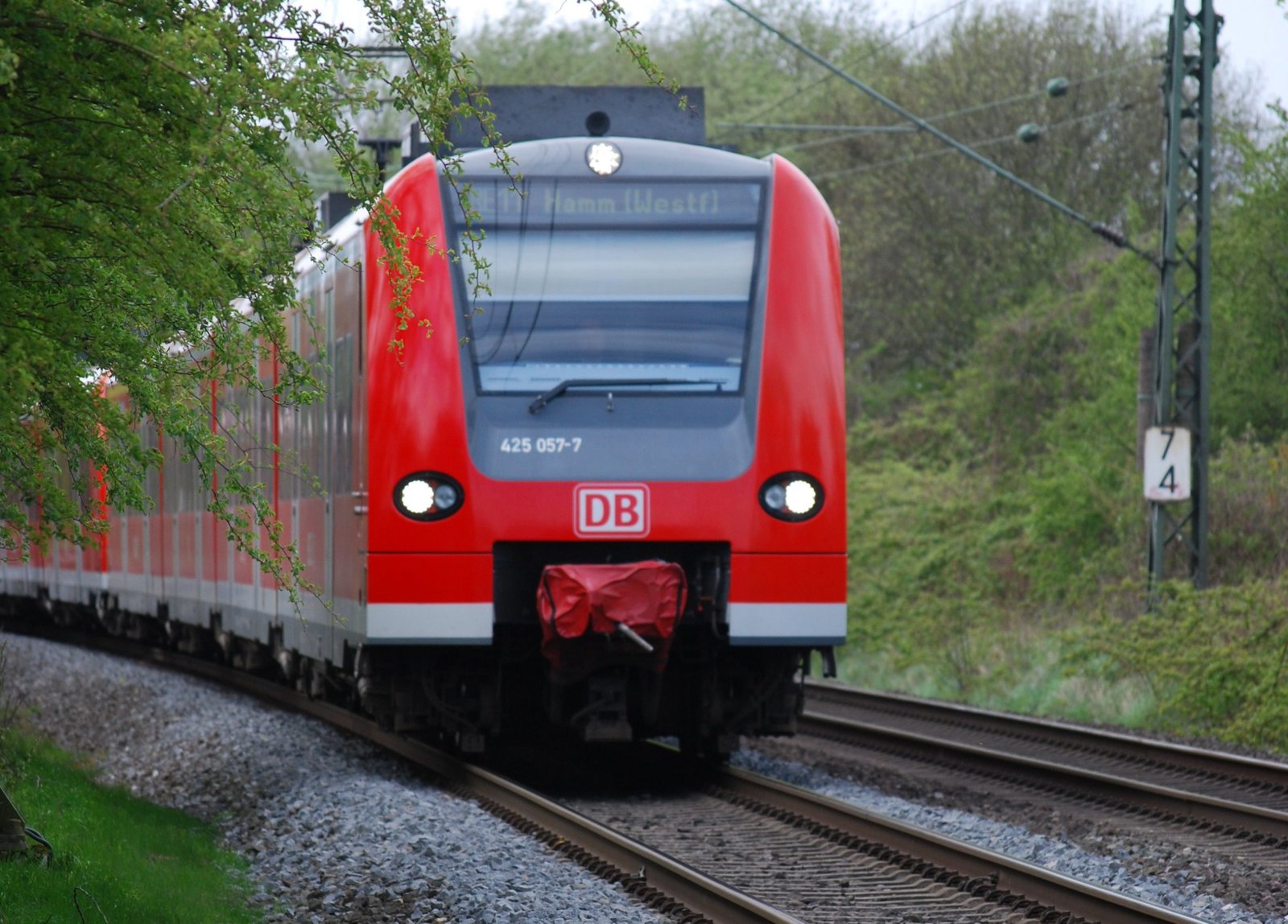

“At the moment, the answer is no,” replied Heiko Büttner, head of the Munich S-Bahn, when asked whether trains in Munich would soon operate without drivers. While not yet a full “Version 2.0,” this experiment marks a potential step in that direction. Over recent months, trials for the remote operation of train sets took place at the Steinhausen maintenance facilities in eastern Munich. Following the completion of the project, the results were presented to Bavarian Transport Minister Christian Bernreiter.
Remote Control Testing in Steinhausen
Inside an ordinary room on the upper floor of the workshop building, Bernreiter took his seat at a control console. By operating the traction and braking levers, he set the train in motion. Within seconds, the train—equipped with the Remote Train Operation (RTO) system—began moving on tracks located 100 meters away. Speeds were restricted to 15 km/h. The movement was tested in only one direction; otherwise, Alstom, the technology provider, would have had to retrofit the entire train set. These are merely the first steps. The system also allows for the remote opening of doors and control of lighting, with future goals including the automated coupling and uncoupling of cars.
The project’s cost amounted to one million euros. S-Bahn management now intends to secure tens of millions of euros in subsidies to initiate official certification with the Federal Railway Authority and equip additional trains. Bernreiter promised his support, though he emphasized: “The primary condition is that the standard is functional.” He noted that the trains must operate with absolute reliability during routine service.
Harmen van Zijderveld, the new head of DB Regio who recently succeeded Evelyn Palla, was also present at the trials. Addressing him, Bernreiter remarked: “Wherever I go, I am criticized,” though he noted he is not personally responsible for infrastructure improvements, as that task falls to the DB InfraGo division. “We all need to be patient,” he added.
Drivers Still Required On-Site
The limitations of the experiment were immediately apparent. For instance, safety regulations require a driver to walk alongside the train when it enters the workshop building, controlling the set via a tablet. Overall, the railway expects the technology to accelerate processes and allow for more efficient personnel deployment. Currently, if an S-Bahn train is parked in the fenced depot area, it cannot simply start moving—the set must first be prepared for operation manually. This is a time-consuming process that remote control could streamline. It would also spare employees from having to walk long distances across the expansive depot grounds. According to Büttner, approximately 350 shunting trips occur at the depot daily.
Pending funding, the certification process could be completed by 2028. Following this, 100 of the most modern Class 423 trains could be equipped with the system. Eventually, the technology could facilitate the implementation of the European Train Control System (ETCS), which allows for shorter intervals between trains. Büttner saw no immediate prospect for driverless passenger trains in Munich, though he mentioned that Copenhagen is planning such a move by 2032. “Our goal would be to transfer empty trains without drivers from Steinhausen to the East Station (Ostbahnhof).” This covers a distance of approximately two kilometers.
Source: dpa