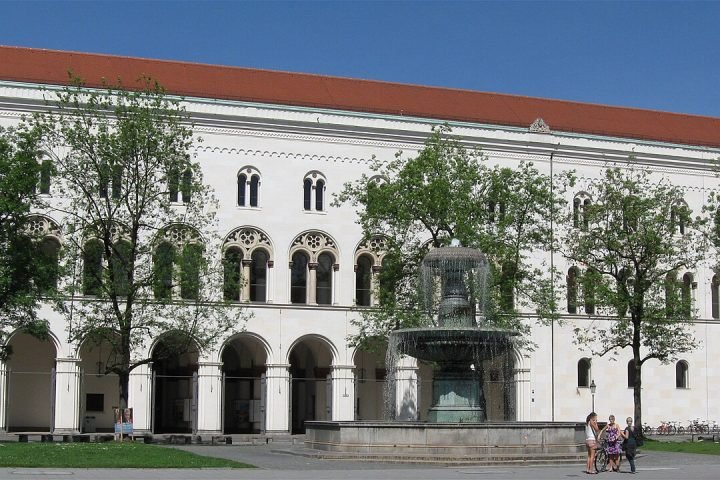

MUNICH. Most university subjects have a bachelor’s degree exam midway through the course of study—but not law. In Bavaria, prospective lawyers must see it through to the end: only after the standard period of study, following the 10th semester, can they take the First State Examination in Law. If they pass, they receive their first professional qualification.
The Bavarian State Student Council for Law has long demanded the introduction of a bachelor’s degree for law studies as an intermediate stage. “The psychological pressure to succeed is immense,” noted Jasmin Jablonksi, a 7th-semester law student at Ludwig Maximilian University of Munich (LMU) and a member of the law student council. There is an “‘all or nothing’ mentality” among students. If something goes wrong, “you end up with nothing.” And that can happen, as current data from the Bavarian Ministry of Justice shows. Out of 1,311 students who took the First State Examination in spring 2025, one in four failed (354 individuals). 52 examinees were retaking the exam and thus “ultimately failed.”
Is Baden-Württemberg the Model?
Students have recently been given hope by developments in Baden-Württemberg. There, the state parliament recently decided to introduce a statewide Bachelor of Laws (LL.B.), even retroactively. “This gives students who failed the First State Examination a fair chance for the first time to obtain a recognized university degree,” stated Baden-Württemberg’s science policy spokesman, Michael Joukov (Greens).
For conservatives, such a development is a horror. Professor Peter M. Huber was a judge at the Federal Constitutional Court and CDU interior minister in Thuringia. The professor of jurisprudence at LMU rejected these plans in an interview with the “Münchner Merkur” as a “capitulation to the spirit of the times” in principle. Generations of lawyers have passed the State Examination; suddenly, it seems too much for today’s students and drives many to even “seek psychological help.” A bachelor’s degree, Huber argued, might ease stress for an individual. “However, in the medium term, it would displace the State Examination and with it the German concept of the Volljurist, a unified legal professional.” Huber warned: this would “harm the international influence that German law still holds in global comparison in many areas, something politicians and corporate leaders, however, know little about.”
Discussions on Legal Education in Bavaria: Opinions on Introducing a Bachelor’s Degree are Divided
Not everyone at the faculty rejects the bachelor’s degree as uncompromisingly as Huber, according to reports from the student council. The studies will not be stress-free anyway, said student Jasmin Jablonksi. Her student council considers it sensible to assess the Schwerpunktbereich (specialization area) seminar paper, typically written in the 5th semester, as a bachelor’s thesis. Perhaps an oral exam could be added, but that would be an additional burden for students and their examiners.
However, students have also found no receptive ear in the Bavarian Ministry of Justice. A so-called integrated Bachelor of Laws, which would be awarded automatically without additional qualifications, “is not permissible under Bavarian higher education law,” explained ministry spokeswoman Marina Schreier. She pointed out that various Bavarian universities do indeed offer a Bachelor of Laws—but only in combination with another discipline. For example, the University of Regensburg offers a “Digital Law” program, and the University of Passau offers “Legal Tech”—each involves studying computer science alongside law. With a Bachelor of Laws without such additional qualifications, graduates would stand no chance in the job market compared to fully qualified lawyers (Volljuristen).
Professor Huber is also concerned with fundamental questions. He is against any “concession to the decreasing stress resilience of modern exam candidates,” stated the lawyer. “What this crisis-ridden and depressed country needs is more self-confidence, greater readiness for achievement, more resilience, and more determination.”
The Long Path to Full Legal Qualification in Bavaria
Legal education in Bavaria is considered highly regulated and requires great discipline. The standard period of study is ten semesters, followed by the First State Examination in Law. The written part includes six five-hour exams over two weeks. This is followed by oral exams, as well as the Schwerpunktbereich seminar paper (with an oral defense and written exam). Those who continue undertake a two-year legal traineeship (Referendariat), after which comes the Second State Examination in Law. Only with that does a person gain the right to work as a judge or attorney.

Latest Posts