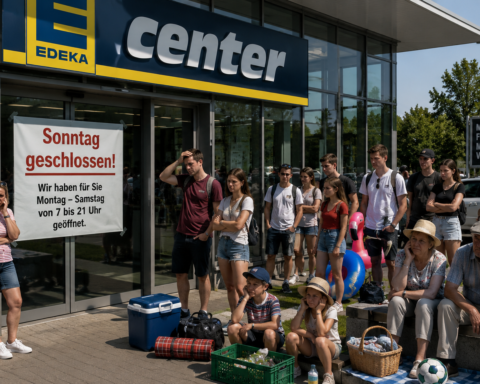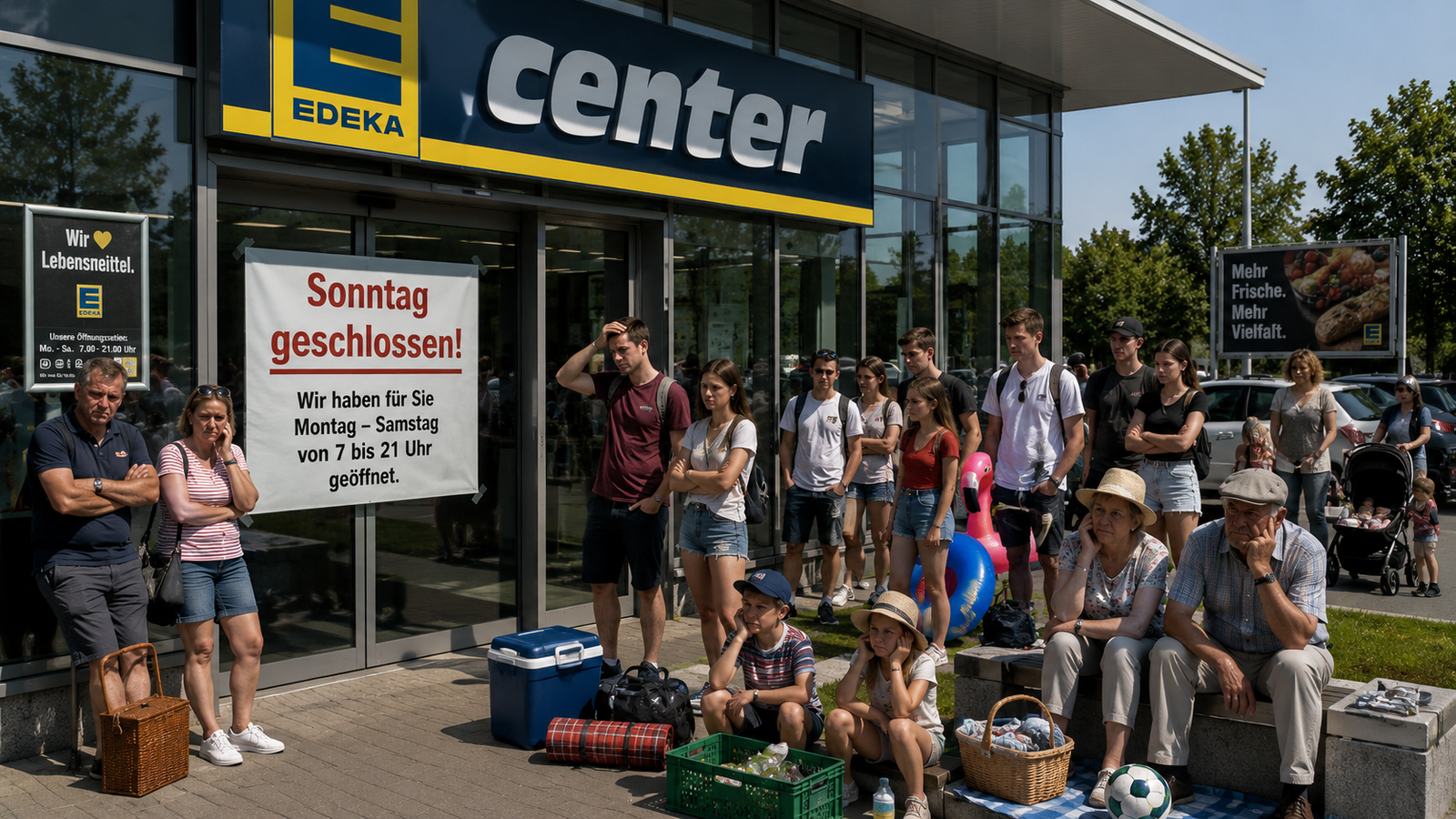

At first glance this looks like a narrow, sector-specific amendment, but it has exposed a conflict of interests among several parties at once. Trade associations, above all the German Retail Federation (HDE), are pushing for the ban to be lifted entirely for the whole sector. Some politicians have shown willingness to revisit rules they consider outdated. Trade unions, by contrast, describe Sunday rest as a cornerstone of the social order that should not be put at risk for commercial gain.
Other European countries have gone through similar disputes at various times, and almost every one of them has arrived at its own answer. Some states have opened Sunday completely to trade, others have kept strict restrictions, and still others have chosen an intermediate form of regulation. Below is how the question has been settled by Germany’s closest neighbours.
Sweden, the Netherlands and France have opened Sunday to shoppers
Sweden abolished statutory restrictions on shop opening hours back in 1972 — earlier than most other European countries. Since then, shops have been allowed to open from 6 a.m. to midnight on any day of the week, including Sunday. The only exception is the state-owned alcohol shops, Systembolaget, which hold a monopoly on the sale of spirits and traditionally remain closed on Sundays. Instead of an administrative ban, the Swedes opted for a financial mechanism: those who work on weekends and public holidays are entitled to a substantial pay supplement.
On weekdays the Netherlands keeps shops open from 6 a.m. to 10 p.m. Sunday trading is permitted too — usually from noon to 5 p.m., though large supermarkets often stay open longer. Individual municipalities are entitled to set their own exceptions, for instance in the tourist districts of major cities. In effect, the decision on the scope of Sunday trading has been delegated to the local level, producing different regulatory models in different regions of the same country.
France allows local authorities to approve up to twelve trading Sundays a year for a given municipality. Broader exemptions apply in officially recognised tourist zones, including Paris and Nice. On permitted days, supermarkets are usually open from 9 a.m. to 1 p.m. National legislation sets the general framework, but the final decision rests with the individual commune.
Britain and Ireland have almost no restrictions, Portugal eased its rules recently
In the United Kingdom and Ireland there are effectively no statutory bans left on Sunday trading. Shops may operate around the clock on any day of the year. Employees’ rights are protected separately, with specific working conditions set out in collective agreements within each sector.
Portugal significantly overhauled its law on shop opening hours in July 2023. Since then, all retail outlets, including large chains, have been allowed to open on Sundays from 6 a.m. to midnight. Before the reform, large supermarkets were required to close by 1 p.m. on Sundays, which many in the industry regarded as a serious constraint on competition.
Finland took the same path even earlier: restrictions on Sunday trading there were lifted entirely in January 2016.
Poland and Austria have kept a strict ban
Since 2018, Poland has steadily tightened its law on Sunday shop closures. Sunday trading in the country is now almost entirely banned — shops are allowed to open on only a handful of exceptional days, around seven a year, usually before Christmas or Easter. The law was adopted as a deliberate measure to protect retail workers and their family time, and it is actively supported by the Catholic Church.
At the federal level, Austria requires shops to close on Sundays and public holidays. Exceptions apply only to a narrow range of businesses — petrol stations, pharmacies, and certain tourism-related enterprises in specific regions. Breaching this rule is classed as an administrative offence. In terms of the strictness of its regulation, Austria remains one of the toughest examples anywhere in the German-speaking world.
Denmark reserves Sunday for small business, Spain leaves the matter to its regions
Denmark allows extended opening hours on weekdays, but draws a clear line on Sundays: large shops are required to remain closed.
Small shops with turnover below the statutory threshold are still allowed to open on Sundays — in practice, this rule benefits family-run shops and kiosks. For the rest of the retail sector, the larger players, the Sunday ban remains essentially unconditional.
Spain has delegated the regulation of opening hours to its autonomous communities, so there is no single rule for the whole country. In many regions, including much of Catalonia and the Basque Country, Sunday is enshrined by law as a day of rest. Exceptions apply only to officially recognised tourist zones. Spanish trade unions have historically defended the right to Sunday rest fiercely.
Germany’s constitutional peculiarity
According to defenders of the ban on Sunday and holiday trading, Germany differs fundamentally from most of its neighbours: Article 140 of the Basic Law, read together with Article 139 of the Weimar Constitution, enshrines Sundays and public holidays as days of rest from work at the constitutional level itself. Such a legal barrier is simply absent in most European countries, where the matter is settled by ordinary legislation or regional rules, without any special constitutional protection.
But there is a legislative loophole here: the Constitution is not a binding Law as such; the Constitution and the Basic Law govern legislative codes, laws and legislative acts. Put simply, the Constitution cannot itself impose bans — it exists to keep laws and decisions within certain bounds. Citing the Constitution as grounds for a ban is, to put it mildly, unprofessional.
From a third angle: every worker is entitled to a day off. An employee who agrees to work on a Sunday or public holiday must receive higher pay, but is equally entitled to a well-earned day off on another day of the week. A ban on trading on these days, meanwhile, prevents everyone else from being able to access everyday goods when they need them. In other words, it effectively infringes on citizens’ constitutional rights.
This is precisely why the debate in Germany goes far beyond an ordinary economic dispute between trade associations and unions. Any substantial easing of the current rules will require not only a political compromise between the federal government, the states and the social partners, but also consideration of legal constraints that none of the European neighbours listed above have to contend with.
And a particularly dangerous element, as in any debate, is the shouting of poorly informed activists who constantly try to impose their own subjective views, while politicians, afraid of losing popularity, never contradict them. As with any contentious issue in Germany, this problem acts as a kind of “spoke in the wheel,” preventing either a retreat or further progress…
The experience of Sweden, the Netherlands, France, Britain, Ireland, Portugal and Finland shows that liberalising Sunday trading does not necessarily lead to violations of labour rights. If anything, it has little to do with labour rights at all.
But the experience of Poland, Austria, Denmark and much of Spain shows that religion needs to be kept separate from the state, or else we end up with what is happening in Poland and Austria, and what used to happen in Hungary before the change of government. A good example of how, within a couple of decades, religion can turn a developed country into a third-world one is Israel.
It is up to us to decide whether to move forward with the times, or to turn back toward the 17th century, like Poland and Israel.
Sources: tagesschau.de, bundestag.de

Latest Posts