
Back then, the last total solar eclipse phase to be observed here passed over the territory of modern Germany, including Bavaria. Almost twenty-seven years later, residents of the region will once again have the opportunity to witness a similar, though not identical, phenomenon.
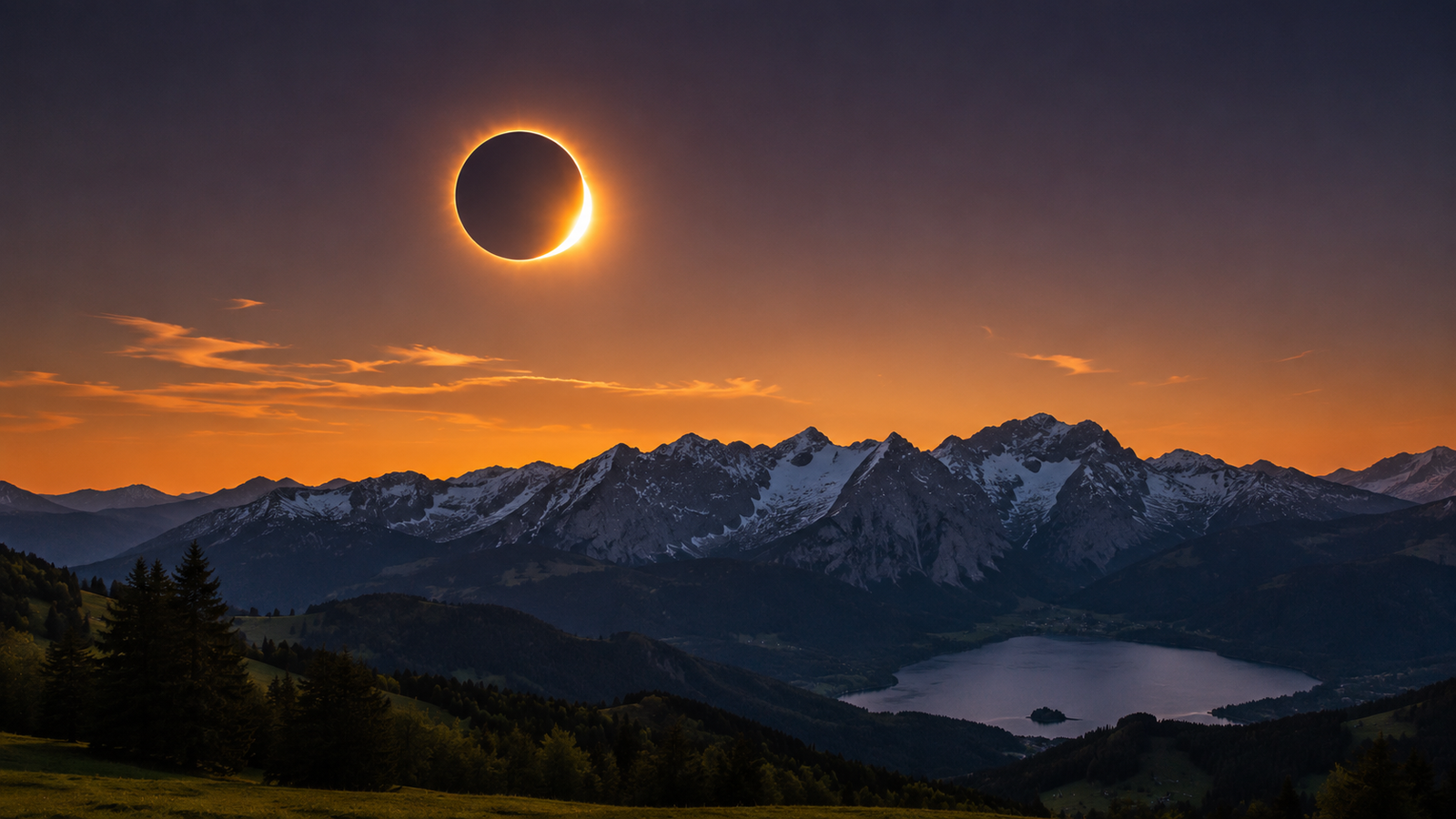
On August 12, 2026, the Moon will once again obscure the solar disk-this time not completely, but with a significant degree of obscuration, reaching up to 90 percent. According to specialists’ forecasts, the most favorable viewing conditions are expected right over the Alpine foothills: the maximum phase of the eclipse combined with the clearest skies in all of southern Germany.
When and Where Best to Watch the Eclipse
The solar eclipse can be observed on the evening of Wednesday, August 12. The Moon will begin to cover the solar disk at approximately 19:10 and will complete its movement around 20:45-shortly before sunset, low above the western horizon. The degree of obscuration will vary noticeably depending on the region: in Bavaria and other areas of the south and southwest of the country, including Baden-Württemberg, the coverage of the solar disk will reach its maximum at 90 percent. Meteorologists also forecast the clearest skies for observation here, and an open space with a view toward the west-northwest will provide the best vantage point.
The unique feature of this current eclipse is that for a significant part of Europe, the maximum phase will occur literally a few minutes before sunset, causing the familiar solar disk to transform before one’s eyes into a thin, glowing crescent against the backdrop of the sunset sky. Such a coincidence of an eclipse and a sunset is a great rarity, and this year it can be observed not only in Bavaria but also in France, Poland, Italy, and Austria.
The Total Eclipse and Its Historical Significance
The Moon will completely cover the Sun not over Bavaria, but over Greenland, Iceland, Spain, the North Atlantic, and the Arctic Ocean. The maximum phase of the eclipse will occur west of Iceland over the Atlantic Ocean, where the total eclipse will last for two minutes and eighteen seconds. The conclusion of the eclipse is expected around 21:05, but it will not be visible in Bavaria: by this time, the sun will have already vanished below the horizon. This was reported in a press release by the House of Astronomy and the Institute of Astronomy of the Max Planck Society.
For continental Europe, this event carries a broader significance: the total phase of a solar eclipse was last observed on the mainland of the continent in 2006, and within the European Union-back in that very year of 1999, which Bavarian residents recall. The 2026 eclipse itself belongs to Solar Saros 126-a cycle of repeating eclipses.
How a Solar Eclipse Occurs
A solar eclipse occurs when the Moon, in its orbit, passes between the Earth and the Sun, partially or completely obscuring the solar disk and casting a shadow onto the planet’s surface. If the Sun is completely obscured, it is a total eclipse-it usually lasts only a few minutes because the narrow path of the lunar shadow shifts rapidly across the Earth’s surface. The entire process of the Moon passing in front of the Sun, including the partial phases, takes about two hours.
How to Observe the Eclipse Safely
Looking at a partially obscured Sun without specialized protection is dangerous to eyesight. The Federal Office for Radiation Protection warns that observation-including through a telescope or camera-mandatorily requires the use of certified eye protection.
The safest method is considered to be indirect observation-projecting the image through a pinhole camera. Special solar observation glasses that comply with the current DIN EN ISO 12312-2:2015 standard are also suitable. The lenses must be free of scratches, cracks, or holes.
What is categorically unsuitable for observation: ordinary sunglasses, smoked or tinted glass, as well as welding goggles and similar household protective items.
As long as the Moon does not obscure the Sun completely, the specialized film in protective glasses reduces the brightness of the light to a safe level while simultaneously blocking ultraviolet and infrared radiation capable of damaging the retina. Some institutions, such as the House of Astronomy in Heidelberg, will be distributing such glasses free of charge to anyone interested on the evening of August 12, 2026.
The Perseid Shower on the Very Same Night
The eclipse is not the only celestial event of this night. Closer to midnight from August 12 to 13, the annual Perseid meteor shower will reach its peak, crossing Earth’s orbit every year in August and leaving bright streaks of particles burning up in the atmosphere. A number of observatories, including the Hamburg Planetarium and the Astronomy Museum in Sonneberg (Thuringia), are organizing separate events this evening for those wishing to observe both phenomena at once-the partial eclipse at sunset and the meteor shower after midnight.
When to Expect the Next Total Eclipse
Those who wish to see a total solar eclipse specifically over Bavaria will have to be patient: according to astronomers’ calculations, the next one will occur over Germany only on September 3, 2081. Until then, residents of the region will have to settle for partial phases-however, as this current August event demonstrates, even they are capable of delivering a truly memorable spectacle, particularly if one is fortunate enough to have clear skies over the Alpine foothills.