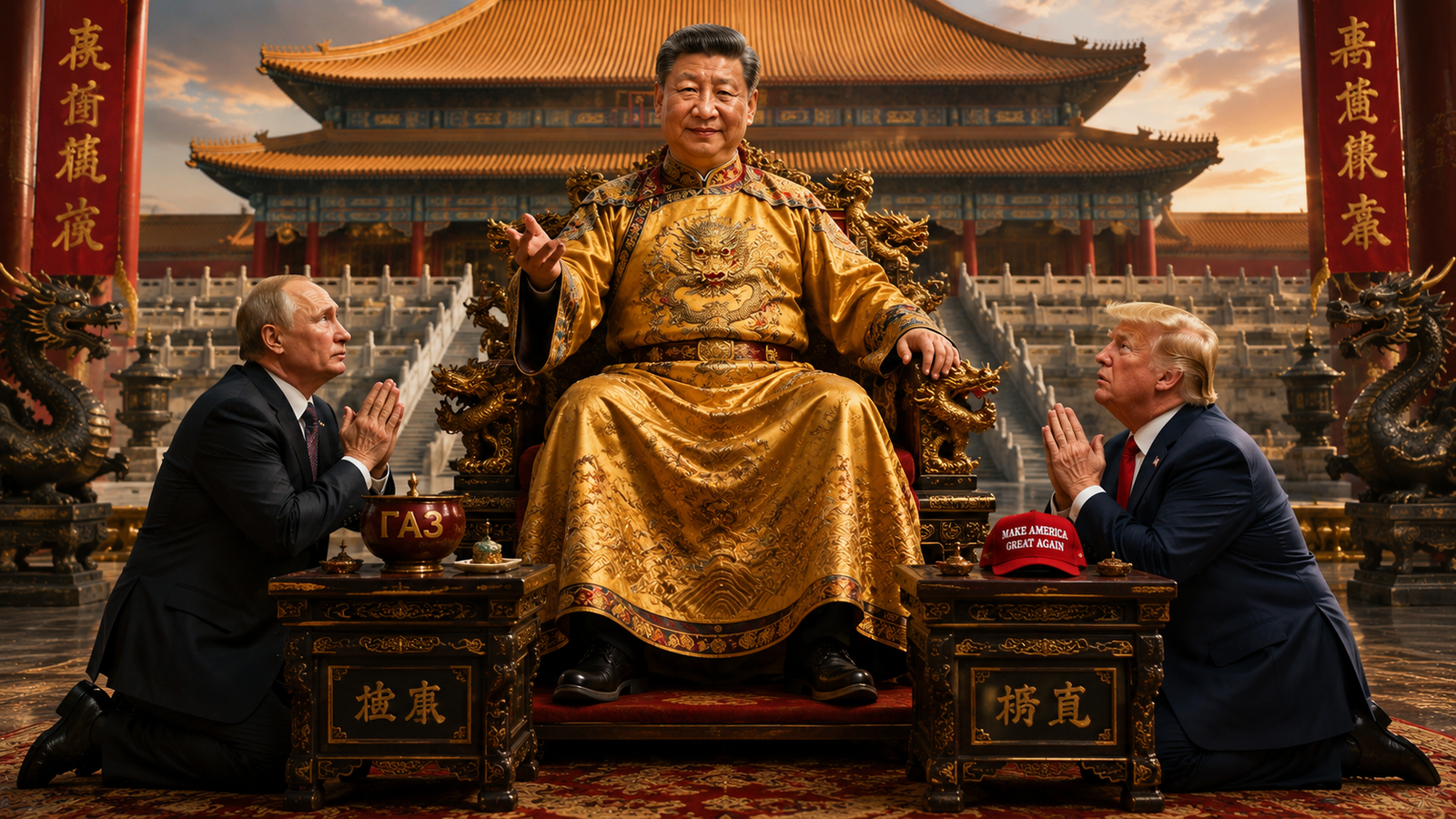

Beijing’s diplomatic calendar vividly illustrates this large-scale shift: first Donald Trump, now Vladimir Putin—the heads of the planet’s largest nuclear powers are succeeding one another in the Chinese capital.
Such a concentration of high-level visits clearly demonstrates the key trend of the current decade: while the United States and Russia consistently weaken their geopolitical and economic positions in protracted military conflicts, Chinese President Xi Jinping is calculatedly expanding his global influence. Amidst the obvious crisis of the former system of checks and balances, it is China that is assuming the role of the main arbiter and the most stable participant in macroeconomic and geopolitical processes.
Donald Trump had barely left the diplomatic residences of Beijing when Vladimir Putin headed there on an official visit. First the American president, then the Russian leader—two figures who consider themselves historical personalities of global stature and stand at the helm of powerful states possessing colossal military and human resources. However, at this historical juncture, both of them, despite all declared independence, acutely need strategic engagement with one specific country—China. This radically alters the customary alignment of forces on the international stage, turning Beijing into an obligatory point of coordination for any global decisions.
This geopolitical alignment constitutes the primary analytical conclusion of the past week. Neither Trump looked like a strong party dictating his terms at this bilateral meeting, nor did Putin have the opportunity to speak from a position of unconditional parity. The sole and absolute winner of this diplomatic spring was Xi Jinping. He does not need to personally embark on foreign tours to resolve crises or seek compromises—he hosts high-ranking guests in Beijing himself. The capital of the Celestial Empire has turned into the key center of power for a state that has long outgrown the limited status of a mere “world factory” and is now actively shaping its own agenda.
The People’s Republic of China consistently seeks to completely restructure the existing world order and, at the very least, firmly establish itself on the same hierarchical level as the Americans, eliminating the unipolar dominance of Washington. Within the implementation of this long-term strategy, Trump and Putin turn out to be highly useful, albeit situational, tools for the President of the PRC, even if their unpredictable actions on the international arena regularly cause Beijing considerable tactical worries and create additional economic risks.
Putin’s Dependence Increases
In the context of the flaring Middle Eastern conflict around Iran, Trump critically needs Beijing’s diplomatic and economic influence on official Tehran to de-escalate the situation. Furthermore, the high-tech industry of the United States itself directly depends on uninterrupted supplies of rare earth metals from China, alternatives to which are practically impossible to find in the coming years. Moreover, in macroeconomic terms, the American administration is incapable of simply severing ties with the People’s Republic of China unilaterally—their domestic markets and billion-dollar trade turnover have been too closely intertwined by decades of globalization.
Putin, in turn, needs Beijing’s favor even more acutely, since his options for maneuver are extremely limited by Western sanctions. With the continuation of large-scale hostilities in Ukraine, the economic and foreign policy of Russia have entered a deep dependence, the real scale of which is preferred not to be spoken about aloud in official statements.
Without support from China, the Russian financial system would, with a high degree of probability, already have faced a systemic collapse and severe isolation. Without large Chinese buyers, Moscow’s commodities business, deprived of European sales markets, would be fraught with huge, practically insurmountable logistical and financial difficulties. This current interaction can hardly be called a partnership of equals—it is an evident and progressing dependence wrapped in a packaging of friendly smiles and protocol assurances.
As a result of the protracted confrontation, the Russian Federation finds itself in an obvious strategic impasse. In the Russian-Ukrainian conflict, the situation has changed significantly: modern drones now regularly threaten remote Russian economic facilities and oil refineries, and Moscow itself is no longer completely protected from aerial attacks.
At the same time, the United States has not managed to achieve a real regime change in the Iranian knot of contradictions or completely eliminate the threat of a blockade of the strategically important Strait of Hormuz, which hits Washington’s position as a global guarantor of security.
Thus, both Putin and Trump arrived for negotiations in Beijing noticeably weakened by the exhausting conflicts they are waging directly or indirectly. The Chinese leadership, as the centuries-old history of this civilization shows, does not know the concept of sincere friendship in its foreign policy—it invariably guides itself exclusively by its own pragmatic interests and considerations of benefit.
China Derives Benefit from Outside Conflicts
During his official visit, Trump emphatically lavished compliments and praise on Xi Jinping, publicly stating that it was a great honor for him to be a personal friend of the President of the PRC. In fact, he arrived in the role of a diplomatic petitioner, hoping to bargain for trade deals favorable to Washington and reduce the balance deficit.
Putin may also still inspire fear in European countries with his nuclear rhetoric, but in the meeting rooms in Beijing, he no longer shapes global history independently. Here, he acts rather in the role of a large seller who vitally needs to promptly market Russian hydrocarbon raw materials, demonstrate geopolitical loyalty, and sign new trade agreements. Russia today acutely needs China as a reliable economic insurance policy against total isolation by the West.
Xi Jinping goes along with this economic rapprochement quite willingly, as it opens up colossal preferences for his own country. He buys Russian resources, but does so exclusively on his own strict terms, dictating prices and conducting a complex geopolitical game on several chessboards at once.
Chinese diplomacy has not officially condemned Russia’s actions in Ukraine, stubbornly calling what is happening the “Ukraine crisis.” Beijing firmly asserts at the same time that it does not supply Moscow with lethal weapons and strictly observes neutrality. However, Russian industry uninterruptedly receives a huge volume of dual-use goods from China, without which modern production is impossible. Microchips, advanced electronics, complex machine tool manufacturing, navigation equipment, and components for drone assembly—all this flows in a continuous stream and is capable of prolonging the hostilities indefinitely. Xi Jinping does not pull the trigger himself, but carefully sees to it that Putin retains sufficient material resources for a long and grueling confrontation with the collective West, thereby weakening Russia.
In this approach lies the deep and pragmatic meaning of these interstate relations: official China constantly speaks of peace on international tribunes, but at the same time earns colossally on someone else’s conflict.
Despite all this, Xi Jinping absolutely does not desire a sudden collapse or destabilization of Russia. A weakened, dependent, and compliant Russia is extremely useful to China as a resource rear, whereas a disintegrating country gripped by chaos is dangerous.
The states share a long land border, the security of which Beijing does not want to jeopardize. They are temporarily united by a categorical rejection of the world order led by the United States. Both authoritarian systems completely reject the values of liberal democracy, independent courts, and a free press, seeing them as a threat to their existence.
Both Putin and Xi Jinping certainly strive for absolute authority and recognition of their zones of influence. But there is a fundamental methodological difference between them: Moscow acts crudely, impulsively, and directly on the world stage, while Beijing behaves many times more patiently and subtly.
Russia relies on classic twentieth-century tools—tanks, missiles, and direct military threats. China is also rapidly building up modern military power, but predominantly utilizes economic dependencies, economic and cultural expansion, control of supply chains, rare earth raw materials, and quiet financial diplomacy.
Putin conducts open warfare, inevitably losing the remnants of geopolitical influence. Xi Jinping accumulates systemic strength while the other players exhaust themselves.
The Pragmatic Calculation of Xi Jinping
European political elites should certainly not give in to illusions or misunderstand what is happening in this situation. Chinese diplomacy very willingly discusses stability, indivisible security, peace, and the need for inclusive dialogue at international summits. This always sounds harmless, respectable, and at times even quite reasonable.
But Beijing’s real policy is never neutral—it is always an icy, pragmatic calculation. Unlike Trump and Putin, who often act out of domestic political considerations, the leadership in Beijing always sees long-term strategic goals for decades ahead.
China deliberately presents itself to the developing world as an island of absolute tranquility. It is precisely this advantageous image that Xi Jinping wants to fixate: on one side—a chaotic America torn by internal crises; on the other—an aggressive, unpredictable Russia; and between them—a stable, economically reliable, and tightly controlled China with a billion-strong population.
This is high-quality propaganda, but it works flawlessly in the Global South because Trump and Putin inadvertently play along with it through their destructive actions. They voluntarily give Xi Jinping what his administration needs most—colossal space for geopolitical maneuver and the conclusion of profitable alliances, including with countries that have either been rejected by the other leaders or pushed toward breaking close relations with the United States and Russia.
All this, of course, does not mean that China has already definitively become an absolute and unquestionable dominant superpower. Beijing also has enough serious internal problems holding back its expansion: a noticeable slowdown in economic growth rates, heavy demographic pressure due to an aging population, and growing distrust from its closest Asian neighbors. But genuine international influence is born not only from the demonstration of one’s own absolute strength—it is very often fed by the obvious weakness and strategic errors of all other players. And Xi Jinping is currently utilizing this rule with extreme success.
It is long past time for Europe to draw a clear and harsh lesson from these visits: today it is categorically impossible to view China only as a complex trading partner, and Russia as an isolated regional security problem. These issues are now inseparable and represent communicating vessels. Putin’s actions on the European security theater become possible largely thanks to the tacit economic support of China. In turn, the further strengthening of China is significantly facilitated by deep disagreements within the West and the unpredictable foreign policy of the United States. Such is the harsh reality of the new era of the grand chess game.
Summing up, it can be stated that Beijing’s current balancing between Moscow and Washington is not an accident, but a systematically implemented scenario. Xi Jinping successfully converts other countries’ military ambitions and political crises into his own geopolitical capital. For a thinking observer, it is obvious that the outcome of this confrontation will be determined not on the battlefields, but in the offices of Beijing, where the rules of global cohabitation for the next half-century are slowly but surely being rewritten.